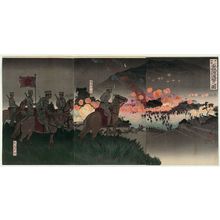
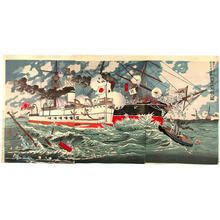
Advancing across the Ansong River at the Battle of Asan (Gazan gekisen Anjô no watashi shingeki no zu)
- Medium:
- Woodblock print
- Source:
- Museum of Fine Arts Boston
- Image courtesy of
- Museum of Fine Arts Boston
Description
This battle print records the Japanese crossing of the Ansong (Anjō) River during the Battle of Asan, an early engagement of the First Sino-Japanese War fought in Korea in July 1894. The full title Gazan gekisen Anjō no watashi shingeki no zu translates roughly as 'Picture of the Fierce Battle at Gazan and the Advance Crossing at Anjō.' Kiyochika likely presents the crossing as a triptych composition, with soldiers wading through the river under fire or pressing forward in disciplined formation. The diagonal thrust of advancing troops across water was a compositional convention in Meiji battle prints that conveyed military momentum. Kiyochika's rendering integrates Western-influenced spatial recession with the flat color fields of traditional woodblock technique.
More Prints by Kobayashi Kiyochika
More Landscapes Prints

Lake Kugushi in Wakasa Province (Wakasa Kugushiko), from the series Souvenirs of Travel I (Tabi miyage dai isshu)"
Wakasa Kugushiko
1920
Color woodblock print; oban
Autumn Maple Leaves at Takao, from the album Eight Views of Kyoto (Kyôto hakkei)
Woodblock print

The Beach at Kaiganji in Sanuki Province (Sanuki Kaiganji no hama), from the series "Collection of Views of Japan II, Kansai Edition (Nihon fukei shu II Kansai hen)"
1934
Color woodblock print; oban

Tea Kettle, section of a sheet from the series "Mirror of Stone Rubbings of Views of the Provinces" (Kohon meihitsu ishizuri kagami)
n.d.
Woodblock print; ishizuri-e, section of harimaze sheet
Featured in Collections
Curated cross-cuts that include this print.
Frequently Asked Questions
Advancing across the Ansong River at the Battle of Asan (Gazan gekisen Anjô no watashi shingeki no zu) was created by Kobayashi Kiyochika (小林清親).
Advancing across the Ansong River at the Battle of Asan (Gazan gekisen Anjô no watashi shingeki no zu) depicts landscapes.