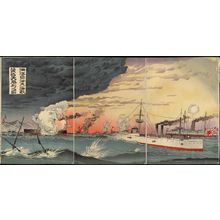
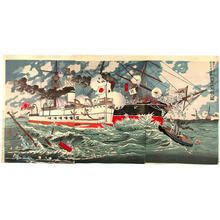
Great Naval Battle off Haiyang Island and Great Victory at Sunset (Kaiyôtô oki daikaisen tasogare daishôri no zu)
- Medium:
- Woodblock print
- Source:
- Museum of Fine Arts Boston
- Image courtesy of
- Museum of Fine Arts Boston
Description
The Battle of the Yellow Sea (August 10, 1904), in which the Japanese fleet engaged Russian naval forces attempting to break out from Port Arthur, included engagements near Haiyang Island. Kiyochika's full title — Kaiyôtô oki daikaisen tasogare daishôri no zu, "Great Naval Battle off Haiyang Island, Great Victory at Sunset" — specifies the twilight setting, a context that allowed his signature atmospheric light effects to serve a patriotic subject. The sunset would have been rendered through graduated bokashi across the sky and reflected on the sea surface, with warships silhouetted against the orange and crimson ground. This integration of his characteristic lighting technique with naval battle reportage represents one of his more compelling war-era compositions.
More Prints by Kobayashi Kiyochika
More Landscapes Prints

Lake Kugushi in Wakasa Province (Wakasa Kugushiko), from the series Souvenirs of Travel I (Tabi miyage dai isshu)"
Wakasa Kugushiko
1920
Color woodblock print; oban
Autumn Maple Leaves at Takao, from the album Eight Views of Kyoto (Kyôto hakkei)
Woodblock print

The Beach at Kaiganji in Sanuki Province (Sanuki Kaiganji no hama), from the series "Collection of Views of Japan II, Kansai Edition (Nihon fukei shu II Kansai hen)"
1934
Color woodblock print; oban

Tea Kettle, section of a sheet from the series "Mirror of Stone Rubbings of Views of the Provinces" (Kohon meihitsu ishizuri kagami)
n.d.
Woodblock print; ishizuri-e, section of harimaze sheet
Featured in Collections
Curated cross-cuts that include this print.
Frequently Asked Questions
Great Naval Battle off Haiyang Island and Great Victory at Sunset (Kaiyôtô oki daikaisen tasogare daishôri no zu) was created by Kobayashi Kiyochika (小林清親).
Great Naval Battle off Haiyang Island and Great Victory at Sunset (Kaiyôtô oki daikaisen tasogare daishôri no zu) depicts landscapes.