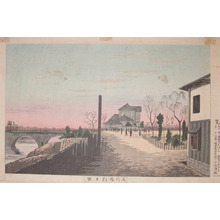
Mandai Bridge in Hinode
- Medium:
- Woodblock print
- Source:
- Ronin Gallery
- Image courtesy of
- Ronin Gallery
Description
Hinode, meaning sunrise or dawn, was a district in the waterfront area of Tokyo, and the Mandai Bridge would have spanned one of the network of canals and waterways threading through this low-lying commercial quarter. Bridge subjects recur throughout Kiyochika's urban landscape work, providing compositional structure through their strong diagonal or orthogonal lines while framing water and sky. A dawn or early-morning title association would suit the Hinode place name and invite the atmospheric treatment Kiyochika applied most effectively to low-light conditions. The industrial waterfront offered subjects quite distinct from the traditional leisure landscapes of Mukojima and the Sumida's upper reaches—warehouses, moored cargo vessels, and the infrastructure of a modernizing port economy—making Hinode prints part of Kiyochika's documentary engagement with Meiji Tokyo's commercial transformation.
More Prints by Kobayashi Kiyochika
More Landscapes Prints

Lake Kugushi in Wakasa Province (Wakasa Kugushiko), from the series Souvenirs of Travel I (Tabi miyage dai isshu)"
Wakasa Kugushiko
1920
Color woodblock print; oban
Autumn Maple Leaves at Takao, from the album Eight Views of Kyoto (Kyôto hakkei)
Woodblock print

The Beach at Kaiganji in Sanuki Province (Sanuki Kaiganji no hama), from the series "Collection of Views of Japan II, Kansai Edition (Nihon fukei shu II Kansai hen)"
1934
Color woodblock print; oban

Tea Kettle, section of a sheet from the series "Mirror of Stone Rubbings of Views of the Provinces" (Kohon meihitsu ishizuri kagami)
n.d.
Woodblock print; ishizuri-e, section of harimaze sheet
Featured in Collections
Curated cross-cuts that include this print.
Frequently Asked Questions
Mandai Bridge in Hinode was created by Kobayashi Kiyochika (小林清親).
Mandai Bridge in Hinode depicts landscapes.