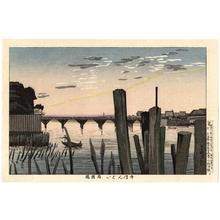
Senbongui and Ryogokubashi Bridge (1000 Poles) — 千ほんくい両国橋
- Medium:
- Woodblock print
- Source:
- Japanese Art Open Database
- Image courtesy of
- Japanese Art Open Database
Description
Ryōgokubashi, spanning the Sumida River between Honjo and the city center, was one of Edo-Tokyo's most iconic landmarks. The title Senbongui (thousand poles) refers to the dense field of wooden pilings driven into the riverbed to stabilize the bridge's foundations—a striking visual feature visible at low water. Kiyochika's composition likely uses the receding rhythm of these pilings to create a strong perspectival thrust into the picture plane, a technique he borrowed from Western linear perspective and applied to river views. The Sumida was central to his atmospheric light studies, and reflections on its surface provided opportunities for the interplay of water, lamplight, and shadow that distinguish his kosen-ga work. This appears to be a second printing or variant state of the same composition.
More Prints by Kobayashi Kiyochika
More Landscapes Prints

Lake Kugushi in Wakasa Province (Wakasa Kugushiko), from the series Souvenirs of Travel I (Tabi miyage dai isshu)"
Wakasa Kugushiko
1920
Color woodblock print; oban
Autumn Maple Leaves at Takao, from the album Eight Views of Kyoto (Kyôto hakkei)
Woodblock print

The Beach at Kaiganji in Sanuki Province (Sanuki Kaiganji no hama), from the series "Collection of Views of Japan II, Kansai Edition (Nihon fukei shu II Kansai hen)"
1934
Color woodblock print; oban

Tea Kettle, section of a sheet from the series "Mirror of Stone Rubbings of Views of the Provinces" (Kohon meihitsu ishizuri kagami)
n.d.
Woodblock print; ishizuri-e, section of harimaze sheet
Featured in Collections
Curated cross-cuts that include this print.
Frequently Asked Questions
Senbongui and Ryogokubashi Bridge (1000 Poles) — 千ほんくい両国橋 was created by Kobayashi Kiyochika (小林清親).
Senbongui and Ryogokubashi Bridge (1000 Poles) — 千ほんくい両国橋 depicts landscapes.