
Snow at Hachimangu shrine at Tsurugaoka in Kamakura
- Medium:
- Mokuhanga (Japanese woodblock)
- Image courtesy of
- Saru Gallery
Description
Snow at Hachimangu shrine at Tsurugaoka in Kamakura translates the same Kamakura site into a winter view, drawing on the printmaking tradition of yuki-e or snow pictures established by Hiroshige and continued by shin-hanga artists including Kawase Hasui and Tsuchiya Koitsu. Snow on a shrine compound provides a structural simplification: roof lines, lantern caps, and torii crossbeams are highlighted in unprinted white paper, while vermilion lacquer and dark woodwork remain visible beneath. Snow prints of this kind depend on the registration of crisp white masses against carefully gradated grey skies, often executed with bokashi to suggest a low overcast. The negative-space treatment of snow, in which the natural color of the washi sheet stands in for accumulation, requires precise carving of the surrounding blocks so that no color creeps onto the snow areas. Snow at Tsurugaoka is a recognized seasonal subject, treated by several twentieth-century printmakers; Konishi's version contributes to that body of imagery, with a second snow print of the same shrine indicating a further attempt at the subject.
More Prints by Konishi Seiichiro


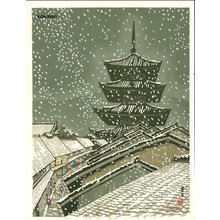
More Snow Scenes Prints
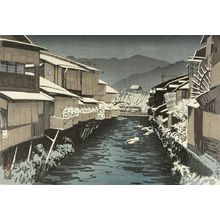
Fair Weather After Snow at Yamato Bridge, Kyoto (Yamato bashi no yukibare), Taishô period, dated 1924
Woodblock print

The Compound of the Tenman Shrine at Kameido in the Snow (Kameido Tenmangu keidai no yuki), from the series "Famous Places in the Eastern Capital (Toto meisho)"
c. 1832/38
Color woodblock print; oban

Miyajima in Snow (Yuki no Miyajima)
Yuki no Miyajima
1929
Color woodblock print; oban
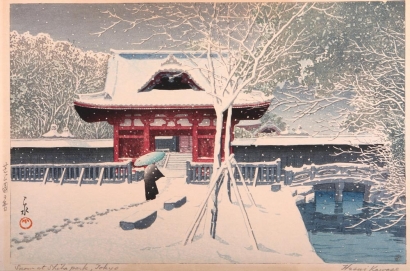
Evening Snow at Shiha Park, Tokyo
1932
Woodblock print
Featured in Collections
Curated cross-cuts that include this print.
Frequently Asked Questions
Snow at Hachimangu shrine at Tsurugaoka in Kamakura was created by Konishi Seiichiro (小西誠一郎).
Snow at Hachimangu shrine at Tsurugaoka in Kamakura depicts snow scenes and temples & shrines.