
Mt Fuji
by Kosaka Gajin
- Medium:
- Mokuhanga (Japanese woodblock)
- Image courtesy of
- Saru Gallery
Description
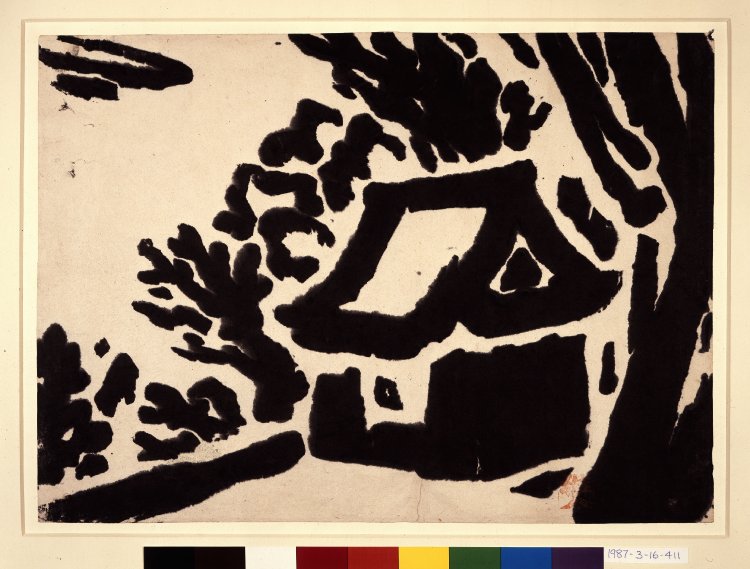
Mt Fuji depicts the iconic volcanic cone in Gajin's distinctive late-period monochrome idiom. Working in Sendai after the 1945 destruction of his Tokyo studio, Gajin developed a method of printing soft outlines onto heavily dampened washi, allowing the ink to bleed gently into the fibers and producing tonal gradations closer to sumi-e ink painting than to conventional nishiki-e. The subject places him within a long meisho-e tradition stretching back through Hokusai and Hiroshige, but his treatment is deliberately stripped of the bold polychrome and sharp keyblock conventions of ukiyo-e. Instead, the mountain is reduced to its essential silhouette, atmospheric rather than topographical. As a sosaku-hanga artist, Gajin designed, carved, and printed the work himself, treating the block as a vehicle for personal expression rather than reproductive craft. The piece reflects the contemplative, pared-down sensibility that earned him solo exhibitions in Los Angeles and Paris and brought his work into the collections of the British Museum and MoMA.
More Prints by Kosaka Gajin



More Mount Fuji Prints
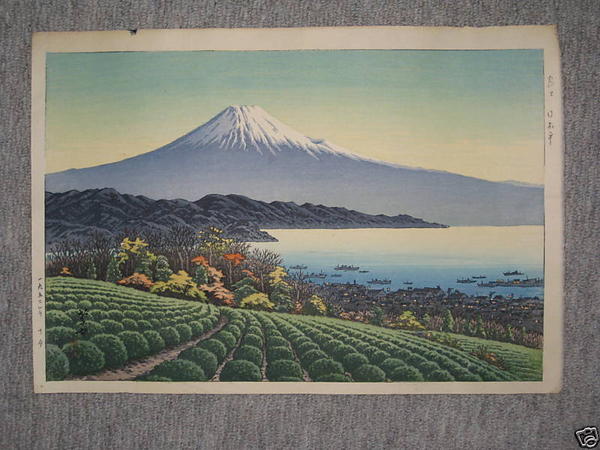
Fuji from tea farm
Woodblock print

Akasaka, Fujikawa, Okazaki, Chiryu, and Narumi, from the series "Famous Places on the Fifty-three Stations of the Tokaido, Five Stations (Tokaido gojusan eki goshuku meisho)"
c. 1830/35
Color woodblock print; oban
![Mount Fuji on a Moonlit Night, Kawai Bridge (Tsukiyo no Fuji [Kawaibashi]), from the series "Selection of Views of the Tokaido (Tokaido fukei senshu)" by Kawase Hasui](https://www.artic.edu/iiif/2/d0960668-1e73-339a-b182-fb995a54bff0/full/843,/0/default.jpg)
Mount Fuji on a Moonlit Night, Kawai Bridge (Tsukiyo no Fuji [Kawaibashi]), from the series "Selection of Views of the Tokaido (Tokaido fukei senshu)"
1947
Color woodblock print; oban

Mt. Fuji in Rain (Ame no Fuji)
n.d.
Color woodblock print
Featured in Collections
Curated cross-cuts that include this print.
Frequently Asked Questions
Mt Fuji was created by Kosaka Gajin (上坂雅人).
Mt Fuji depicts mount fuji.