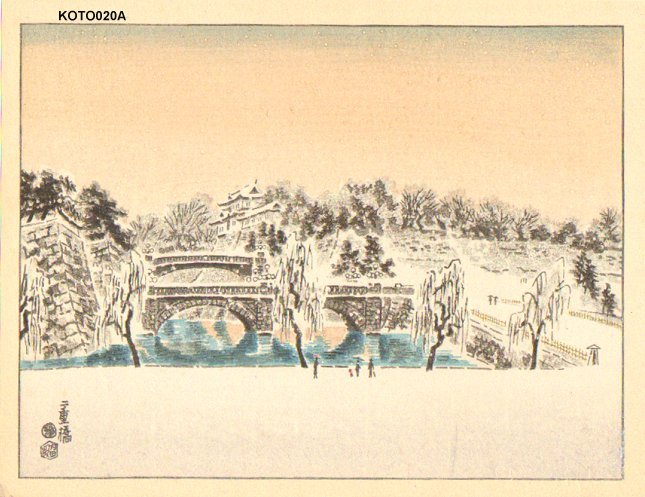
Double Bridge (Tokyo)
- Medium:
- Woodblock print
- Source:
- Watanabe Print
- Image courtesy of
- Watanabe Print
Description
The Nijubashi ('Double Bridge') at the Imperial Palace in Tokyo is one of the most frequently depicted Meiji- and Taisho-era meisho-e subjects, representing the combination of the Meganebashi stone arch and the Seimon Ishibashi that frames the main palace gate. Kotozuka's inclusion of a Tokyo landmark within an otherwise Kyoto-dominated catalog suggests either a commission or an effort to broaden sales reach. The composition typically positions the viewer across the moat, with weeping willows or pine framing the twin bridges and the white-walled palace towers visible in the middle distance. The glassy moat surface offers an opportunity for reflected-sky bokashi gradation, and the pale stone bridges against dark water create the tonal contrast central to this subject's visual appeal.
More Prints by Kotozuka Eiichi
More Landscapes Prints

Lake Kugushi in Wakasa Province (Wakasa Kugushiko), from the series Souvenirs of Travel I (Tabi miyage dai isshu)"
Wakasa Kugushiko
1920
Color woodblock print; oban
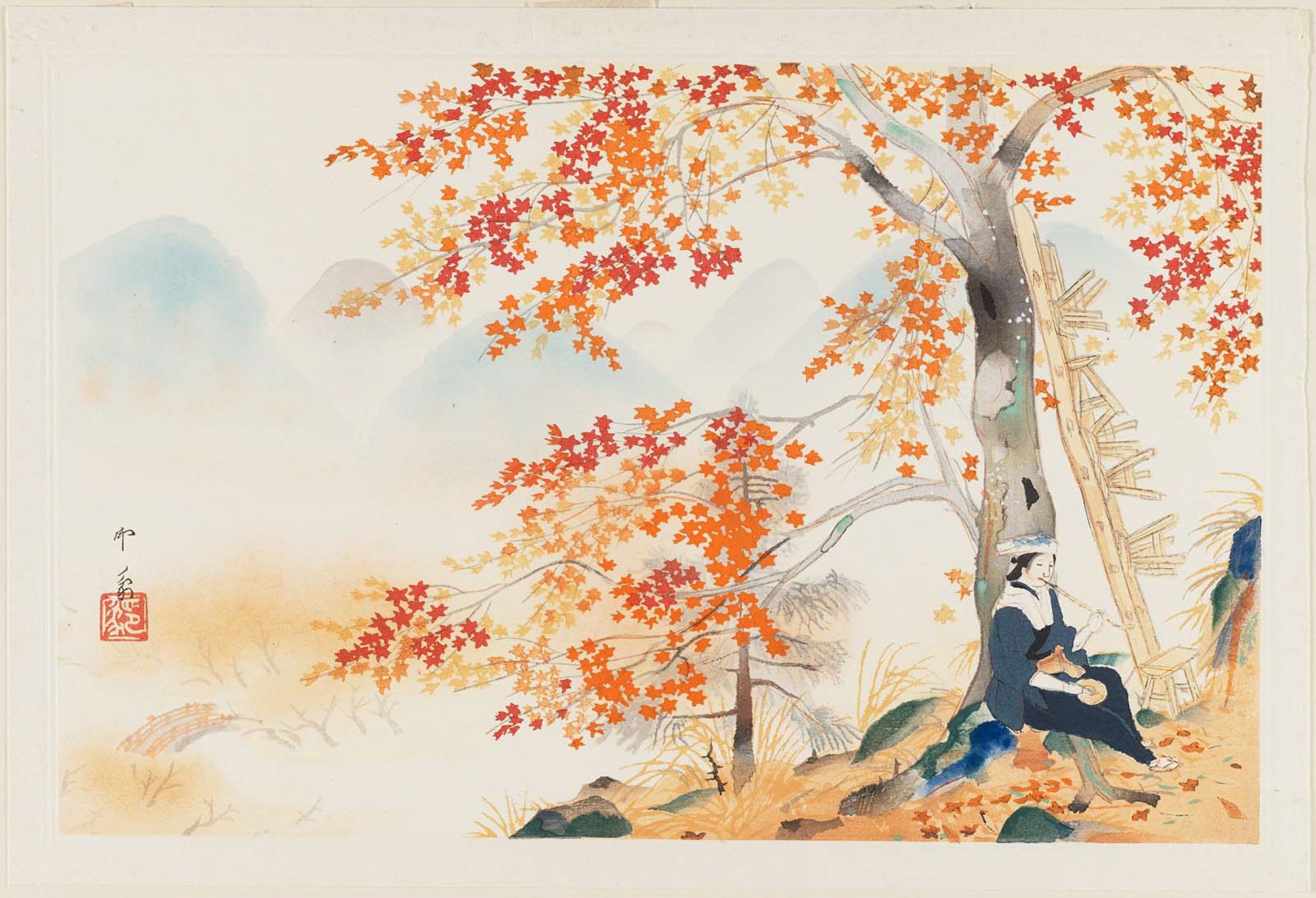
Autumn Maple Leaves at Takao, from the album Eight Views of Kyoto (Kyôto hakkei)
Woodblock print

The Beach at Kaiganji in Sanuki Province (Sanuki Kaiganji no hama), from the series "Collection of Views of Japan II, Kansai Edition (Nihon fukei shu II Kansai hen)"
1934
Color woodblock print; oban

Tea Kettle, section of a sheet from the series "Mirror of Stone Rubbings of Views of the Provinces" (Kohon meihitsu ishizuri kagami)
n.d.
Woodblock print; ishizuri-e, section of harimaze sheet
Featured in Collections
Curated cross-cuts that include this print.
Frequently Asked Questions
Double Bridge (Tokyo) was created by Kotozuka Eiichi (琴塚英一).
Double Bridge (Tokyo) depicts landscapes.