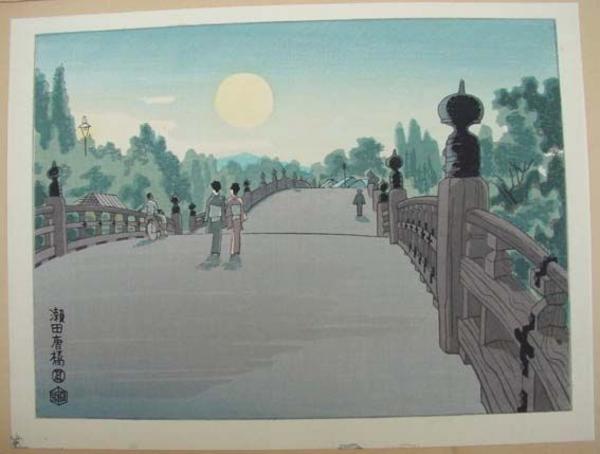
The Full Moon Viewed on the Seta Karahashi Bridge — 瀬田唐橋
- Medium:
- Woodblock print
- Source:
- Japanese Art Open Database
- Image courtesy of
- Japanese Art Open Database
Description
A wide stone bridge with ornate metal finials on its railings stretches across the composition under a pale full moon in a green-tinted evening sky. Small figures in kimono walk across the bridge alone or in pairs, silhouetted against the pale gray roadway, with dark clustered trees lining the banks on both sides. The palette is limited to soft greens, grays, and blue-greens, giving the scene a cool, quiet, twilight stillness. Woodblock print, "The Full Moon Viewed on the Seta Karahashi Bridge — 瀬田唐橋," by Kotozuka Eiichi; year unknown.
More Prints by Kotozuka Eiichi
More Landscapes Prints

Lake Kugushi in Wakasa Province (Wakasa Kugushiko), from the series Souvenirs of Travel I (Tabi miyage dai isshu)"
Wakasa Kugushiko
1920
Color woodblock print; oban
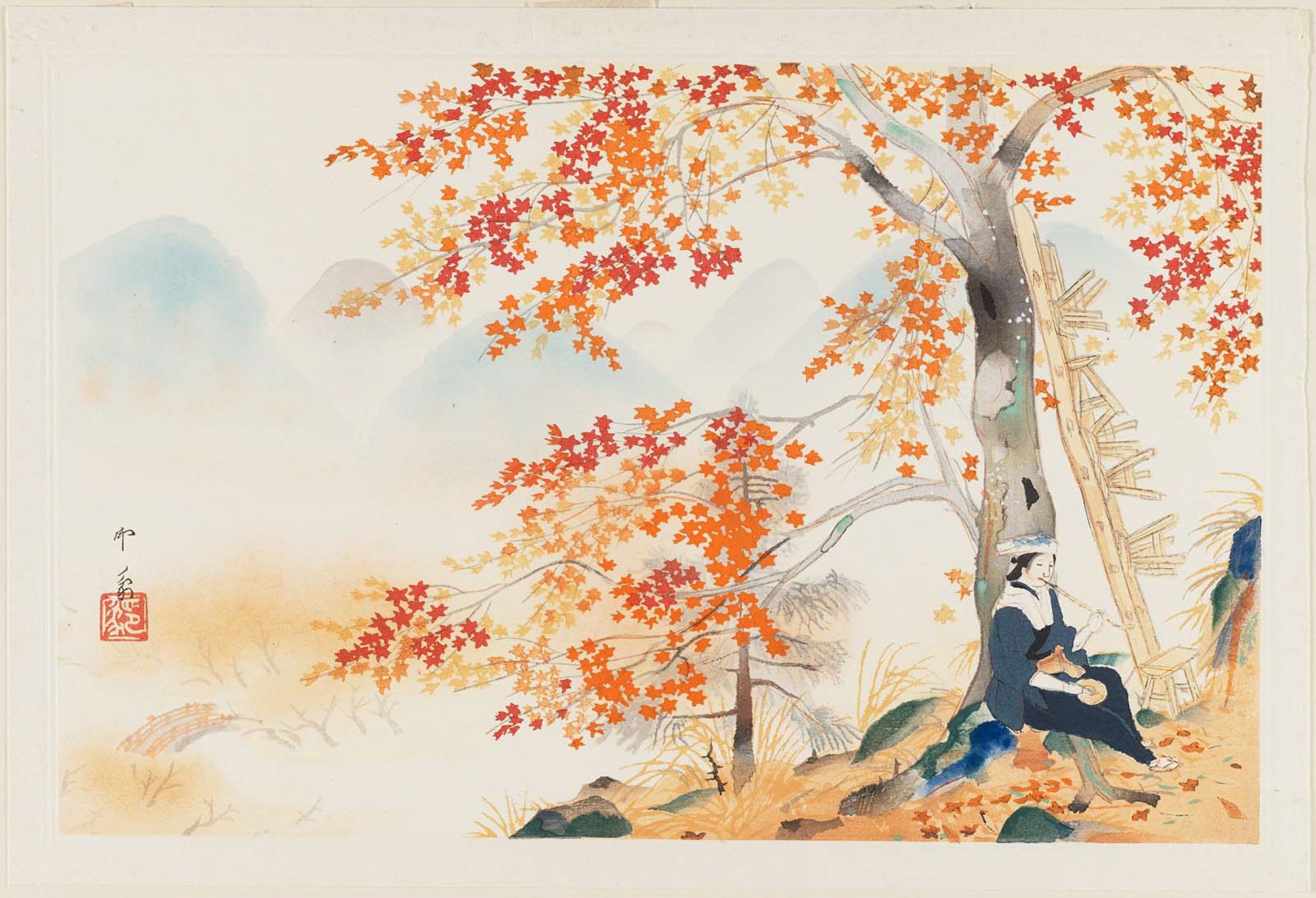
Autumn Maple Leaves at Takao, from the album Eight Views of Kyoto (Kyôto hakkei)
Woodblock print

The Beach at Kaiganji in Sanuki Province (Sanuki Kaiganji no hama), from the series "Collection of Views of Japan II, Kansai Edition (Nihon fukei shu II Kansai hen)"
1934
Color woodblock print; oban

Tea Kettle, section of a sheet from the series "Mirror of Stone Rubbings of Views of the Provinces" (Kohon meihitsu ishizuri kagami)
n.d.
Woodblock print; ishizuri-e, section of harimaze sheet
Featured in Collections
Curated cross-cuts that include this print.
Frequently Asked Questions
The Full Moon Viewed on the Seta Karahashi Bridge — 瀬田唐橋 was created by Kotozuka Eiichi (琴塚英一).
The Full Moon Viewed on the Seta Karahashi Bridge — 瀬田唐橋 depicts landscapes.