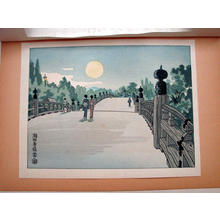
The Full Moon Viewed on the Seta Karahashi Bridge — 瀬田唐橋
- Medium:
- Woodblock print
- Source:
- Japanese Art Open Database
- Image courtesy of
- Japanese Art Open Database
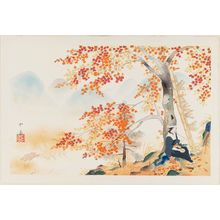
The third impression or edition of Kotozuka's Seta Karahashi moon-view may represent a re-cutting of the original blocks or a late printing with revised colorways. The Seta River bridge subject — 瀬田唐橋 — carried strong associative weight within classical Japanese landscape conventions, referenced in Noh texts and court poetry before the woodblock print tradition absorbed it into the [meisho-e](/glossary/meisho-e) canon. Kotozuka's treatment likely emphasized the stillness of the nocturnal river and the bridge's silhouette, with the moon as a compositional anchor in the upper register. Atmospheric gradation on the sky block — a [shin-hanga](/glossary/shin-hanga) technique he absorbed from the published Kyoto landscape prints of the Taisho era — would have required precise pressure control by the printer during [bokashi](/glossary/bokashi) application. The variation between this and related impressions rewards comparative viewing as evidence of Kotozuka's studio printing practice.

Wakasa Kugushiko
1920
Color woodblock print; oban
Woodblock print

1934
Color woodblock print; oban

n.d.
Woodblock print; ishizuri-e, section of harimaze sheet
Curated cross-cuts that include this print.
The Full Moon Viewed on the Seta Karahashi Bridge — 瀬田唐橋 was created by Kotozuka Eiichi (琴塚英一).
The Full Moon Viewed on the Seta Karahashi Bridge — 瀬田唐橋 depicts landscapes.