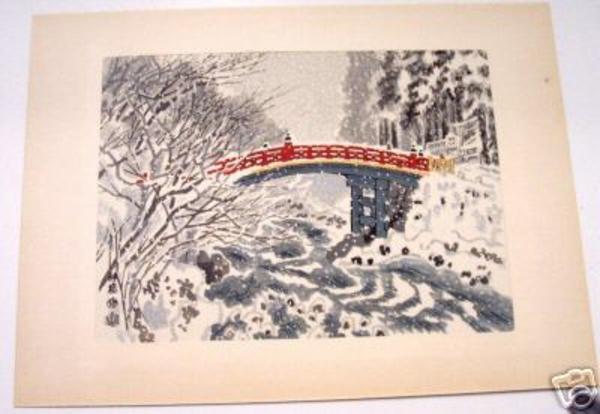
The Shinkyo Bridge in Winter
- Medium:
- Woodblock print
- Source:
- Japanese Art Open Database
- Image courtesy of
- Japanese Art Open Database
Description
The Shinkyo (Sacred Bridge, 神橋) spans the Daiya River at the approach to the Nikkō shrine complex. Its lacquered vermillion railings and curved wooden structure—reserved historically for the passage of the shogun and imperial messengers—make it one of Japan's most recognizable bridges. A winter composition would show the bridge blanketed in snow, its red lacquer emerging through white accumulations while surrounding cedar and the stone embankments carry heavy loads. The river below, running dark against pale banks, would provide a strong horizontal counterpoint to the bridge's arch. Kotozuka would have employed a cool white and blue-gray palette for snow passages, using reserve areas left unprinted for the brightest snow surfaces, with bokashi transitions moving from pale sky into shadow beneath the bridge deck. The contrast between artificial vermillion lacquer and the natural winter palette is characteristic of architectural landscape subjects in shin-hanga, where seasonal severity serves to isolate and intensify the presence of a built structure within its landscape.
More Prints by Kotozuka Eiichi
More Landscapes Prints

Lake Kugushi in Wakasa Province (Wakasa Kugushiko), from the series Souvenirs of Travel I (Tabi miyage dai isshu)"
Wakasa Kugushiko
1920
Color woodblock print; oban
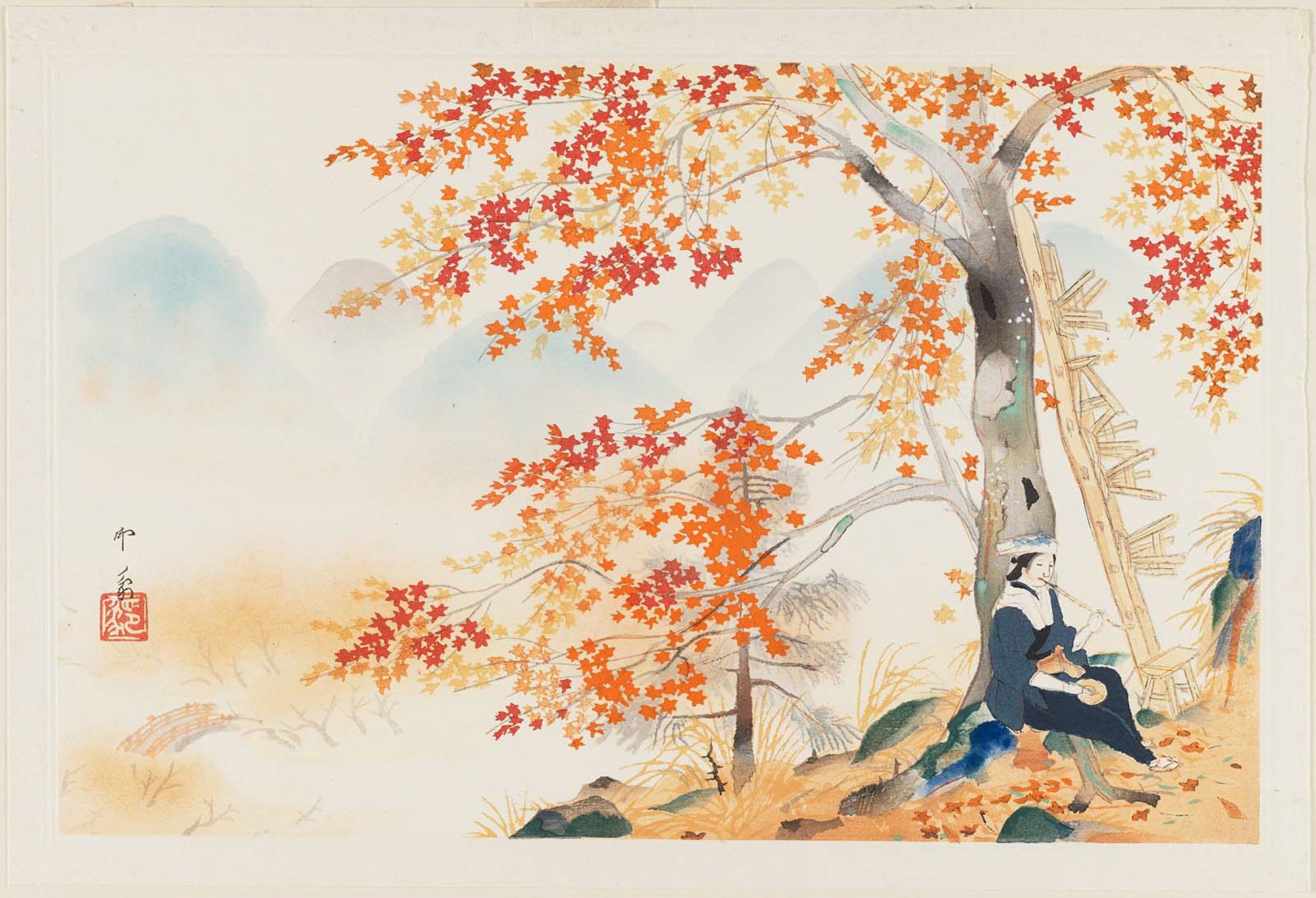
Autumn Maple Leaves at Takao, from the album Eight Views of Kyoto (Kyôto hakkei)
Woodblock print

The Beach at Kaiganji in Sanuki Province (Sanuki Kaiganji no hama), from the series "Collection of Views of Japan II, Kansai Edition (Nihon fukei shu II Kansai hen)"
1934
Color woodblock print; oban

Tea Kettle, section of a sheet from the series "Mirror of Stone Rubbings of Views of the Provinces" (Kohon meihitsu ishizuri kagami)
n.d.
Woodblock print; ishizuri-e, section of harimaze sheet
Featured in Collections
Curated cross-cuts that include this print.
Frequently Asked Questions
The Shinkyo Bridge in Winter was created by Kotozuka Eiichi (琴塚英一).
The Shinkyo Bridge in Winter depicts landscapes.