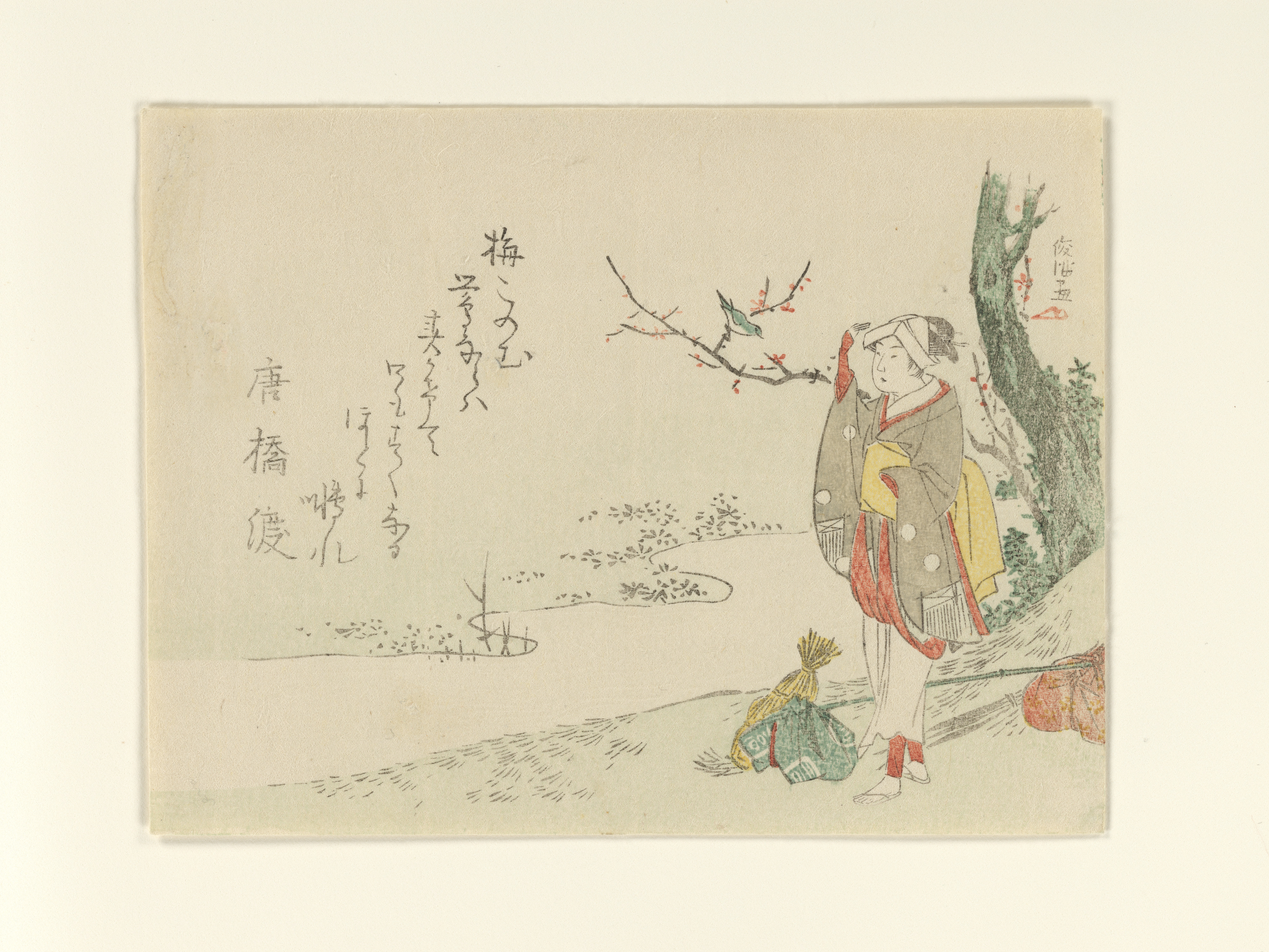
Traveling Woman Pauses to Listen to a Warbler
by Kubo Shunman
- Date:
- 1797
- Medium:
- Woodblock print (surimono); ink and color on paper
- Source:
- Metropolitan Museum of Art
Description
Traveling Woman Pauses to Listen to a Warbler captures a quiet roadside moment in the refined idiom that made Kubo Shunman a sought-after designer for kyoka circles in late eighteenth-century Edo. Dated to 1797 and held by the Metropolitan Museum of Art, the print shows a woman dressed for travel, her bundle and footwear suggesting the open road, who has paused at the call of a bush warbler. The uguisu, classically associated with plum blossoms and the first stirrings of spring, was a standard cue in Japanese poetry, and its appearance here links the picture to the seasonal vocabulary that kyoka poets prized. Shunman's drawing is unhurried: the figure's posture leans subtly toward the unseen bird, her sleeves and sash arranged so that the picture's center of gravity rests on the act of listening rather than on any narrative incident. This restraint is characteristic of Edo ukiyo-e surimono and kyoka-e production, where pictures functioned as visual partners to poems and so were designed to support reflection rather than command attention. The print's muted palette and careful registration are typical of the high standards of surimono printing, even when, as here, the image appears in a slightly larger format. For collectors and readers approaching Kubo Shunman, the work demonstrates the way a single gesture, treated with sensitivity and economy of means, can encapsulate a season, a literary tradition, and the contemplative mood that defined the kyoka world he inhabited.
More Prints by Kubo Shunman

Righteousness (Gi), from the series "Five Designs for the Katsushika Poetry Circle (Katsushika goban)"
early 1810s
Color woodblock print; shikishiban, surimono

Soga no Goro, Oiso no Tora, and Kewaizaka no Shosho
1809
Color woodblock print; surimono
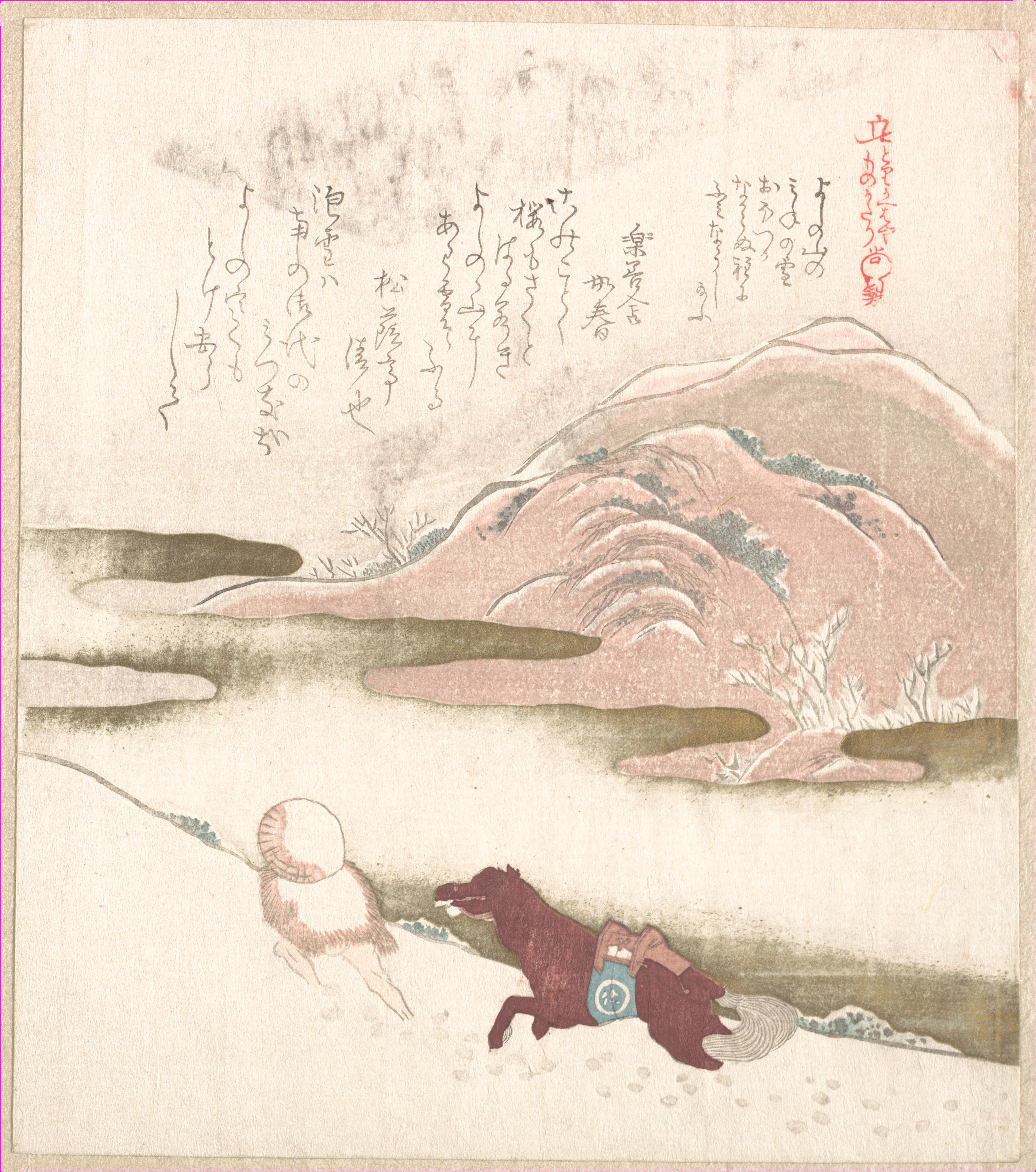
Snowy Landscape
19th century
Woodblock print (surimono); ink and color on paper

Woman and two boys gathering abalone, from the series "The Tosa Diary (Tosa nikki)"
1810s
Color woodblock print; shikishiban, surimono
Frequently Asked Questions
Traveling Woman Pauses to Listen to a Warbler was created by Kubo Shunman (窪俊満) in 1797.