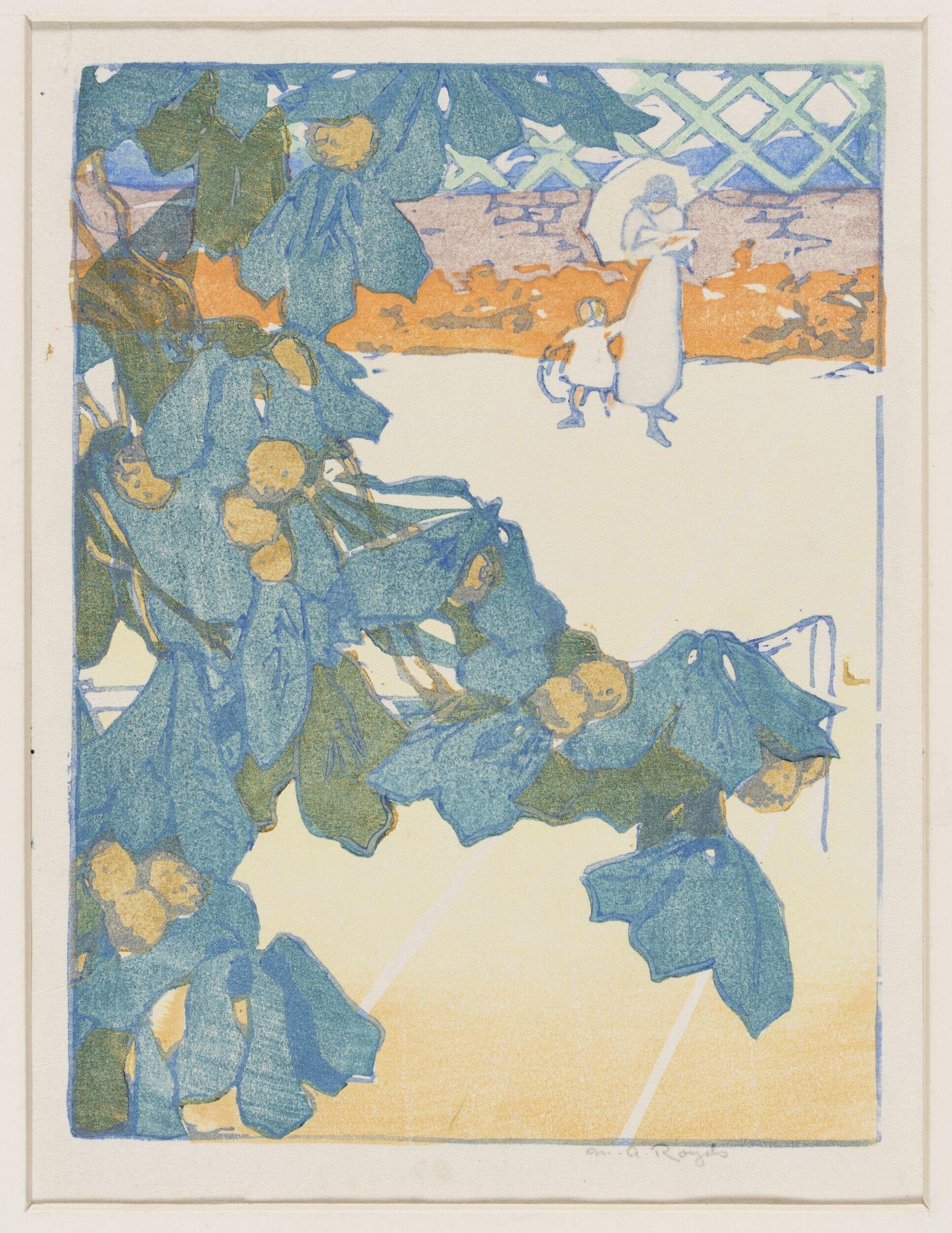
Chestnut Burrs
by Mabel Royds
- Date:
- circa 1912
- Medium:
- Colour woodcut print on paper
- Source:
- Victoria and Albert Museum
Description
Chestnut Burrs, circa 1912, is a colour woodcut by Mabel Royds in the Victoria and Albert Museum (E.211-2016) belonging to the earliest group of her surviving prints, made in the years immediately after her marriage to Ernest Stephen Lumsden and her arrival in Edinburgh in 1911. The subject — the spiked burrs of the sweet chestnut tree, with leaves and twigs framing the composition — is a close-focused natural-history motif of the kind that the British colour woodcut school of the late Edwardian and early interwar period inherited from the broader arts-and-crafts movement and from the example of late-Meiji Japanese kachō-e printmaking transmitted via the teaching of Frank Morley Fletcher. Royds reduces the scene to a small number of flat colour planes — the brown and ochre tones of the burrs, the green of the leaves, the muted ground colour — printed by hand on dampened Japanese-style paper from separate woodblocks registered with kentō notches. The print's early date and its quiet observation of an English-countryside motif place it before the South Asian journeys that would dominate her mature production, and it demonstrates the grounding in plant studies that remained one of her continuing interests through the 1920s and 1930s.
More Prints by Mabel Royds
Featured in Collections
Curated cross-cuts that include this print.
Frequently Asked Questions
Chestnut Burrs was created by Mabel Royds in circa 1912.