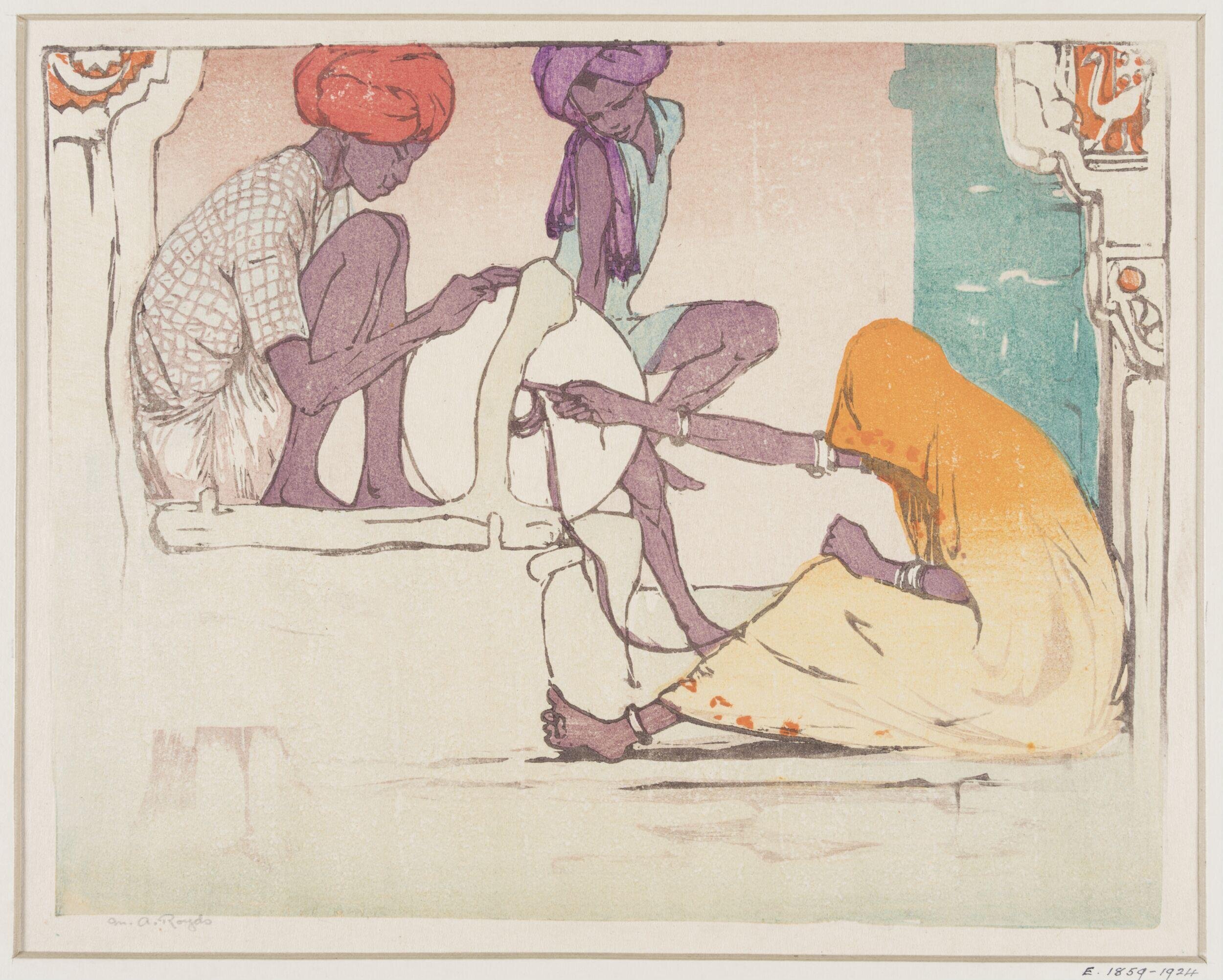
The Sword Grinder (Jodhpur)
by Mabel Royds
- Date:
- circa 1918-1920
- Medium:
- Colour woodcut on paper (printing ink on woodcut)
- Source:
- Victoria and Albert Museum
Description
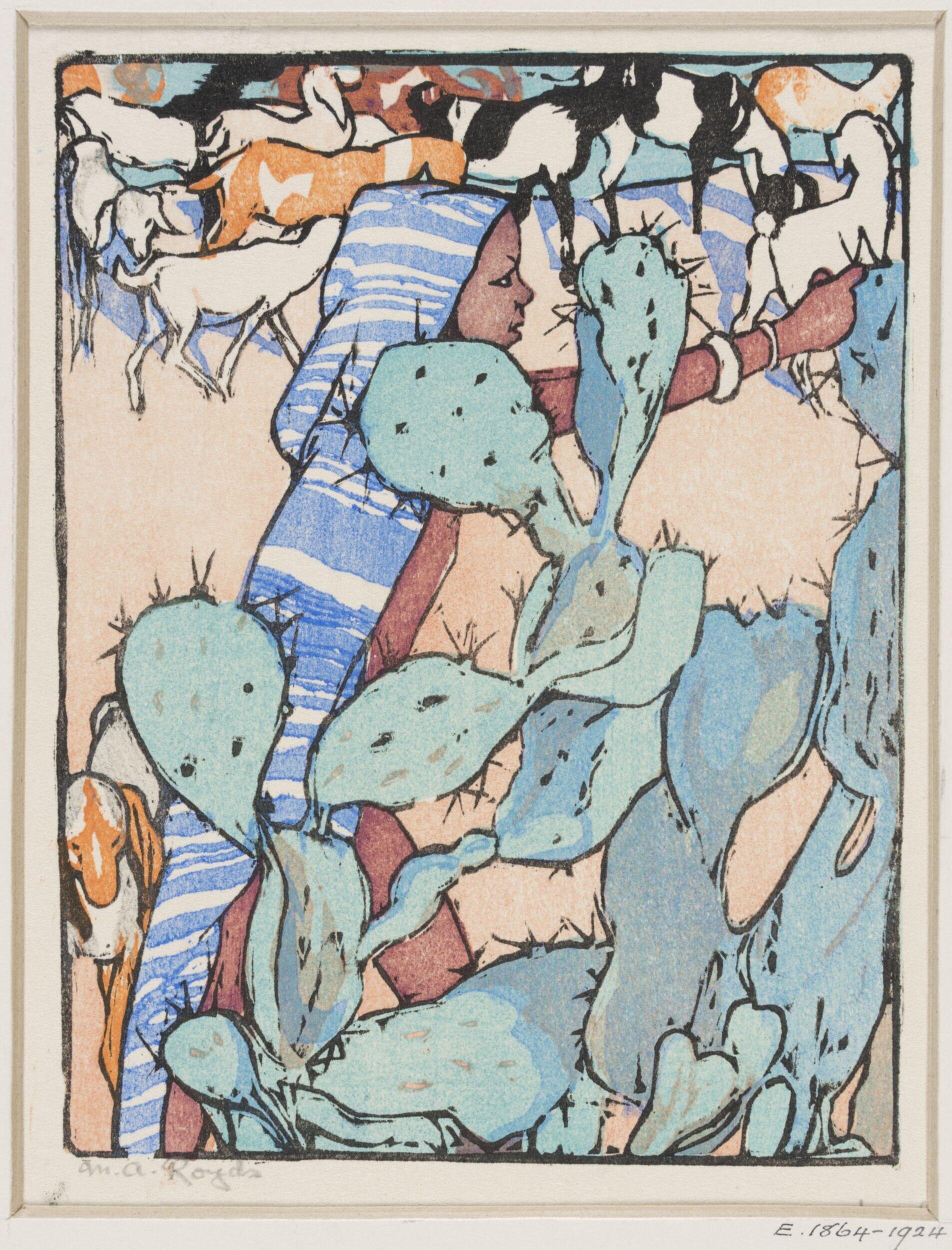
The Sword Grinder (Jodhpur) is one of Mabel Royds's signature Indian colour woodcuts, dating from circa 1918-1920 and acquired by the Victoria and Albert Museum in 2016 (E.214-2016). The subject is an itinerant sword-grinder at work on a Jodhpur street — a familiar figure in Rajasthani towns of the late colonial period, sharpening blades on a pedal-driven grinding wheel — depicted with the brightly turned wheel as the visual centre of the composition and the bowed figure of the craftsman crouched behind it. Royds's treatment exemplifies the mature Anglo-Japanese colour woodcut style that she developed in Edinburgh after her marriage to Ernest Stephen Lumsden in 1911 and after the couple's first extended journeys to India and the Himalayas in the mid-1910s. The image is built from a small number of separate blocks, each carrying a single flat colour applied with water-based pigment to dampened paper, registered with the kentō notch system that British colour woodcut artists had adopted from Japanese practice via the teaching of Frank Morley Fletcher. The simplified planar treatment, the use of distinctive saturated hues rather than atmospheric broken colour, and the willingness to leave visible grain and tool marks are all characteristic of Royds's approach and distinguish her work from the more traditionally tonal British colour woodcuts of the period. The print is one of the most often-reproduced of her Indian subjects and is frequently cited in surveys of the British colour woodcut revival as an example of how the Anglo-Japanese technique was adapted by interwar artists to non-Japanese subject matter.
More Prints by Mabel Royds
Featured in Collections
Curated cross-cuts that include this print.
Frequently Asked Questions
The Sword Grinder (Jodhpur) was created by Mabel Royds in circa 1918-1920.