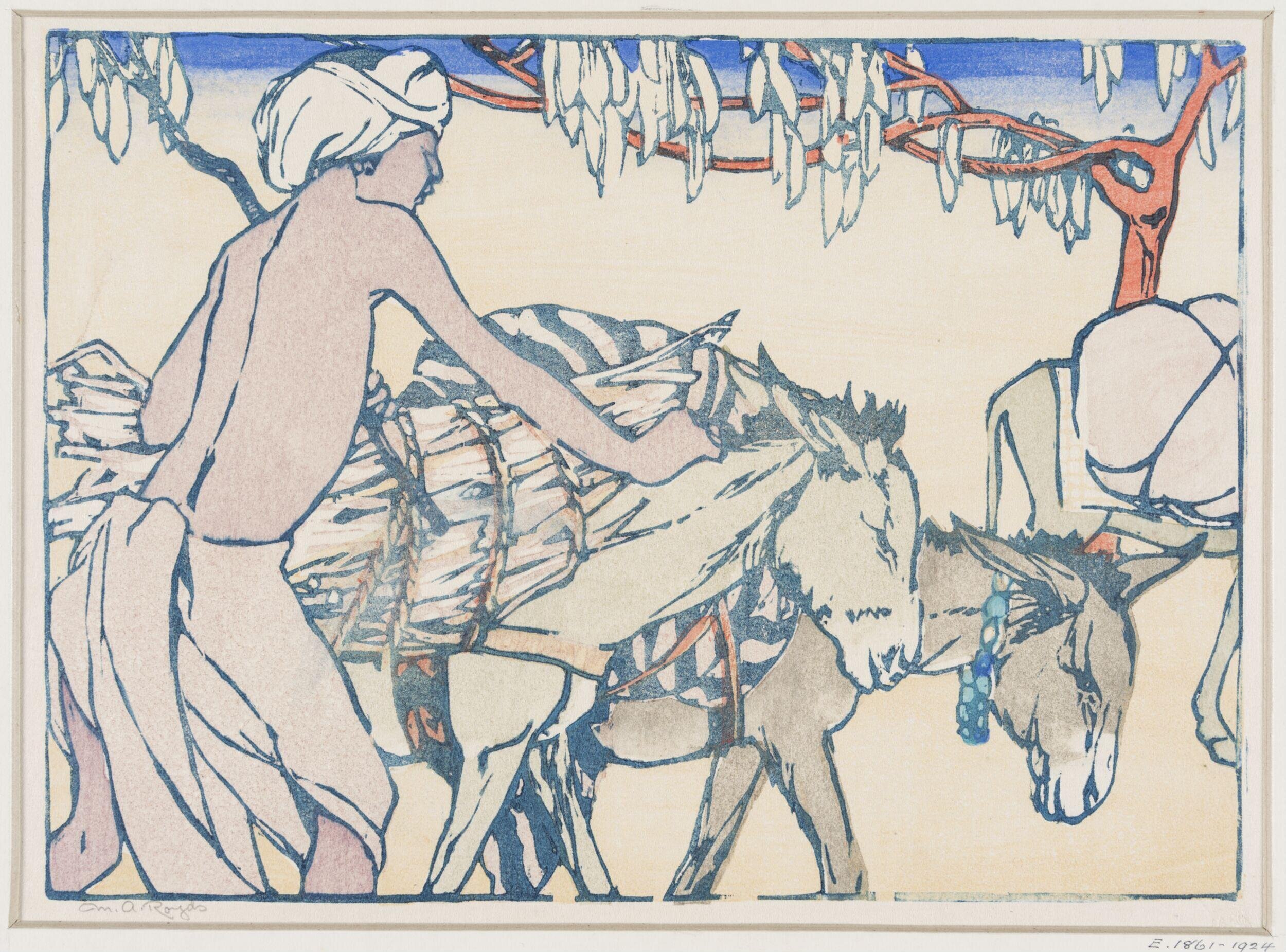
Donkey Boy
by Mabel Royds
- Date:
- circa 1924
- Medium:
- Colour woodcut on paper
- Source:
- Victoria and Albert Museum
Description
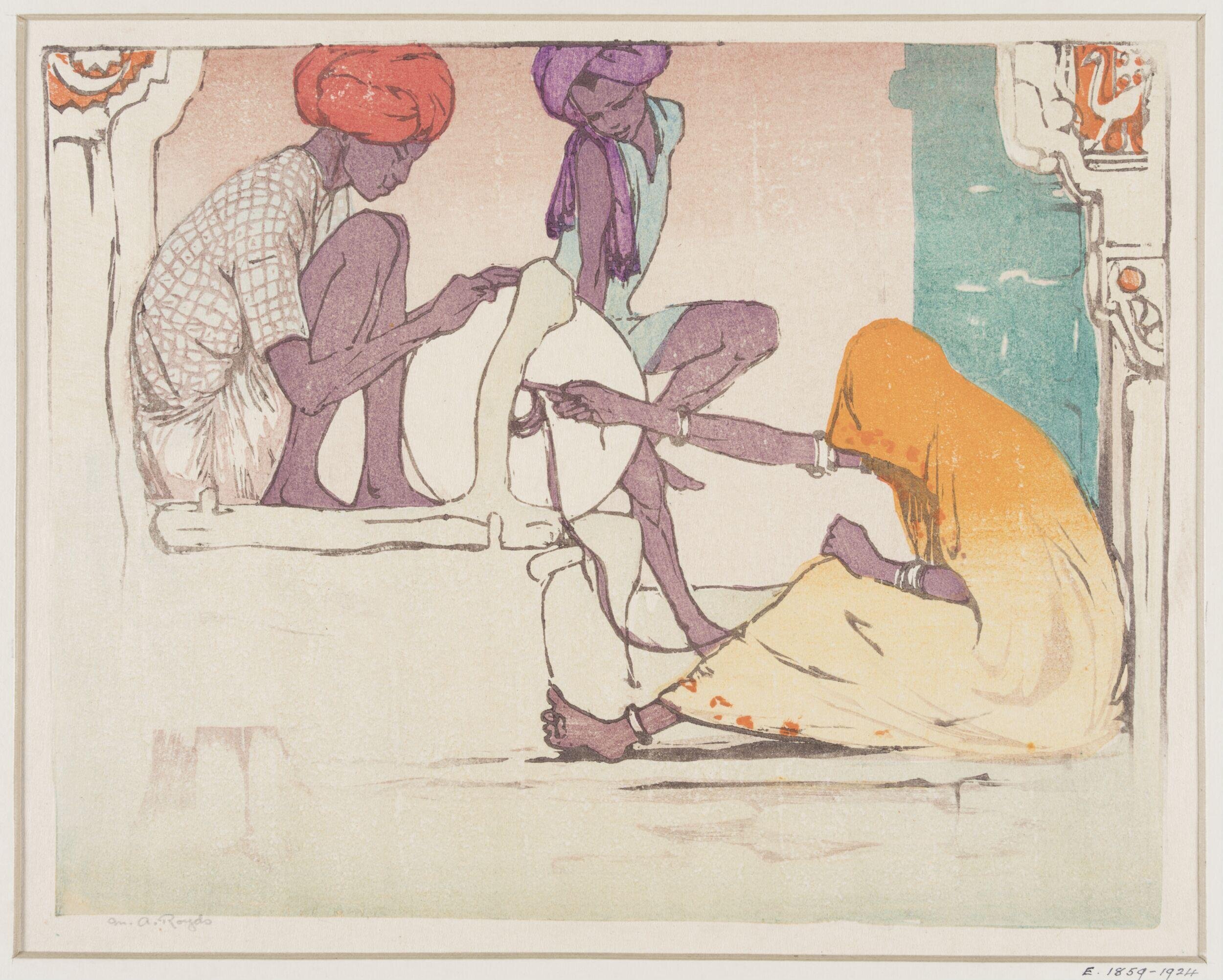
Donkey Boy, circa 1924, is a colour woodcut by Mabel Royds depicting a young donkey handler with his animal, acquired by the Victoria and Albert Museum in 2016 (E.220-2016). The subject — a boy leading or standing with a donkey loaded with goods — is one of the recurrent figure motifs of Royds's Indian and North African work of the 1910s and 1920s, in which she returned repeatedly to porters, market traders, animal handlers, and other working figures observed at first hand during the journeys she and her husband Ernest Stephen Lumsden took from their Edinburgh base. Royds reduces the image to a small number of flat planes: the silhouette of the boy, the bulk of the donkey, and a flat ground tone, with details suggested by minimal interior drawing on the figure and animal. The technique is the Anglo-Japanese colour woodcut in which she had become fluent — a separate block for each colour, printed by hand on dampened Japanese-style paper with water-based pigment and registered with kentō notches — but applied with the looser, more graphic sense of design that distinguishes her from more traditionalist British colour woodcut artists. The print typifies her interest in working figures observed without picturesque sentimentality, drawn from direct observation during her Asian and North African travels rather than from studio convention.
More Prints by Mabel Royds
Featured in Collections
Curated cross-cuts that include this print.
Frequently Asked Questions
Donkey Boy was created by Mabel Royds in circa 1924.