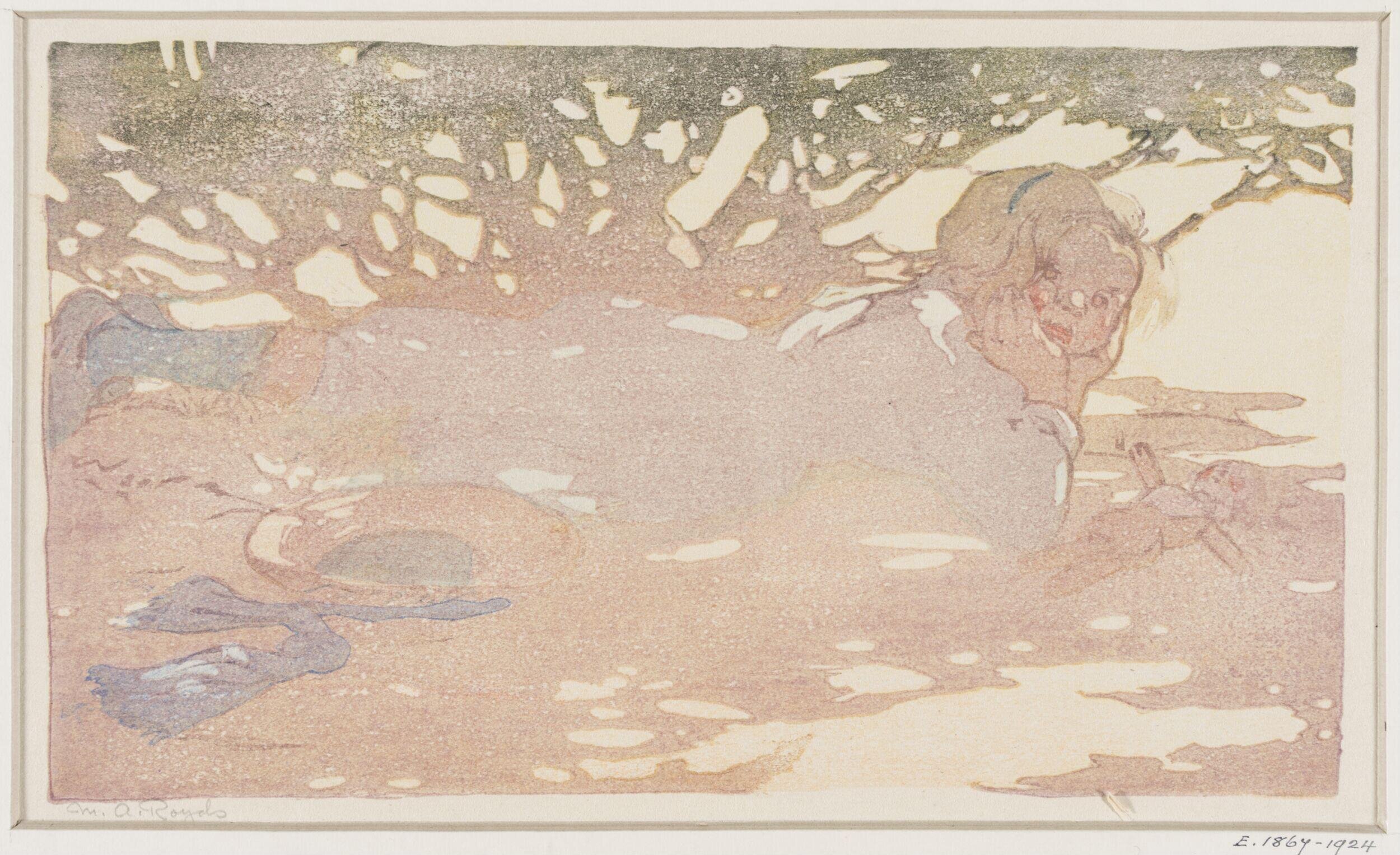
Sunspots
by Mabel Royds
- Date:
- circa 1913
- Medium:
- Colour woodcut on paper (printing ink on woodcut)
- Source:
- Victoria and Albert Museum
Description
Sunspots, circa 1913, is a colour woodcut by Mabel Royds depicting dappled light falling through trees, acquired by the Victoria and Albert Museum in 2016 (E.215-2016). The motif — patches of bright sunlight on a shaded ground beneath a leafy canopy — was a favourite subject of the British colour woodcut school of the late Edwardian and early interwar period, taken up by artists including Allen Seaby, William Giles, and others as a way of testing the abstract possibilities of flat colour against an observed natural effect. Royds's treatment reduces the scene to a small number of separate blocks of flat colour printed on dampened paper in water-based pigment, with the patches of sunlight registered as bright shapes against the darker ground tones of the foliage and earth. The print belongs to her earliest mature period in Edinburgh, the years immediately following her marriage to Ernest Stephen Lumsden and her arrival at the Edinburgh College of Art, and shows her absorbing the Anglo-Japanese colour woodcut idiom that British artists of her generation had developed since the 1890s through the writings of Frank Morley Fletcher and the example of John Dickson Batten and others.
More Prints by Mabel Royds

Featured in Collections
Curated cross-cuts that include this print.
Frequently Asked Questions
Sunspots was created by Mabel Royds in circa 1913.