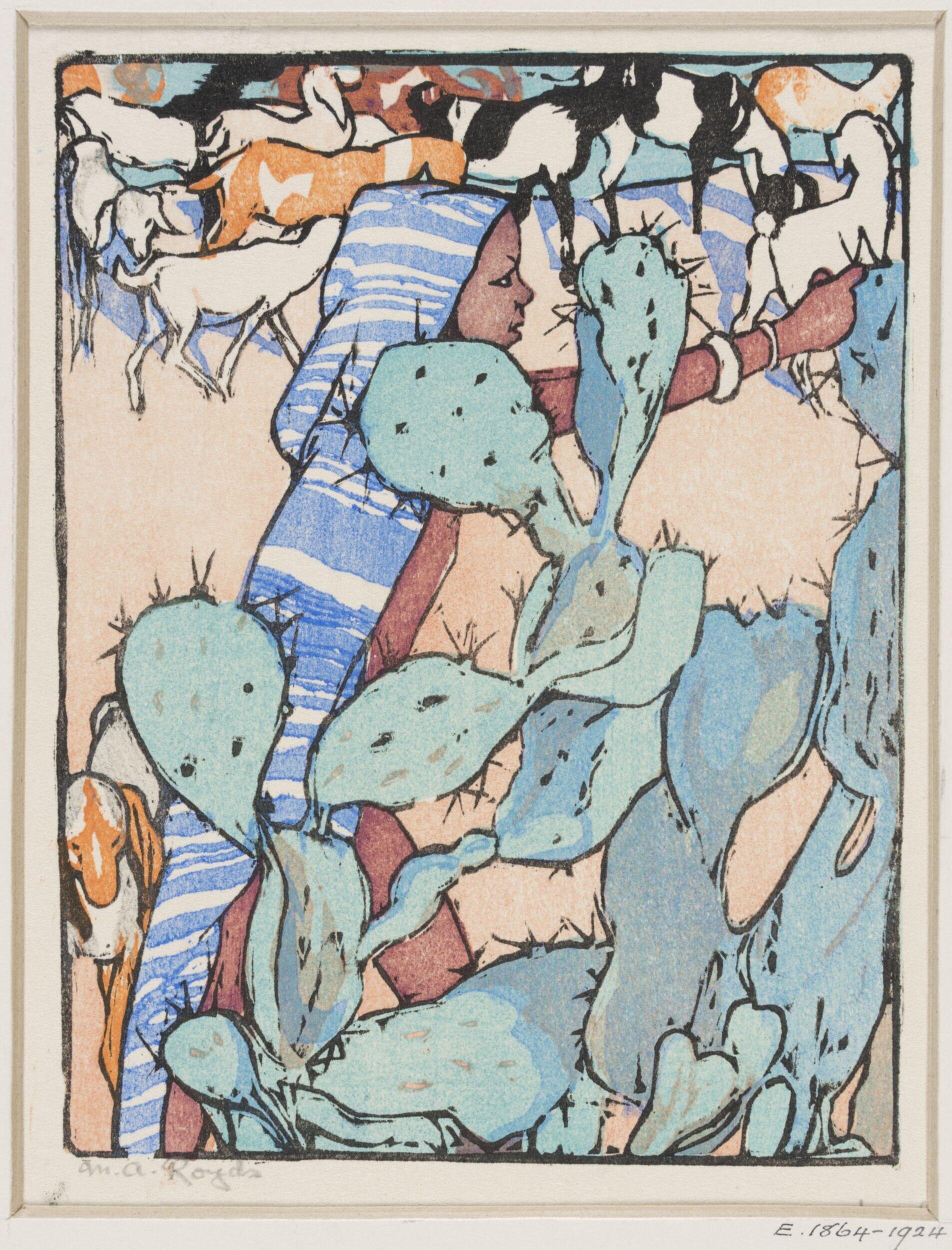
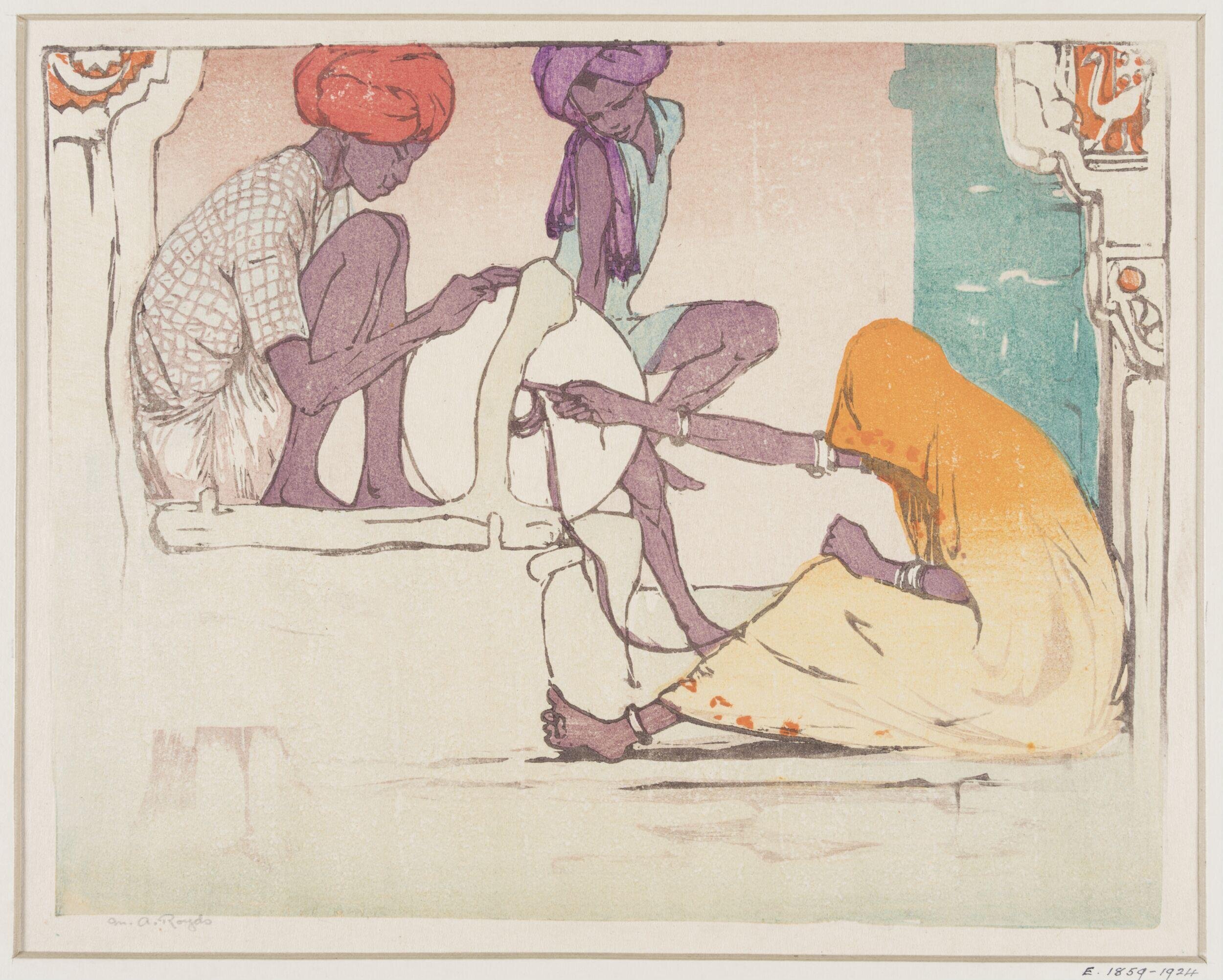
The Goatherd
by Mabel Royds
- Date:
- circa 1920
- Medium:
- Colour woodcut on paper (printing ink)
- Source:
- Victoria and Albert Museum
Description
The Goatherd, circa 1920, is one of Mabel Royds's distinctive Himalayan or North Indian figure compositions, acquired by the Victoria and Albert Museum in 2016 (E.217-2016). The subject — a young herder with his goats on a rocky path — is reduced to a small number of flat planar shapes: the silhouette of the figure, the curved backs of the animals, and the suggested landscape behind, all printed in saturated water-based colour from separate blocks on dampened paper. The composition is characteristic of Royds's approach to working figures observed during the journeys she and Ernest Stephen Lumsden made through India, Tibet, and the Himalayan foothills in the late 1910s and 1920s: rather than the picturesque conventions inherited from nineteenth-century British orientalist painting, she translates the subject into a flat-planar graphic design that draws on the Anglo-Japanese colour woodcut technique she had learned via Frank Morley Fletcher's and Allen Seaby's reformulation of Japanese practice for British use. The print is one of the most often-cited examples of how she adapted the colour woodcut to non-European working subjects and is among the works that established her reputation within the Society of Graver-Printers in Colour during the interwar period.
More Prints by Mabel Royds
Featured in Collections
Curated cross-cuts that include this print.
Frequently Asked Questions
The Goatherd was created by Mabel Royds in circa 1920.