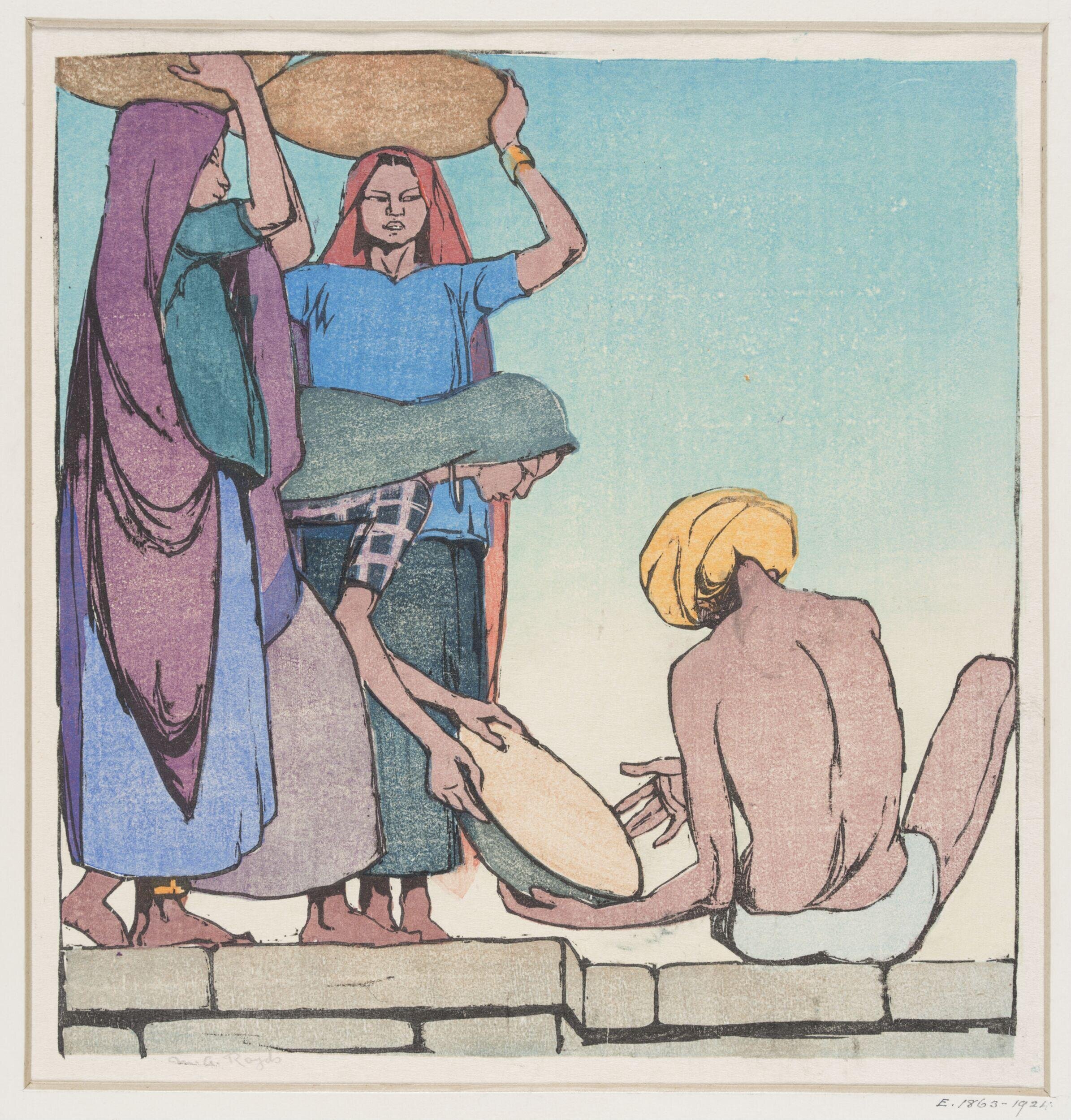
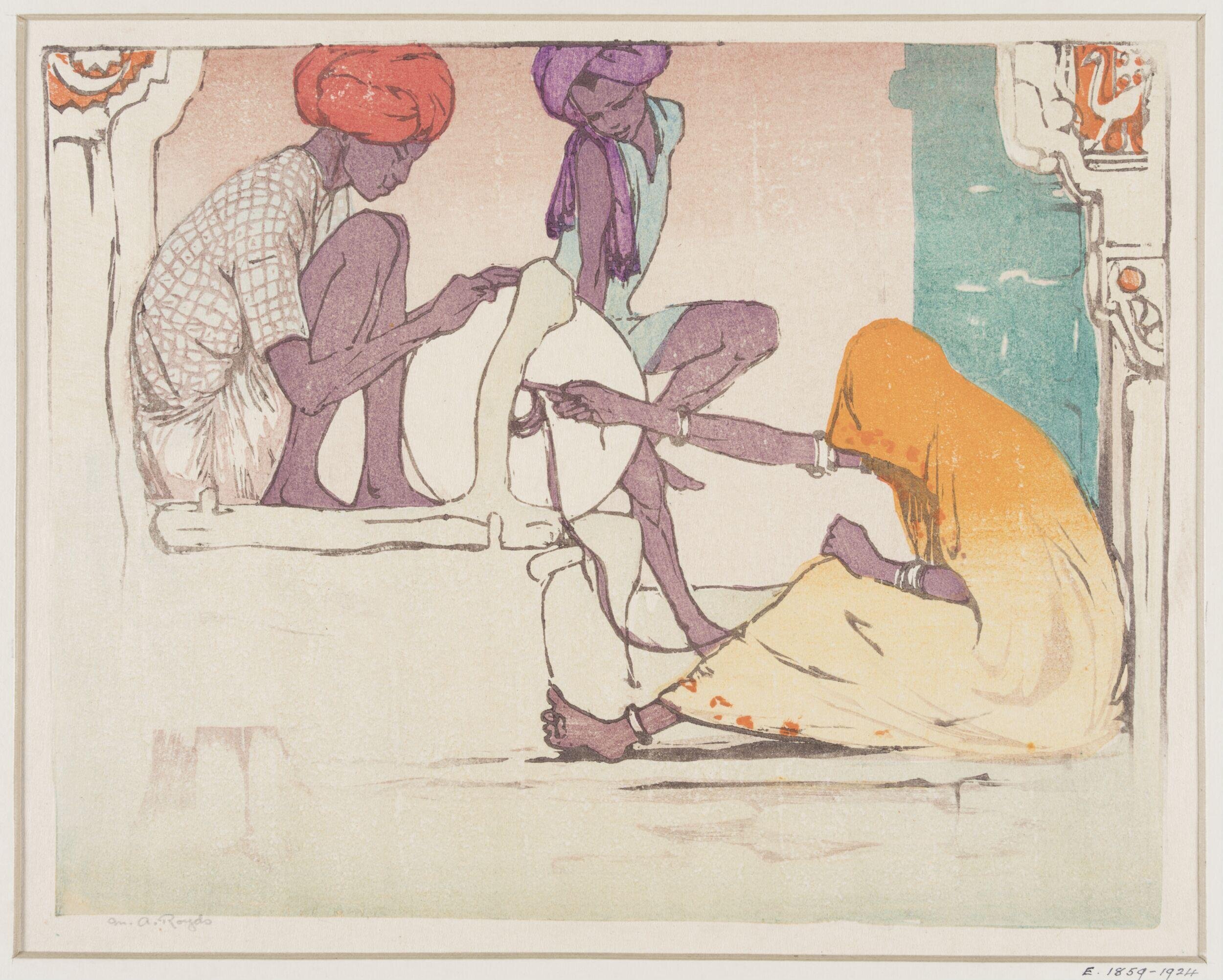
The House-top
by Mabel Royds
- Date:
- circa 1920
- Medium:
- Colour woodcut on paper (printing ink on wood)
- Source:
- Victoria and Albert Museum
Description
The House-top, circa 1920, is a colour woodcut by Mabel Royds depicting figures on a flat-roofed house in a hill or plateau setting, made during the period of her South Asian journeys with her husband Ernest Stephen Lumsden and acquired by the Victoria and Albert Museum in 2016 (E.218-2016). The flat roof and the architecture of the village suggest either a North Indian or a Himalayan setting; the small group of figures on the roof — variously interpreted as women drying grain, observing the surrounding landscape, or simply at rest — gives the composition its narrative focus. Royds reduces the architecture and figures to a small number of flat planar shapes printed in saturated water-based colour on dampened paper, with separate blocks carrying each colour and the keylines simplified almost to the level of cut-out silhouettes. The print belongs to the most distinctive group of her woodcuts, in which her direct experience of Indian and Himalayan villages in the late 1910s and early 1920s is translated into the Anglo-Japanese colour woodcut technique she had absorbed from the British colour woodcut revival of the 1890s and 1900s. The result is a graphic image that is recognizably modernist in its handling of design while remaining grounded in observed subject matter.
More Prints by Mabel Royds
Featured in Collections
Curated cross-cuts that include this print.
Frequently Asked Questions
The House-top was created by Mabel Royds in circa 1920.