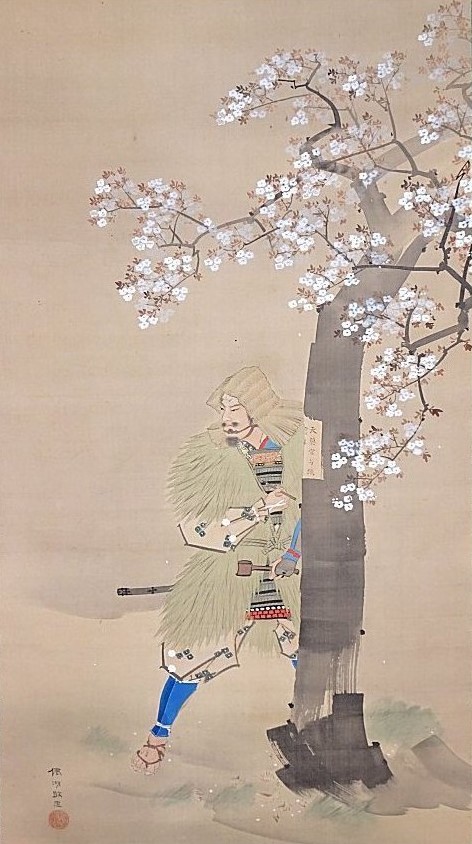
Kojima Takanori Inscribing the Cherry Tree
児島高徳
- Date:
- before 1924
- Medium:
- Hanging scroll; ink and colour on silk
Description
Kojima Takanori Inscribing the Cherry Tree (児島高徳) is a hanging-scroll painting by Matsumoto Fūko depicting one of the most beloved patriotic subjects of Meiji and Taishō rekishiga. Kojima Takanori (active c. 1330) was a fourteenth-century samurai loyal to Emperor Go-Daigo during the Kemmu Restoration; the canonical episode, recorded in the Taiheiki, has him following the exiled emperor's procession to Oki, slipping into the imperial encampment at Innōshō by night, and carving a Chinese-style ten-character poem onto a cherry tree to encourage the emperor — the lines, traditionally rendered as "Heaven will not abandon Goujian; lacking only a Fan Li," compared Go-Daigo to the deposed king of Yue who eventually recovered his throne. The episode became one of the most famous expressions of imperial loyalism in the modern period: Kojima was canonised as a Meiji national hero, and the cherry-tree-inscription scene was reproduced in school textbooks, on postage stamps, and as a standard subject for historical painters. Fūko's treatment shows Takanori standing beside the cherry tree, brush in hand, looking up at the surface he has just inscribed. The painting is one of the canonical late-Meiji or Taishō-period Fūko treatments of the historical-loyalist subject and stands within a longer tradition of nineteenth-century rekishiga depictions of the same scene by Kikuchi Yōsai, Ogata Gekkō, and Tsukioka Yoshitoshi.
More Prints by Matsumoto Fūko

Portrait of Itagaki Nobukata (One of the Twenty-Four Generals of Takeda Shingen)
板垣信方像
1860 (inscription added 1872)
Hanging scroll; ink and colour on paper

Three Flowers in Snow (Centre Scroll)
雪中三花図 中幅
before 1924
Hanging scroll; ink and colour on silk
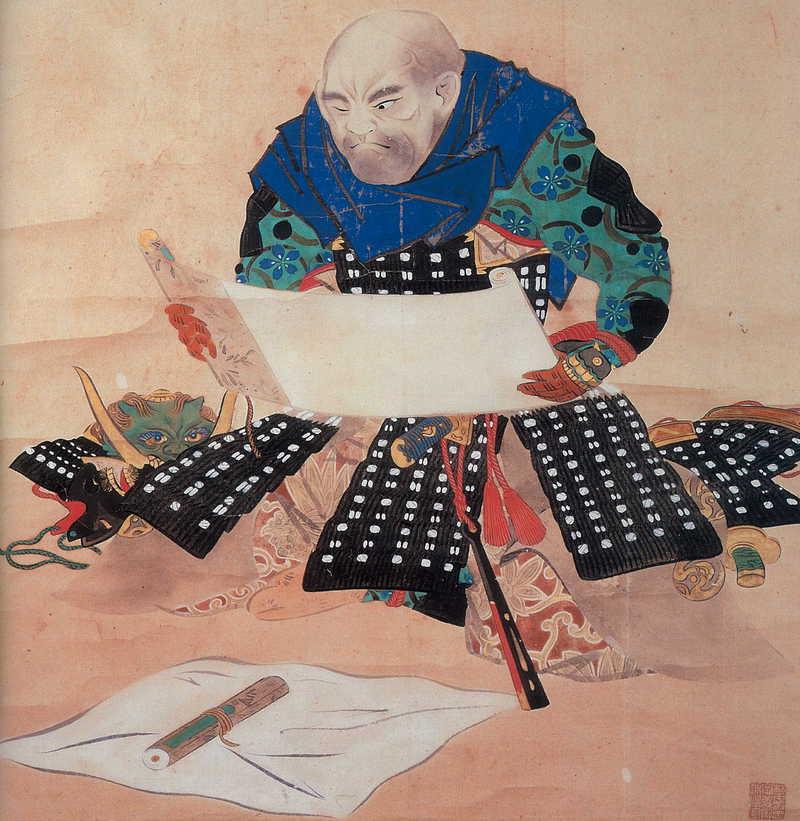
Portrait of Yamamoto Kansuke (One of the Twenty-Four Generals of Takeda Shingen)
山本勘助像
c. 1871–1873
Hanging scroll; ink and colour on paper

Portrait of Tsuchiya Masatsugu (One of the Twenty-Four Generals of Takeda Shingen)
土屋昌続像
c. 1871–1873
Hanging scroll; ink and colour on paper
Frequently Asked Questions
Kojima Takanori Inscribing the Cherry Tree (児島高徳) was created by Matsumoto Fūko (松本楓湖) in before 1924.