
Ushiwakamaru (The Young Minamoto no Yoshitsune)
牛若丸
- Date:
- before 1924
- Medium:
- Hanging scroll; ink and colour on silk
Description
Ushiwakamaru, the Young Minamoto no Yoshitsune (牛若丸) is a large hanging scroll by Matsumoto Fūko depicting the most celebrated boyhood image in the Japanese historical-narrative tradition: the youthful Yoshitsune (1159–1189), known by his childhood name Ushiwakamaru, training in swordsmanship at Kurama-dera, the mountain temple north of Kyoto where the Genji exile was sent as a boy after his father's defeat in the Heiji Disturbance of 1159. The episode — the young Yoshitsune learning sword-skill at night in the cedar forests of Mount Kurama under the supervision of the tengu — was one of the most familiar Heian-Kamakura subjects in late-Edo and Meiji historical painting, treated in popular literature, kabuki, and the prints of Kuniyoshi and Yoshitoshi. Fūko's vertical composition presents the boy in flowing white robes against a darker background of mountain pine and rock, his hair tied at the nape in the youthful Heian manner, his sword raised in the practice gesture that the rekishiga tradition codified as the standard Ushiwakamaru pose. The painting carries forward Kikuchi Yōsai's iconography of the figure from the Zenken kojitsu album, inflected through Fūko's mature handling of robe drapery and atmospheric ground, and is a representative example of his treatment of the Genpei-period heroes who were a central subject of late-Meiji and Taishō historical painting.
More Prints by Matsumoto Fūko

Portrait of Itagaki Nobukata (One of the Twenty-Four Generals of Takeda Shingen)
板垣信方像
1860 (inscription added 1872)
Hanging scroll; ink and colour on paper

Three Flowers in Snow (Centre Scroll)
雪中三花図 中幅
before 1924
Hanging scroll; ink and colour on silk
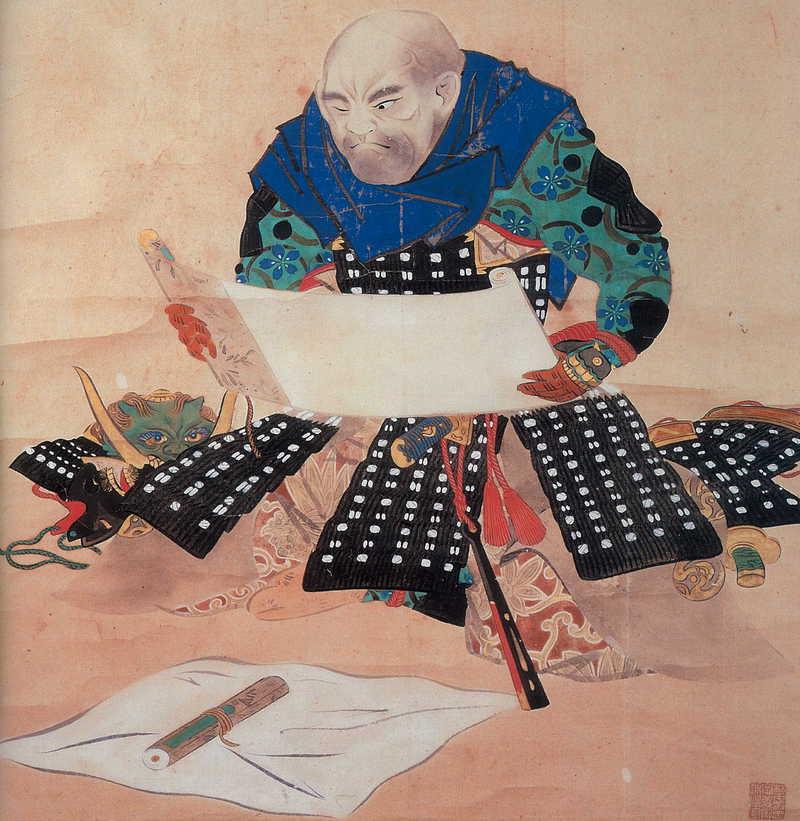
Portrait of Yamamoto Kansuke (One of the Twenty-Four Generals of Takeda Shingen)
山本勘助像
c. 1871–1873
Hanging scroll; ink and colour on paper

Portrait of Tsuchiya Masatsugu (One of the Twenty-Four Generals of Takeda Shingen)
土屋昌続像
c. 1871–1873
Hanging scroll; ink and colour on paper
Frequently Asked Questions
Ushiwakamaru (The Young Minamoto no Yoshitsune) (牛若丸) was created by Matsumoto Fūko (松本楓湖) in before 1924.