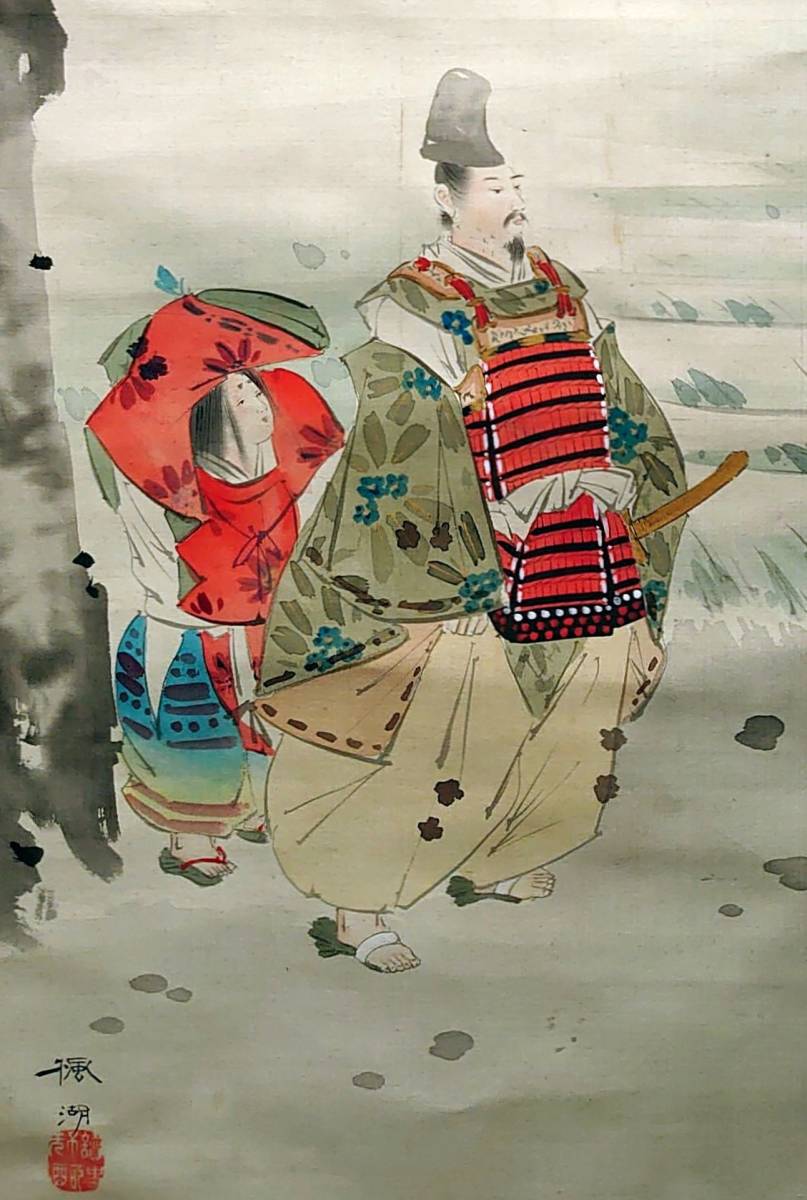
Warrior and Attendant
武将と従者図
- Date:
- before 1924
- Medium:
- Hanging scroll; ink and colour on silk
Description
A tall warrior strides forward wearing a red lamellar cuirass and shoulder guards over an olive-green kimono patterned with leaves and blue flowers, a tan under-robe, a black eboshi cap, and a sword slung at his hip; his beard and mustache are rendered in fine ink line. Beside him a smaller attendant, mostly hidden beneath a wide red hat and matching red robe, peers out with a blue-and-white patterned underskirt and sandals visible below. The figures are set against a pale, sparsely washed ground with faint grey-green reeds or grasses and a dark tree trunk at the left edge, the artist's ink signature and red seals appearing in the lower left corner of this hanging scroll by Matsumoto Fūko, 1900, ink and colour on silk.
More Prints by Matsumoto Fūko

Portrait of Itagaki Nobukata (One of the Twenty-Four Generals of Takeda Shingen)
板垣信方像
1860 (inscription added 1872)
Hanging scroll; ink and colour on paper

Three Flowers in Snow (Centre Scroll)
雪中三花図 中幅
before 1924
Hanging scroll; ink and colour on silk
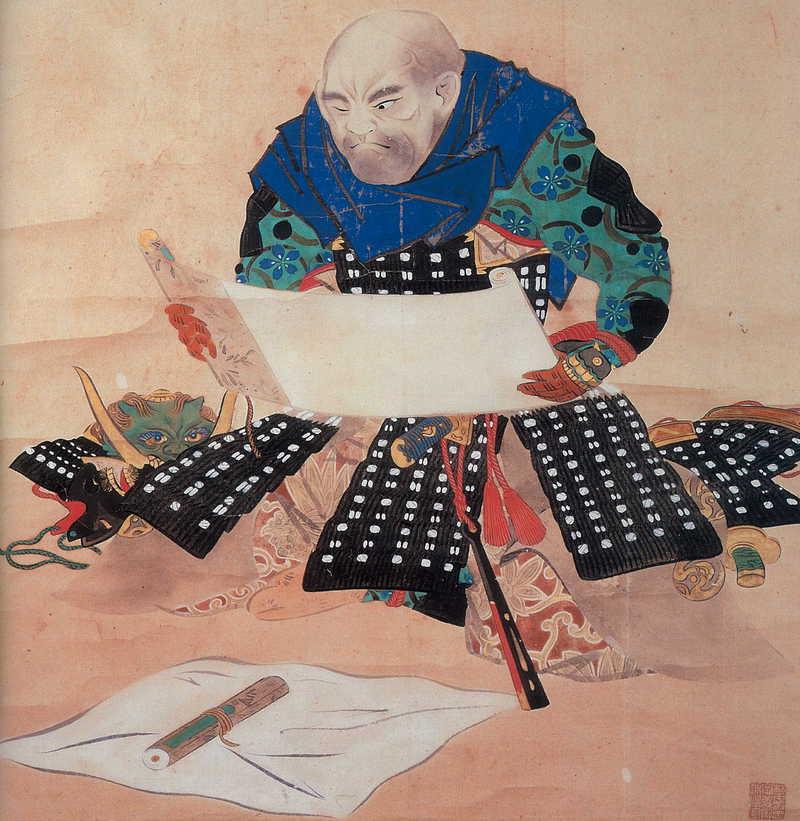
Portrait of Yamamoto Kansuke (One of the Twenty-Four Generals of Takeda Shingen)
山本勘助像
c. 1871–1873
Hanging scroll; ink and colour on paper

Portrait of Tsuchiya Masatsugu (One of the Twenty-Four Generals of Takeda Shingen)
土屋昌続像
c. 1871–1873
Hanging scroll; ink and colour on paper
Frequently Asked Questions
Warrior and Attendant (武将と従者図) was created by Matsumoto Fūko (松本楓湖) in before 1924.