
Hahakigi (from In the Garden of Genji)
帚木
- Medium:
- Aquatint, deep etching, gold leaf
- Image courtesy of
- Hiroaki Miyayama Official Site — In the Garden of Genji
Description
The second chapter of The Tale of Genji takes its title from the hahakigi, a tree of poetic legend said to be visible from a distance but to vanish on approach — a figure for the elusiveness of the woman Utsusemi, whose evasion of Genji structures the chapter, and a chapter largely occupied by the so-called rainy-night discussion in which young men classify women by type. Miyayama's plate for Hahakigi follows the visual logic established across the series: a flat decorative ground worked in gold leaf, intaglio passages of deep etching, and aquatint tonalities that introduce spatial recession only obliquely. The botanical reference — the broom-tree silhouette as emblematic carrier — anchors the composition to the chapter while preserving the abstracted, sign-like mode by which the cycle codes each volume. Within the arc of In the Garden of Genji, the sheet typifies Miyayama's strategy of compressing each chapter's literary content into a botanical or atmospheric distillation rather than pursuing narrative illustration.
More Prints by Hiroaki Miyayama


More Gardens Prints
![[Garden of] Taj Mahal, No. 1 (Taji Maharu no niwa, dai ichi) by Hiroshi Yoshida](https://www.artic.edu/iiif/2/230993a7-d4f0-c979-c267-127d48e1ef1c/full/843,/0/default.jpg)
[Garden of] Taj Mahal, No. 1 (Taji Maharu no niwa, dai ichi)
Taji Maharu no niwa, dai ichi
1931
Color woodblock print; oban

Kiyozumi Garden in Moonlight
January 1938
Woodblock print, ink and color on paper

Moon over Kiyosumi Garden (Tsuki no Kiyosumien)
1938
Color woodblock print; oban
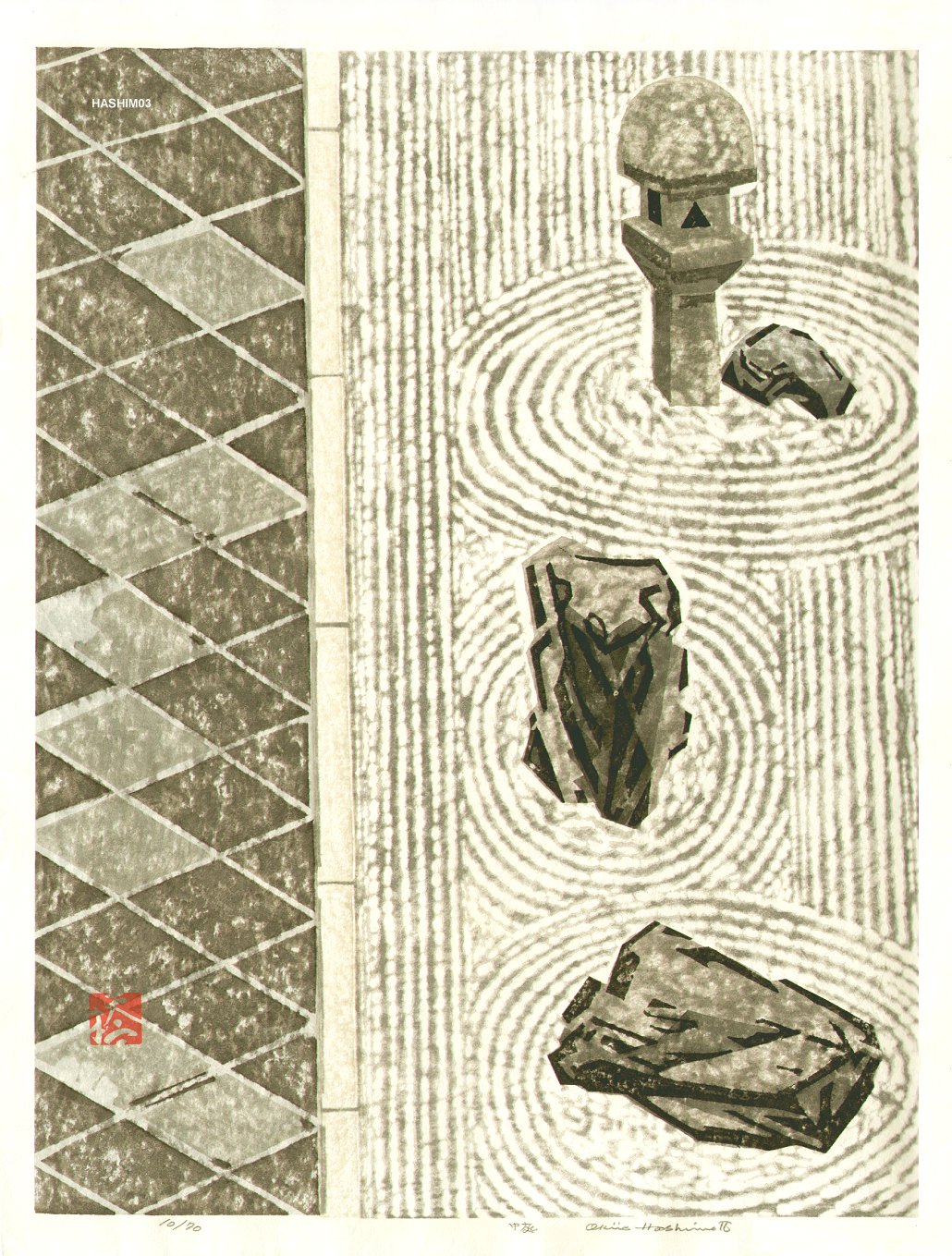
Rock garden
10/70, 1966
Woodblock print
Frequently Asked Questions
Hahakigi (from In the Garden of Genji) (帚木) was created by Hiroaki Miyayama (宮山 広明).
Hahakigi (from In the Garden of Genji) depicts gardens and literary.