
Biography
Hiroaki Miyayama (born 1955, Tokyo) is a Japanese intaglio printmaker whose long-running series 'In the Garden of Genji' has produced one of the most extensive contemporary visual responses to Murasaki Shikibu's eleventh-century Tale of Genji. Combining deep etching, aquatint, and gold leaf in compositions whose flat decorative grounds reference traditional Japanese painting, Miyayama has across more than three decades produced a substantial body of prints that translate the fifty-four chapters of the Genji into a distinct contemporary visual register.
Miyayama trained at the University of Tsukuba, where he completed his master's degree in 1979. From 1989 to 1990 he undertook a Japanese government Overseas Research Fellowship that took him to the United States and Belgium, an exchange that brought his practice into contact with European intaglio traditions and consolidated the direction of his subsequent print work. He maintains his studio practice at Print Studio Utsushi (版画工房うつし), the printmaking workshop that serves as his base.
His recognition came early. In 1985 he received the Minister of Education Award at the Republic of China International Print Biennial in Taipei, one of Asia's most prestigious print prizes. He has been a regular participant in the College Women's Association of Japan (CWAJ) Print Show in Tokyo since 1986, the annual showcase that has been a principal commercial channel for contemporary Japanese print since 1956. At the Small Print International New York biennial he was awarded honourable mention in 1990 and first prize in 1998. He was an invited artist at the Chamalières International Print Triennial in France in 1994 and took part in a Japanese–Chinese cultural-exchange print exhibition held in Taiwan in 2000.
The 'In the Garden of Genji' series reads each of the fifty-four chapters of Murasaki Shikibu's novel as a discrete print, working through the chapter sequence — Kiritsubo, Hahakigi, Utsusemi, Yugao, Wakamurasaki, Suetsumuhana, Momiji-no-ga, Hana-no-utage, and onward — and assigning each its own visual emblem. The chapter prints are produced in three principal techniques layered together: aquatint for the soft tonal middle ground, deep biting of the etched plate for a tactile printed surface, and the application of gold leaf in flat passages that echo both the gilded grounds of traditional Japanese painting and the contemporary decorative print tradition. Individual chapter sheets have circulated through CWAJ and through gallery channels in the United States as standalone works.
His In the Garden of Genji prints have been shown in the United States at Highfield Hall and Gardens in Falmouth, Massachusetts, as part of the 60th CWAJ exhibition of contemporary Japanese prints, presented under the title 'Kanreki: A 60 Year Journey.' Earlier in his career he held solo exhibitions in New Jersey (1989), Belgium (1990), and New York (1991). His work is represented by the Japanese gallery Galerie Shinkura and has reached audiences in the United States through CWAJ exhibitions; it is documented in the Hanganet Japanese prints knowledge base.
Miyayama's pictorial vocabulary draws together two strands of Japanese visual tradition that are typically kept separate. The decorative gold-leaf surfaces of traditional Japanese decorative painting and the formal flat composition of yamato-e are reread through the technical and conceptual armatures of contemporary intaglio — the etched plate, aquatint tonality, the editioned print, the printed-paper ground rather than silk or board. The result is a series that sits inside the contemporary Japanese intaglio tradition while opening it onto one of the foundational works of Japanese literature.
Key Facts
- Active Period
- 1955
- Nationality
- 🇯🇵Japan
- Movement
- Contemporary Mokuhanga
- Works Indexed
- 15
Frequently Asked Questions
Hiroaki Miyayama (born 1955, Tokyo) is a Japanese intaglio printmaker whose long-running series 'In the Garden of Genji' has produced one of the most extensive contemporary visual responses to Murasaki Shikibu's eleventh-century Tale of Genji. Combining deep etching, aquatint, and gold leaf in compositions whose flat decorative grounds reference traditional Japanese painting, Miyayama has across more than three decades produced a substantial body of prints that translate the fifty-four chapters of the Genji into a distinct contemporary visual register.
Hiroaki Miyayama was active born in 1955. They were associated with the Contemporary Mokuhanga movement.
Hiroaki Miyayama's work was shaped by the Contemporary Mokuhanga tradition in Japanese woodblock printmaking. Contemporary Mokuhanga: Contemporary mokuhanga (literally "wood-block print") encompasses artists working from approximately 1970 to the present who continue or reinvent traditional Japanese woodblock printing techniques.
Woodblock Prints by Hiroaki Miyayama (15)
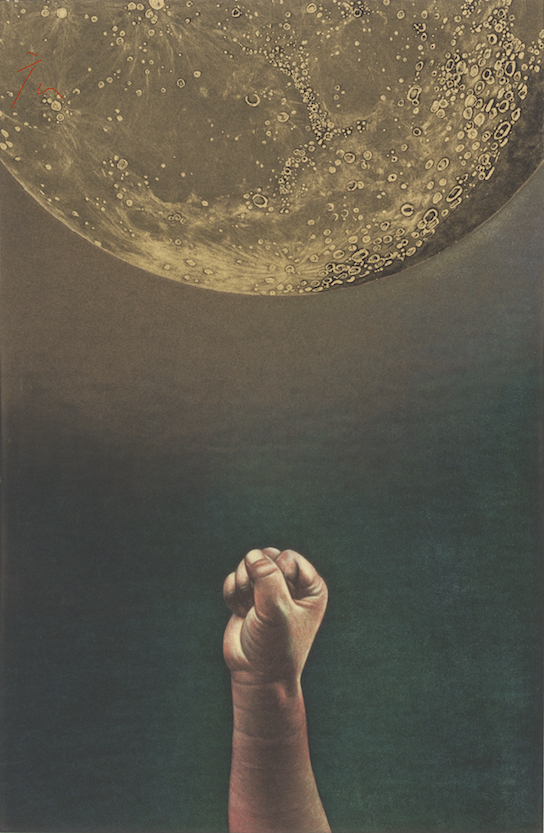
Kiritsubo (from In the Garden of Genji)
桐壺
Aquatint, deep etching, gold leaf

Hana-no-utage (from In the Garden of Genji)
花宴
Aquatint, deep etching, gold leaf

Sakaki (from In the Garden of Genji)
賢木
Aquatint, deep etching, gold leaf

Asagao (from In the Garden of Genji)
朝顔
Aquatint, deep etching, gold leaf

Eawase (from In the Garden of Genji)
絵合
Aquatint, deep etching, gold leaf
Akashi (from In the Garden of Genji)
明石
Aquatint, deep etching, gold leaf

Hotaru (from In the Garden of Genji)
蛍
Aquatint, deep etching, gold leaf

Hahakigi (from In the Garden of Genji)
帚木
Aquatint, deep etching, gold leaf

Utsusemi (from In the Garden of Genji)
空蝉
Aquatint, deep etching, gold leaf

Fujitsubo (from In the Garden of Genji)
藤壺
Aquatint, deep etching, gold leaf

Suetsumuhana (from In the Garden of Genji)
末摘花
Aquatint, deep etching, gold leaf

Momiji-no-ga (from In the Garden of Genji)
紅葉賀
Aquatint, deep etching, gold leaf

Hana-chiru-sato (from In the Garden of Genji)
花散里
Aquatint, deep etching, gold leaf

Yomogiu (from In the Garden of Genji)
蓬生
Aquatint, deep etching, gold leaf

Sekiya (from In the Garden of Genji)
関屋
Aquatint, deep etching, gold leaf