
Stone garden of Ryoan-ji Temple
- Medium:
- Mokuhanga (Japanese woodblock)
- Image courtesy of
- Saru Gallery
Description
The subject is the karesansui (dry landscape) garden at Ryōan-ji in northwestern Kyoto, whose fifteen rocks are arranged in five groupings on a rectangular bed of raked white gravel enclosed by an earthen wall. Translating this composition into mokuhanga presents a particular challenge: the print must register the parallel raked lines of the gravel and the rounded mass of each stone using a limited number of blocks. The contrast typically depends on a key block for the rock outlines and tonal blocks of grey or pale beige for the gravel field, with bokashi gradations sometimes used along the wall to suggest weathered plaster and tile. As one of the most reproduced Zen subjects in postwar Japanese printmaking, Ryōan-ji recurs across the work of many sōsaku-hanga artists; Nakagawa Isaku's treatment fits a broader twentieth-century tendency to render famous temple sites with restrained palettes and emphasis on flat planar geometry.
More Prints by Nakagawa Isaku


More Temples & Shrines Prints

Fushimi Inari Temple
伏見稲荷
Woodblock print

The Compound of the Tenman Shrine at Kameido in the Snow (Kameido Tenmangu keidai no yuki), from the series "Famous Places in the Eastern Capital (Toto meisho)"
c. 1832/38
Color woodblock print; oban
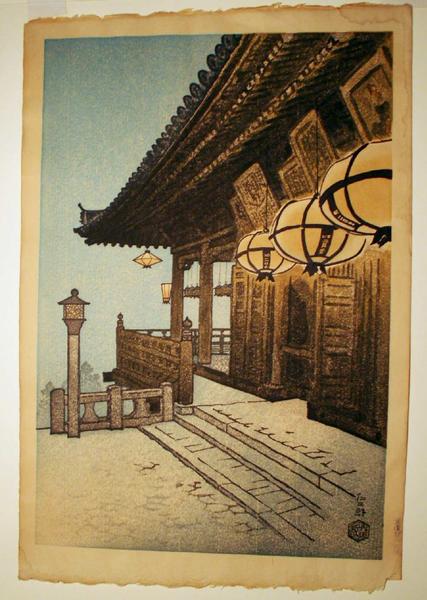
Temple with lanterns
Woodblock print

A Section of the Byodo Temple at Uji (Uji Byodoin no ichibu), from the series "Souvenirs of Travel, Second Series (Tabi miyage dai nishu)"
Uji Byodoin no ichibu
1921
Color woodblock print; oban
Featured in Collections
Curated cross-cuts that include this print.
Frequently Asked Questions
Stone garden of Ryoan-ji Temple was created by Nakagawa Isaku (中川伊作).
Stone garden of Ryoan-ji Temple depicts temples & shrines and gardens.