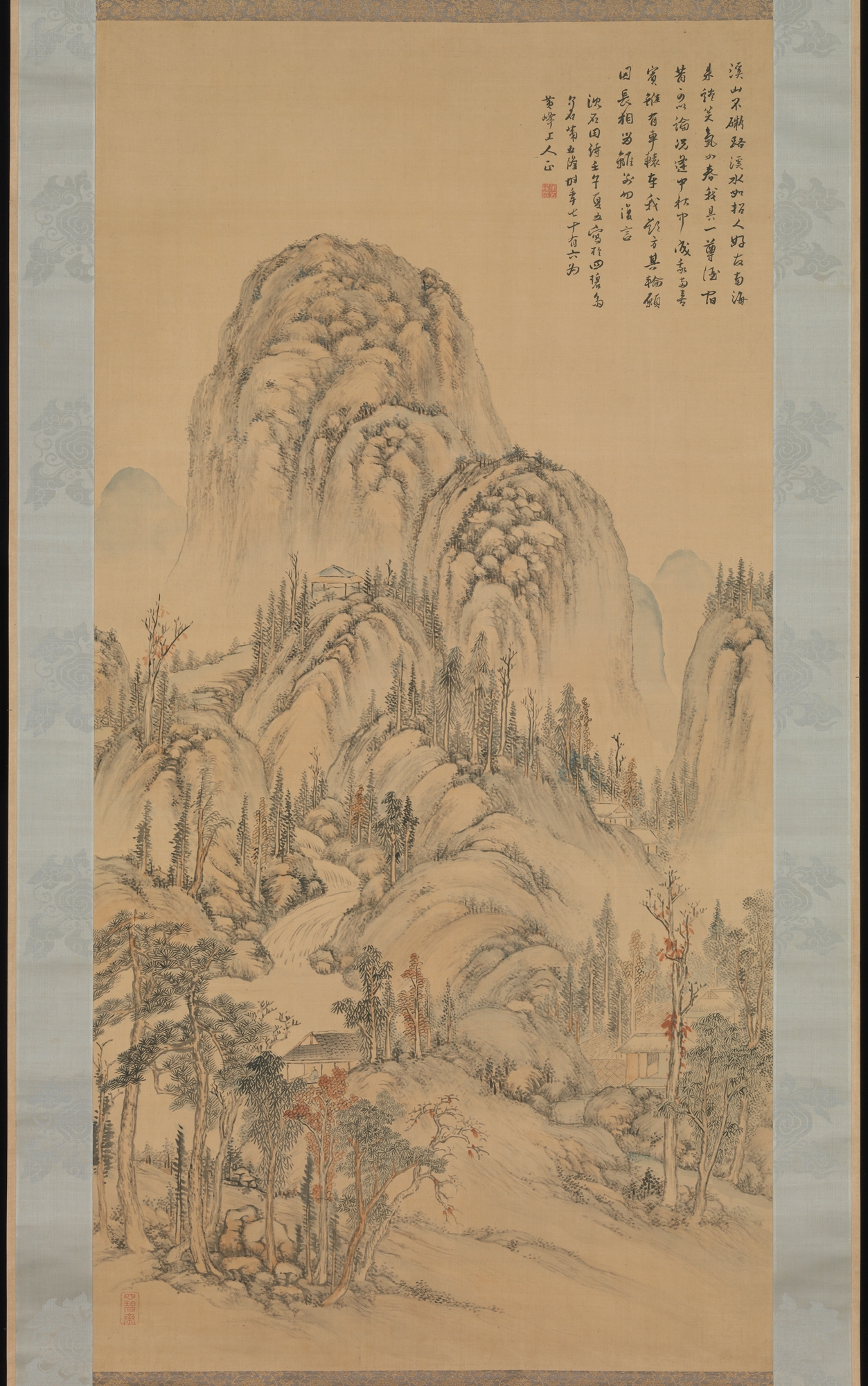
Meeting with a Friend on an Autumn Day
by Noro Kaiseki
- Date:
- 1822
- Medium:
- Hanging scroll; ink and color on silk
- Source:
- Metropolitan Museum of Art
Description
Meeting with a Friend on an Autumn Day, dated 1822, is a hanging-scroll painting by Noro Kaiseki (野呂介石, 1747-1828), held by the Metropolitan Museum of Art (accession recorded at https://www.metmuseum.org/art/collection/search/45393). The subject of meeting a friend amid autumn mountains — usually two scholar-figures encountering one another on a path, or a small figure climbing toward a distant pavilion where a friend awaits — is among the most canonical themes of the Chinese literati tradition. It is drawn from the poetic culture of Tao Yuanming, Wang Wei, and the broader Tang and Song scholar-recluse repertoire that Edo bunjin painters absorbed through imported Ming and Qing scrolls and woodblock-printed Chinese painting manuals. The theme carries the long association of cultivated friendship that the Chinese literati ideal placed at the center of scholarly existence: the painted meeting between cultivated companions is at once an image of a particular encounter and a figure for the larger bonds of shared learning, brushwork, and poetic exchange that constituted the bunjin form of life. As a Kii-province literati painter who had absorbed the lineage of Ike no Taiga (1723-1776) and worked at the formation of the Kansai nanga tradition, Kaiseki was the near-contemporary of Okada Beisanjin (1744-1820) and a senior figure of the first mature bunjinga generation. The 1822 date places the painting in his late seventies, six years before his death. The autumnal palette, the small scholar-figures, the implied seasonal cool, and the layered recession of peaks together compose an image whose meaning lies in its accord with a cultivated literati sensibility — and whose handling, in his characteristically personal nanga brush, carries the rhythm of the cultivated amateur's hand over academic finish.
More Prints by Noro Kaiseki
More Autumn Foliage Prints

A Farmhouse in Autumn, Ayashi, Miyagi Prefecture (Noka no aki (Miyagi ken Ayashi)
Noka no aki (Miyagi ken Ayashi
1946
Color woodblock print
Yoro Waterfall in Mino Province (Mino no kuni Yoro no taki), from the series Tour of the Waterfalls in Various Provinces (Shokoku Takimeguri)
Woodblock print

Tengui Rock, Autumn in Shiobara (Shiobara no aki (Tenguiwa))
1950
Color woodblock print

Autumn at the Arayu Hot Spring, Shiobara
Autumn 1920
Woodblock print, ink and color on paper
Frequently Asked Questions
Meeting with a Friend on an Autumn Day was created by Noro Kaiseki (野呂介石) in 1822.
Meeting with a Friend on an Autumn Day depicts autumn foliage.