
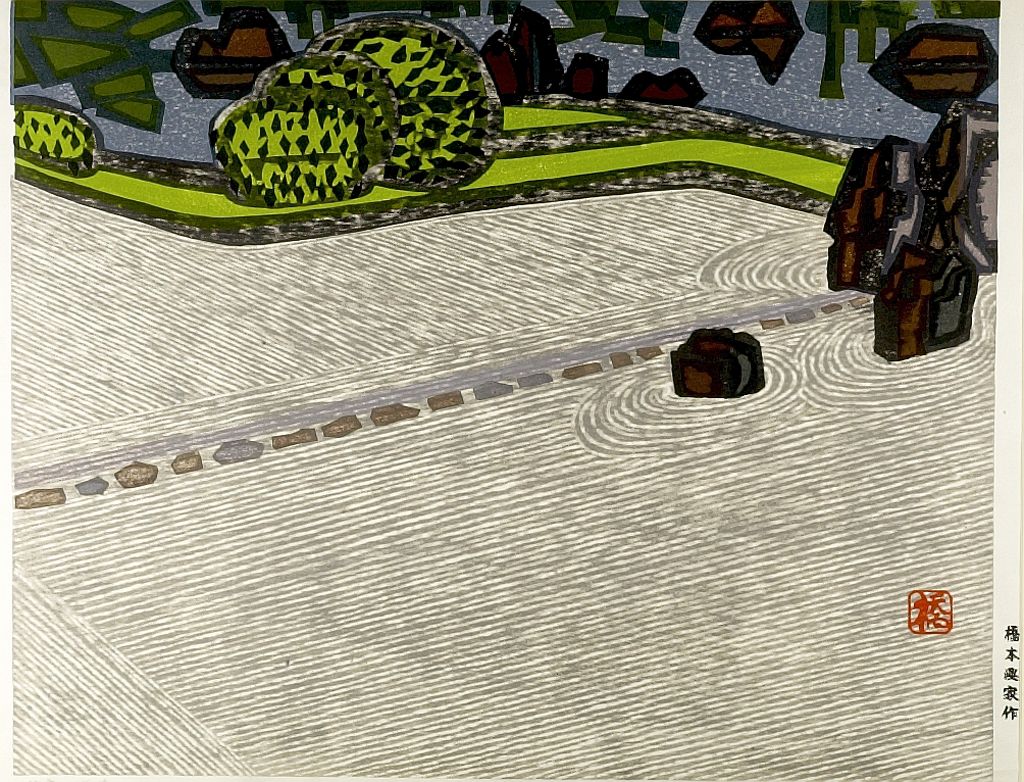
Kōgetsudai Sand Garden
- Date:
- 1961
- Medium:
- Woodblock print, ink and color on paper
- Dimensions:
- 60.6 × 49.7 cm
- Edition:
- Self-printed
- Source:
- Minneapolis Institute of Art
Description
The Kōgetsudai — the "viewing moon platform" — is the distinctive cone-shaped sand mound in the garden of Kinkaku-ji (the Silver Pavilion) in Kyoto, created to reflect moonlight and provide a geometric counterpoint to the raked sand garden surrounding it. Hashimoto's 1961 rendering focuses on this extraordinary landscape element, whose precise geometric form — a perfect cone rising from the flat gravel field — must have appealed enormously to an artist committed to discovering structure in the traditional Japanese aesthetic environment.
More Prints by Okiie Hashimoto

More Gardens Prints
![[Garden of] Taj Mahal, No. 1 (Taji Maharu no niwa, dai ichi) by Hiroshi Yoshida](https://www.artic.edu/iiif/2/230993a7-d4f0-c979-c267-127d48e1ef1c/full/843,/0/default.jpg)
[Garden of] Taj Mahal, No. 1 (Taji Maharu no niwa, dai ichi)
Taji Maharu no niwa, dai ichi
1931
Color woodblock print; oban

Kiyozumi Garden in Moonlight
January 1938
Woodblock print, ink and color on paper

Moon over Kiyosumi Garden (Tsuki no Kiyosumien)
1938
Color woodblock print; oban
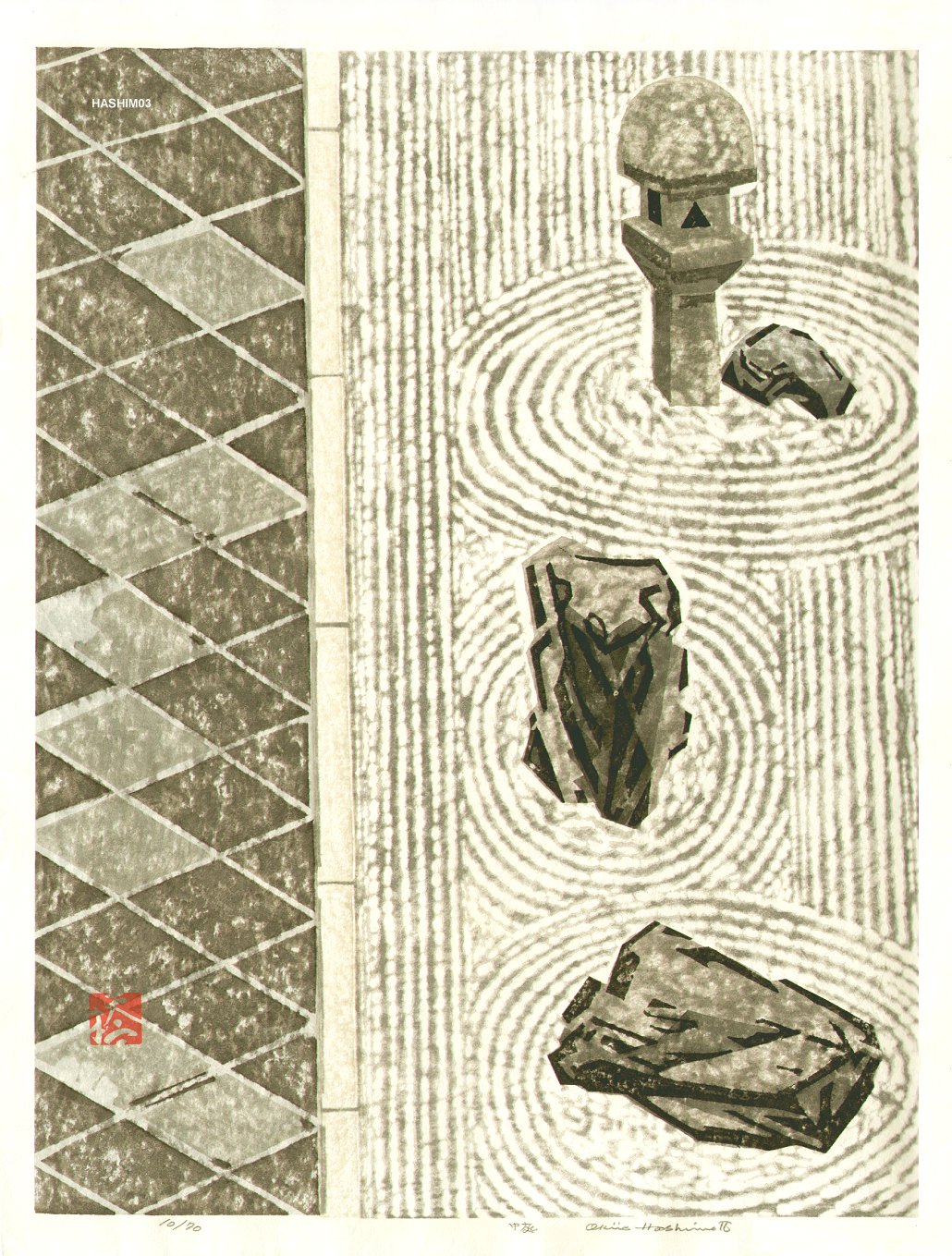
Rock garden
10/70, 1966
Woodblock print
Featured in Collections
Curated cross-cuts that include this print.
Frequently Asked Questions
Kōgetsudai Sand Garden was created by Okiie Hashimoto (橋本興家) in 1961.
Kōgetsudai Sand Garden depicts gardens.
Kōgetsudai Sand Garden measures 60.6 × 49.7 cm.