
Back entrance gate to the garden
- Medium:
- Mokuhanga (Japanese woodblock)
- Image courtesy of
- Saru Gallery
Description
Where the formal main gate (omote-mon) of a Japanese garden announces ceremony, the back entrance (ura-mon) is a working passage — humbler in scale, often roofed with simple shingles or thatched cedar bark, set into a hedge or earthen wall. Hashimoto's interest in such service architecture is consistent with the sosaku-hanga generation's broader turn toward vernacular subjects, away from the famous-place tradition of ukiyo-e meisho-e. The print likely emphasizes the gate's relationship to surrounding plantings — bamboo, moss, perhaps a stone path — through Hashimoto's characteristic flat color planes and incised keylines. Working as both designer and craftsman within the creative-print movement, he carved each block and pulled each impression himself, applying pigment to washi with a baren. The subject extends his lifelong inquiry into how built structures register human use of landscape, distinguishing him from contemporaries focused on figures or pure landscape.
More Prints by Okiie Hashimoto

More Gardens Prints
![[Garden of] Taj Mahal, No. 1 (Taji Maharu no niwa, dai ichi) by Hiroshi Yoshida](https://www.artic.edu/iiif/2/230993a7-d4f0-c979-c267-127d48e1ef1c/full/843,/0/default.jpg)
[Garden of] Taj Mahal, No. 1 (Taji Maharu no niwa, dai ichi)
Taji Maharu no niwa, dai ichi
1931
Color woodblock print; oban

Kiyozumi Garden in Moonlight
January 1938
Woodblock print, ink and color on paper

Moon over Kiyosumi Garden (Tsuki no Kiyosumien)
1938
Color woodblock print; oban
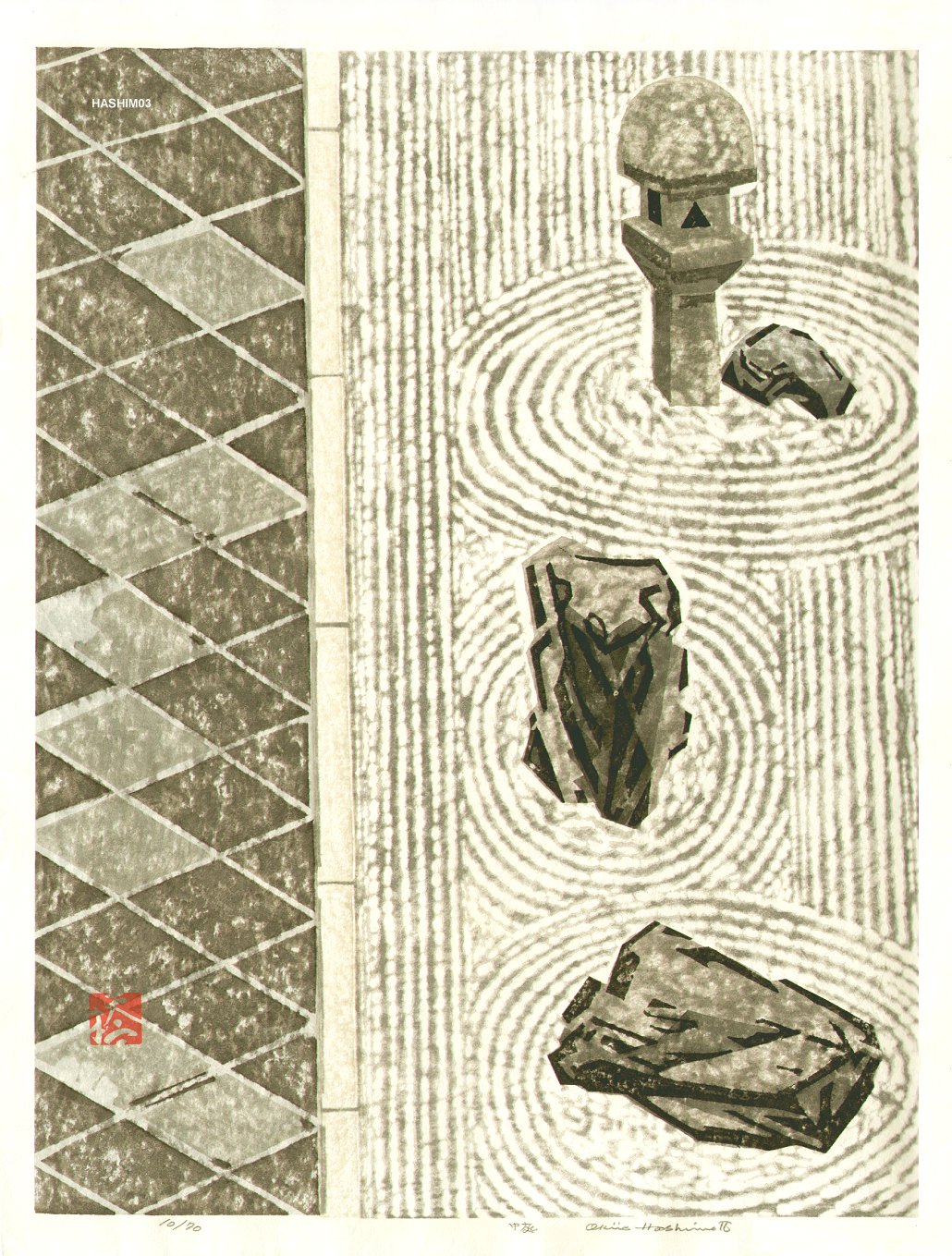
Rock garden
10/70, 1966
Woodblock print
Featured in Collections
Curated cross-cuts that include this print.
Frequently Asked Questions
Back entrance gate to the garden was created by Okiie Hashimoto (橋本興家).
Back entrance gate to the garden depicts gardens.