
Castle (Nagoya Castle)
- Medium:
- Mokuhanga (Japanese woodblock)
- Image courtesy of
- Saru Gallery
Description
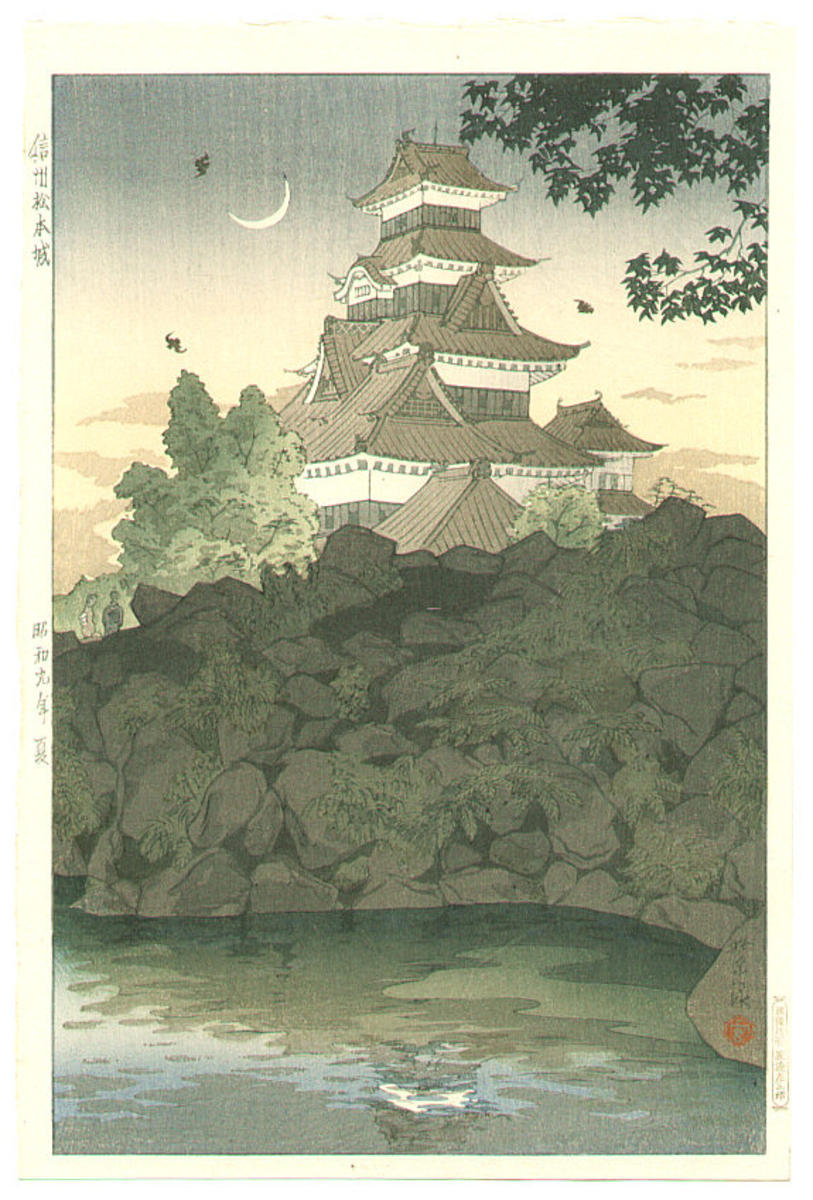
Nagoya Castle, completed in 1612 under Tokugawa Ieyasu and reconstructed after wartime destruction, is identified by the gilded shachihoko — mythical fish-tiger ornaments crowning its main keep. Hashimoto's castle prints survey major surviving and reconstructed Japanese castles, and Nagoya offers a clear architectural subject: a five-story donjon with prominent green-tiled roofs and the golden shachihoko at the apex. The print isolates the keep against sky, exploiting the sosaku-hanga preference for broad, flat color planes and visible woodgrain in background areas. Hashimoto's carving renders the multi-tiered roof gables (chidori-hafu and karahafu) and the mortise-and-tenon framing of windows. Because he carved and printed every block himself, the prints carry the tool marks of his hand directly, a sosaku-hanga value that distinguished his work from the ukiyo-e division of labor among publisher, designer, carver, and printer. The Nagoya print sits within his survey of major castles that defines a central thread in his architectural output.
More Prints by Okiie Hashimoto

More Castles Prints


Featured in Collections
Curated cross-cuts that include this print.
Frequently Asked Questions
Castle (Nagoya Castle) was created by Okiie Hashimoto (橋本興家).
Castle (Nagoya Castle) depicts castles.