
Castle: Nagoya Castle
- Medium:
- Mokuhanga (Japanese woodblock)
- Image courtesy of
- Saru Gallery
Description
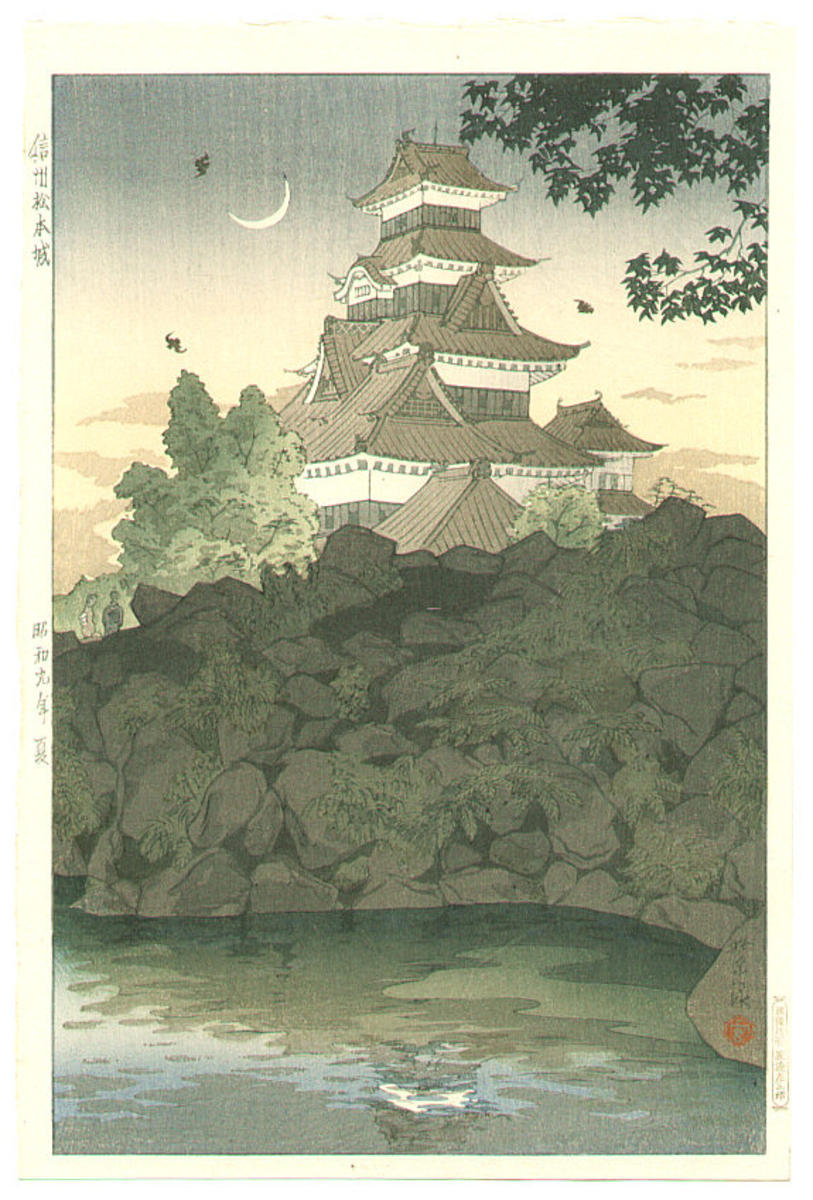
Nagoya Castle, with its distinctive five-story tenshu and the gilded shachihoko finials at its roof ridges, was a recurring subject for Hashimoto, who made castles a central preoccupation across his postwar career. The original keep burned in the 1945 firebombing and was rebuilt in concrete in 1959, a reconstruction Hashimoto and his contemporaries documented as much as recorded. The print likely isolates the donjon against a flat sky, with the tiered roofs reduced to a stack of dark, carved planes — an approach that suits the sosaku-hanga method of building an image from a small number of self-cut blocks. Hashimoto's castle prints emphasize stone base, white plaster wall, and dark tile in clear horizontal registers, with woodgrain often left visible in the broad sky or stonework. The numeric suffix in the slug indicates a variant or later state in the artist's series of architectural studies, of which Himeji, Matsumoto, and Nagoya are the most frequently revisited subjects.
More Prints by Okiie Hashimoto

More Castles Prints


Featured in Collections
Curated cross-cuts that include this print.
Frequently Asked Questions
Castle: Nagoya Castle was created by Okiie Hashimoto (橋本興家).
Castle: Nagoya Castle depicts castles.