
Ginkaku-ji garden
- Medium:
- Mokuhanga (Japanese woodblock)
- Image courtesy of
- Saru Gallery
Description
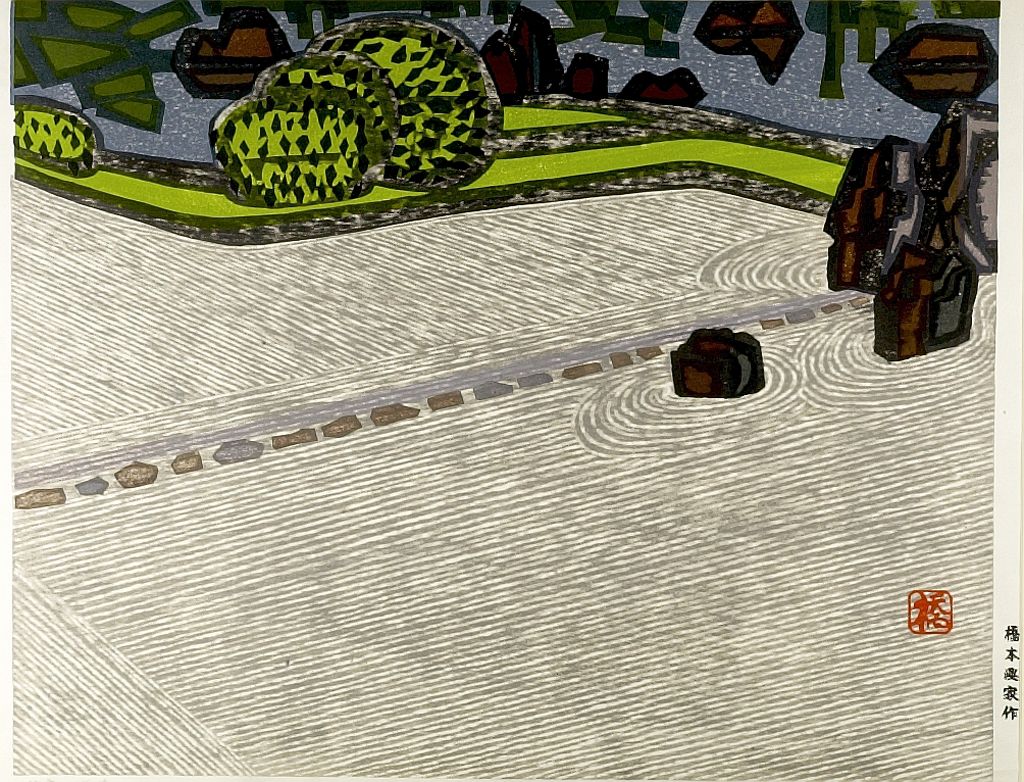
Ginkaku-ji, the Temple of the Silver Pavilion, occupies the eastern Higashiyama foothills of Kyoto and was originally built in 1482 as the retirement villa of the shogun Ashikaga Yoshimasa. Its garden is known for two features: the kōgetsudai cone of raked white sand and the ginshadan expanse of raked sand beside it, both designed to catch moonlight. Hashimoto's print likely takes one of these dry-landscape elements as its compositional anchor, set against the dark mass of moss-covered ground or the silhouette of the Kannon-den pavilion. Representing raked sand in mokuhanga is a printerly problem — fine parallel lines that risk overwhelming the image — and Hashimoto's typical solution is a key block of carved striations printed lightly so the pattern reads as texture rather than drawing. The subject sits within his architectural-garden body of work alongside his Daitoku-ji and Tenryū-ji prints, all of which engage the karesansui tradition that came to define Kyoto's visual identity in the postwar decades.
More Prints by Okiie Hashimoto

More Gardens Prints
![[Garden of] Taj Mahal, No. 1 (Taji Maharu no niwa, dai ichi) by Hiroshi Yoshida](https://www.artic.edu/iiif/2/230993a7-d4f0-c979-c267-127d48e1ef1c/full/843,/0/default.jpg)
[Garden of] Taj Mahal, No. 1 (Taji Maharu no niwa, dai ichi)
Taji Maharu no niwa, dai ichi
1931
Color woodblock print; oban

Kiyozumi Garden in Moonlight
January 1938
Woodblock print, ink and color on paper

Moon over Kiyosumi Garden (Tsuki no Kiyosumien)
1938
Color woodblock print; oban
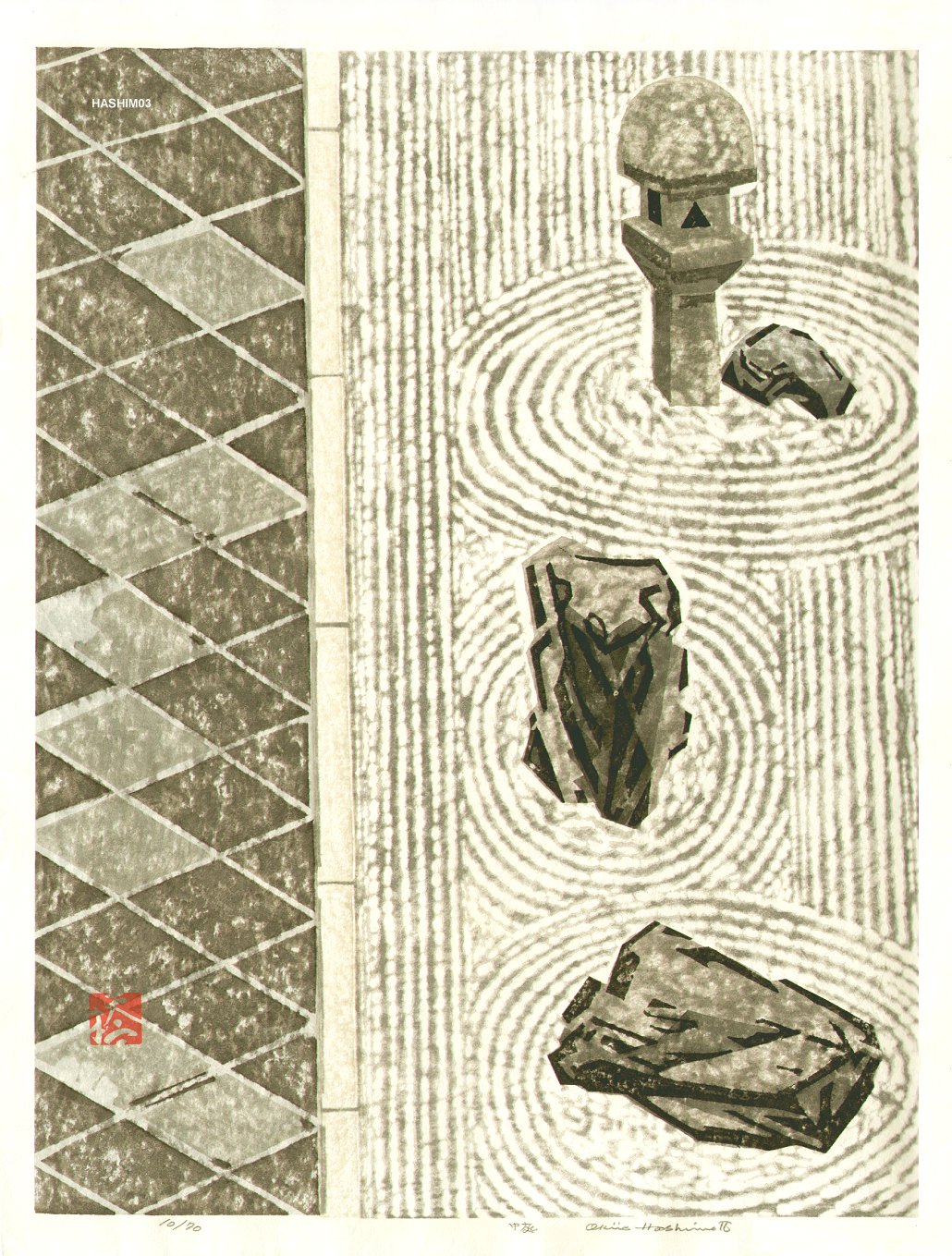
Rock garden
10/70, 1966
Woodblock print
Featured in Collections
Curated cross-cuts that include this print.
Frequently Asked Questions
Ginkaku-ji garden was created by Okiie Hashimoto (橋本興家).
Ginkaku-ji garden depicts gardens.