
Stone garden
- Medium:
- Mokuhanga (Japanese woodblock)
- Image courtesy of
- Saru Gallery
Description
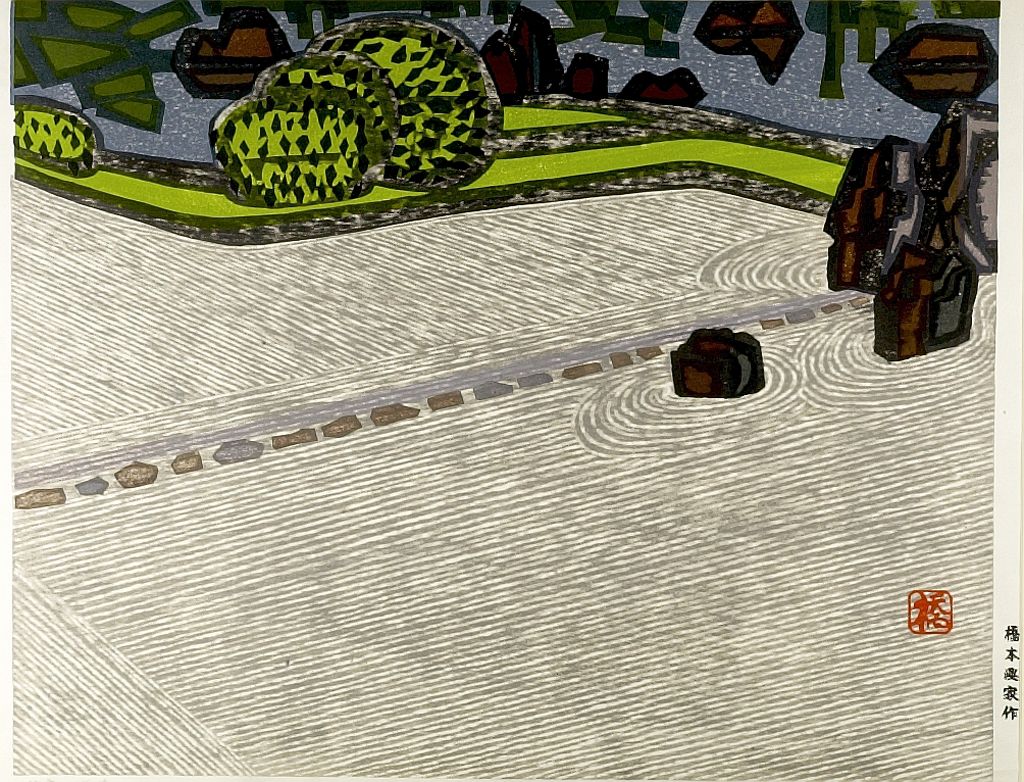
Karesansui — the Japanese dry landscape garden composed of raked gravel and placed stones — presents an abstractly formal subject for mokuhanga. Hashimoto's print likely depicts a Zen temple enclosure where the primary compositional elements are the geometry of the raked gravel field, the irregular silhouettes of grouped stones, and an enclosing earthen or tile-capped wall. The near-monochromatic palette of grays, tans, and the warm tone of washi paper demands precise block printing: flat tonal areas for the gravel with incised lines indicating the raking patterns, the stones built up through careful overprinting to suggest weathered surface texture. This subject suits Hashimoto's preference for architecturally structured environments; the karesansui garden is itself a designed composition of calculated geometric order, governed by spatial proportion and deliberate placement. Within the sosaku-hanga tradition, abstract architectural subjects like dry gardens allowed artists to pursue formal reduction while remaining grounded in observed, real sites.
More Prints by Okiie Hashimoto

More Gardens Prints
![[Garden of] Taj Mahal, No. 1 (Taji Maharu no niwa, dai ichi) by Hiroshi Yoshida](https://www.artic.edu/iiif/2/230993a7-d4f0-c979-c267-127d48e1ef1c/full/843,/0/default.jpg)
[Garden of] Taj Mahal, No. 1 (Taji Maharu no niwa, dai ichi)
Taji Maharu no niwa, dai ichi
1931
Color woodblock print; oban

Kiyozumi Garden in Moonlight
January 1938
Woodblock print, ink and color on paper

Moon over Kiyosumi Garden (Tsuki no Kiyosumien)
1938
Color woodblock print; oban
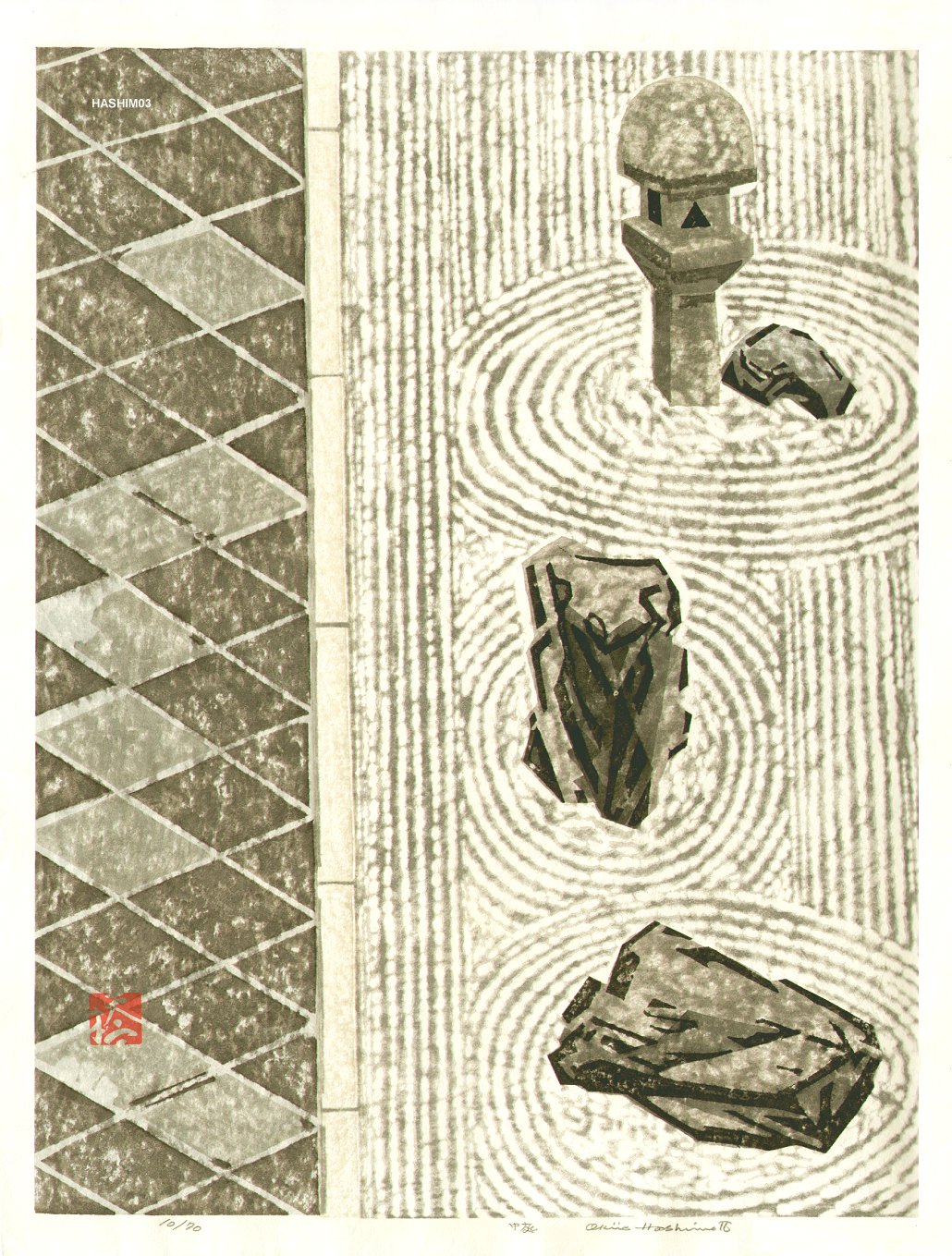
Rock garden
10/70, 1966
Woodblock print
Featured in Collections
Curated cross-cuts that include this print.
Frequently Asked Questions
Stone garden was created by Okiie Hashimoto (橋本興家).
Stone garden depicts gardens.