
Stone garden
- Medium:
- Mokuhanga (Japanese woodblock)
- Image courtesy of
- Saru Gallery
Description
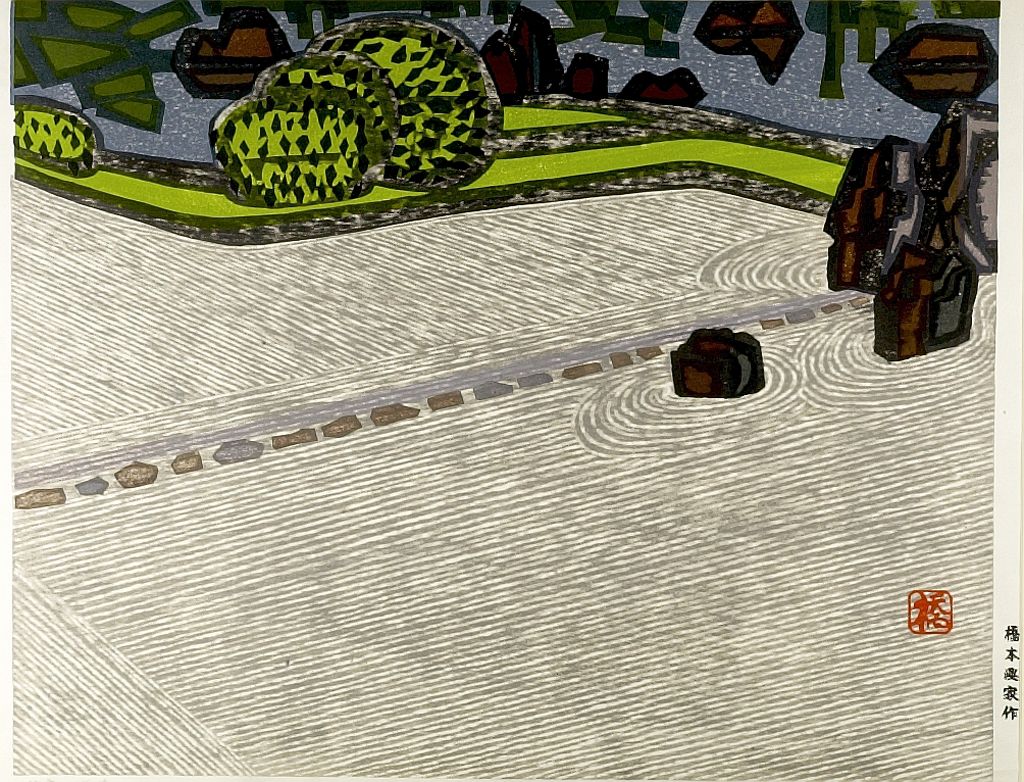
A study of a karesansui — the dry-landscape gardens of raked gravel and standing stones associated with Zen temples such as Ryōan-ji and Daitoku-ji in Kyoto. Hashimoto returned repeatedly to these gardens, finding in their reduced vocabulary of stone, gravel, and bounding wall a subject perfectly matched to the limited block count of sosaku-hanga. The composition typically presents the garden in a high oblique view, the raked gravel rendered as parallel carved lines that exploit the directional grain of the woodblock, with stones massed asymmetrically against the long horizontal of an earthen wall. Color is restrained — ivory or buff for the gravel, charcoal for the stones, with subtle bokashi at the wall's base. The numeric variant suggests a reworked block or alternate impression. Within Hashimoto's output, the stone garden prints stand alongside his castles and temples as architectural subjects in the broadest sense: human-arranged structure, treated with the same structural and abstracting eye.
More Prints by Okiie Hashimoto

More Gardens Prints
![[Garden of] Taj Mahal, No. 1 (Taji Maharu no niwa, dai ichi) by Hiroshi Yoshida](https://www.artic.edu/iiif/2/230993a7-d4f0-c979-c267-127d48e1ef1c/full/843,/0/default.jpg)
[Garden of] Taj Mahal, No. 1 (Taji Maharu no niwa, dai ichi)
Taji Maharu no niwa, dai ichi
1931
Color woodblock print; oban

Kiyozumi Garden in Moonlight
January 1938
Woodblock print, ink and color on paper

Moon over Kiyosumi Garden (Tsuki no Kiyosumien)
1938
Color woodblock print; oban
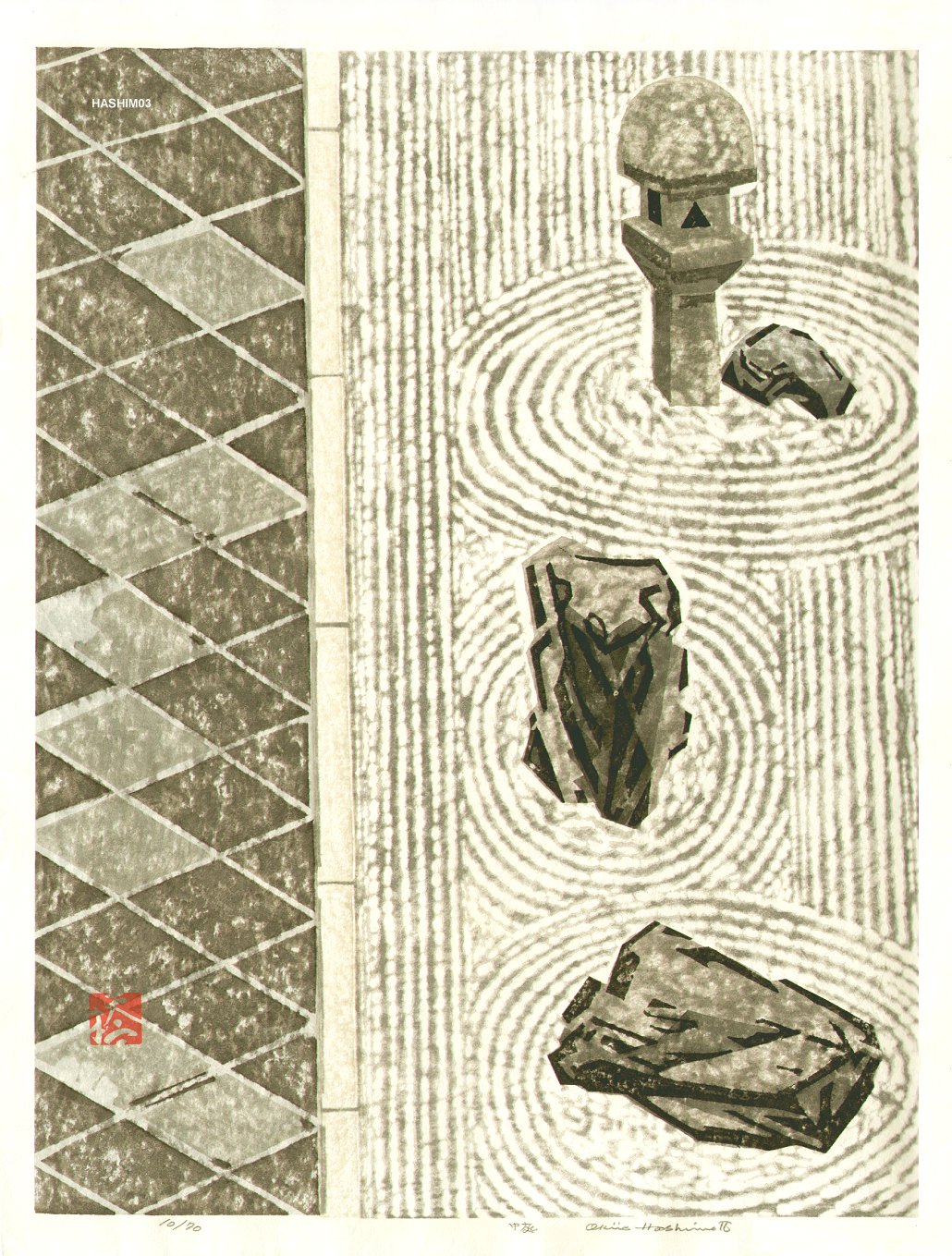
Rock garden
10/70, 1966
Woodblock print
Featured in Collections
Curated cross-cuts that include this print.
Frequently Asked Questions
Stone garden was created by Okiie Hashimoto (橋本興家).
Stone garden depicts gardens.