
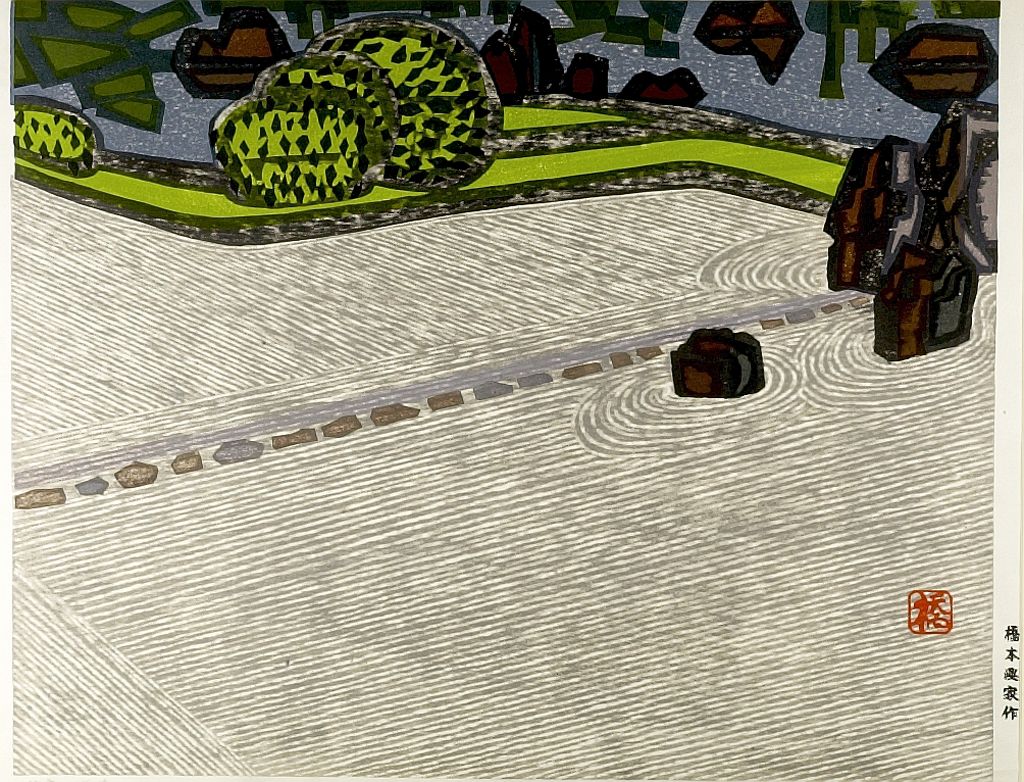
Stone garden
- Medium:
- Mokuhanga (Japanese woodblock)
- Image courtesy of
- Saru Gallery
Description
The numerical suffix marks this as the third in Hashimoto's stone garden series, his sustained engagement with the karesansui dry landscape gardens of Kyoto temples -- Ryoan-ji being the most famous example, though he also depicted gardens at Daitoku-ji and other Zen complexes. The print likely renders raked gravel as broad flat fields, punctuated by the dark masses of standing stones and the dark line of a clay-and-tile wall behind. Such compositions reduce the garden to a near-abstract arrangement of horizontal bands and isolated forms, a subject well-suited to the sosaku-hanga emphasis on personal expression through simplified design. Bokashi would soften the gravel field and articulate the wall's tile coping, while the keyblock supplies the firm contour of stones and architectural framing. Hashimoto's stone garden series, alongside his castles, became among his most collected works internationally during the 1960s and 1970s, valued by Western audiences as accessible expressions of Zen aesthetic principles.
More Prints by Okiie Hashimoto

More Gardens Prints
![[Garden of] Taj Mahal, No. 1 (Taji Maharu no niwa, dai ichi) by Hiroshi Yoshida](https://www.artic.edu/iiif/2/230993a7-d4f0-c979-c267-127d48e1ef1c/full/843,/0/default.jpg)
[Garden of] Taj Mahal, No. 1 (Taji Maharu no niwa, dai ichi)
Taji Maharu no niwa, dai ichi
1931
Color woodblock print; oban

Kiyozumi Garden in Moonlight
January 1938
Woodblock print, ink and color on paper

Moon over Kiyosumi Garden (Tsuki no Kiyosumien)
1938
Color woodblock print; oban
Rock garden
10/70, 1966
Woodblock print
Featured in Collections
Curated cross-cuts that include this print.
Frequently Asked Questions
Stone garden was created by Okiie Hashimoto (橋本興家).
Stone garden depicts gardens.