
Stone garden No. 3: Ryôan-ji
- Medium:
- Mokuhanga (Japanese woodblock)
- Image courtesy of
- Saru Gallery
Description
Ryoan-ji's karesansui (dry rock garden) in northwest Kyoto—fifteen weathered stones arranged in raked gravel within a rectangular enclosure—is among the most studied subjects in Japanese landscape art. Hashimoto produced multiple prints of the garden, with the 'No. 3' designation identifying this as part of a sustained series exploring viewpoint, season, and time of day. The composition challenges a printmaker because so much of its content is empty raked gravel, a flat field that must be carried by the texture of paper and ink alone. Hashimoto typically registered the gravel as a single broad block, using subtle bokashi to suggest swept patterns, while the stones and the surrounding earthen wall (tsuiji-bei) anchor the design with carved outlines. The print sits within his broader engagement with temple and garden architecture, and connects the sosaku-hanga movement to the postwar interest in Zen aesthetics that drew both Japanese and Western collectors.
More Prints by Okiie Hashimoto

More Gardens Prints
![[Garden of] Taj Mahal, No. 1 (Taji Maharu no niwa, dai ichi) by Hiroshi Yoshida](https://www.artic.edu/iiif/2/230993a7-d4f0-c979-c267-127d48e1ef1c/full/843,/0/default.jpg)
[Garden of] Taj Mahal, No. 1 (Taji Maharu no niwa, dai ichi)
Taji Maharu no niwa, dai ichi
1931
Color woodblock print; oban

Kiyozumi Garden in Moonlight
January 1938
Woodblock print, ink and color on paper

Moon over Kiyosumi Garden (Tsuki no Kiyosumien)
1938
Color woodblock print; oban
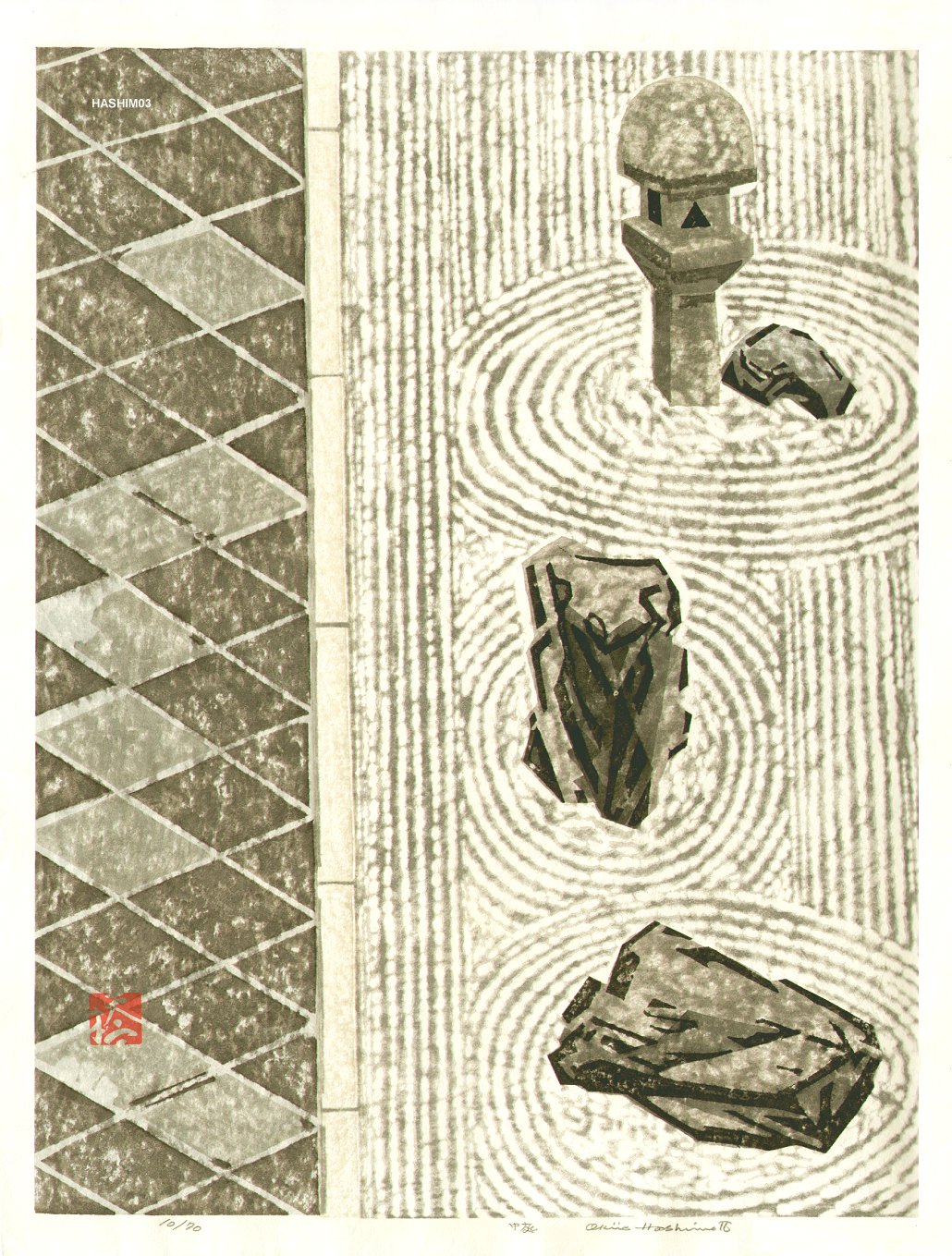
Rock garden
10/70, 1966
Woodblock print
Featured in Collections
Curated cross-cuts that include this print.
Frequently Asked Questions
Stone garden No. 3: Ryôan-ji was created by Okiie Hashimoto (橋本興家).
Stone garden No. 3: Ryôan-ji depicts gardens.