
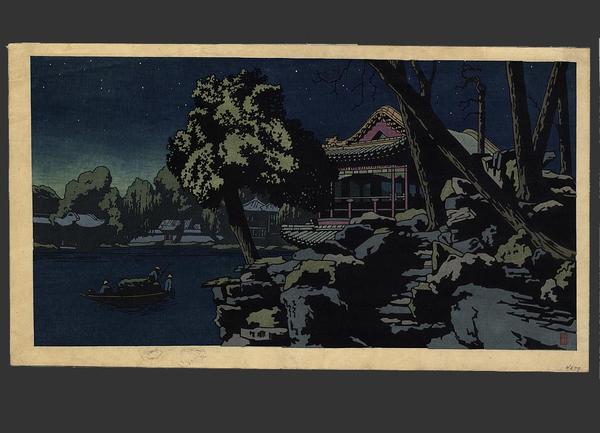
Side View of the US Embassy in Japan
- Source:
- ukiyo-e.org
Description
Side View of the US Embassy in Japan by Pieter Irwin Brown turns the shin-hanga eye toward an unusual urban subject: a foreign diplomatic compound in Tokyo. Brown, a Dutch artist born in 1903 who settled in Japan during the 1930s, was among the small group of Western practitioners who worked within the shin-hanga movement, producing Tokyo views and broader Asian landscapes in collaboration with Japanese carvers and printers. The U.S. Embassy compound, located in the Akasaka district, occupied a prominent site in the capital and was a fixture of foreign life in interwar Tokyo. By choosing this subject, Brown documented a piece of the city that his Japanese shin-hanga colleagues rarely depicted, applying the movement's atmospheric realism and careful attention to light and architecture to a building most associated with the expatriate community. The side view perspective avoids the postcard formality of a frontal portrait and instead emphasizes the embassy's setting among surrounding trees and walls, producing an image that reads as much as a Tokyo cityscape as an architectural record. Brown's Dutch background informed his interest in this kind of cross-cultural urban subject, and the print sits within his broader project of interpreting Tokyo for both Japanese and Western audiences. The work was produced through the standard shin-hanga collaborative process, with Brown providing the design and Japanese craftsmen executing the multi-block color woodblock. Documented on ukiyo-e.org, the print survives as a rare visual record of the embassy compound from the period and as an example of how Dutch shin-hanga widened the movement's subject matter to include the diplomatic and international fabric of Tokyo itself.
More Prints by Pieter Irwin Brown


Featured in Collections
Curated cross-cuts that include this print.
Frequently Asked Questions
Side View of the US Embassy in Japan was created by Pieter Irwin Brown.