
Village deep in snow
by Sano Seiji
- Medium:
- Mokuhanga (Japanese woodblock)
- Image courtesy of
- Saru Gallery
Description
The title indicates a rural settlement enveloped in winter snowfall, a long-standing subject in Japanese landscape printmaking from Edo-period meisho-e through the twentieth-century shin-hanga and sosaku-hanga revivals. Snow scenes in mokuhanga commonly rely on the unprinted ground of the washi to carry the brightness of accumulated snow on rooftops, branches, and pathways, with the surrounding palette restricted to muted greys, browns, and indigos so the white reads with full luminosity. Carved registration on tile-roof outlines and timber framing typically becomes visible only at the edges of snow-laden surfaces, while bokashi gradients are often used in the sky and along distant ridgelines to suggest cold, low light or falling snow. Within Sano Seiji's documented body of work, village scenes recur as a subject category, and the inclusion of this print within that grouping places it alongside other compositions concerned with rural Japanese architecture and seasonal change rather than the urban or theatrical genres associated with earlier ukiyo-e production.
More Prints by Sano Seiji

More Snow Scenes Prints
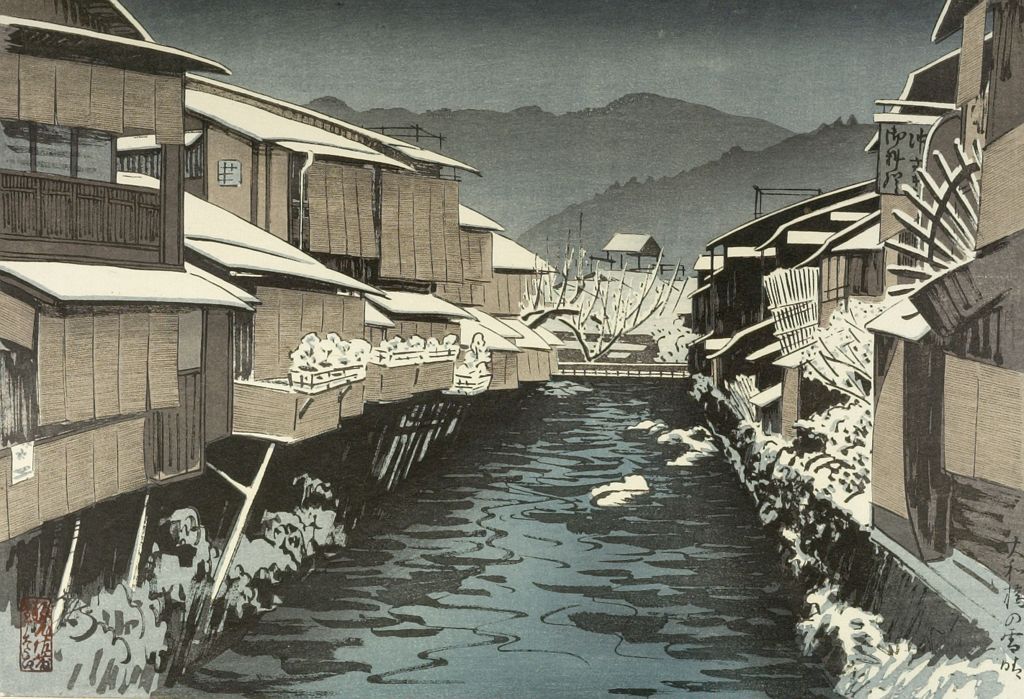
Fair Weather After Snow at Yamato Bridge, Kyoto (Yamato bashi no yukibare), Taishô period, dated 1924
Woodblock print

The Compound of the Tenman Shrine at Kameido in the Snow (Kameido Tenmangu keidai no yuki), from the series "Famous Places in the Eastern Capital (Toto meisho)"
c. 1832/38
Color woodblock print; oban

Miyajima in Snow (Yuki no Miyajima)
Yuki no Miyajima
1929
Color woodblock print; oban
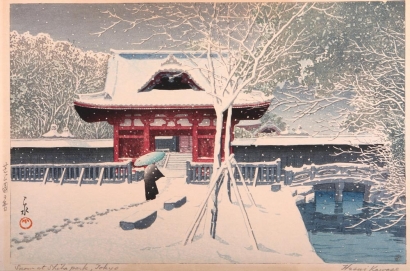
Evening Snow at Shiha Park, Tokyo
1932
Woodblock print
Frequently Asked Questions
Village deep in snow was created by Sano Seiji (佐野精二).
Village deep in snow depicts snow scenes and village scenes.