
Eight Indoor Scenes (Zashiki Hakkei):The Bridges of a Zithern-Geese Alighting (Kotoji no rakugan)
- Source:
- ukiyo-e.org
Description
The Bridges of a Zithern-Geese Alighting (Kotoji no rakugan), from Suzuki Harunobu's Eight Indoor Scenes (Zashiki Hakkei), is one of the most celebrated examples of his mature nishiki-e practice. The print is documented through ukiyo-e.org (image https://ukiyo-e.org/image/aic/110609_596303) from the Art Institute of Chicago. The Eight Indoor Scenes series is a witty mitate, or parody, of the classic Chinese 'Eight Views of Xiao and Xiang,' a venerable subject in East Asian landscape painting that included motifs such as 'Wild Geese Descending on a Sandbank.' Harunobu transposes the descending geese onto the kotoji, the small movable bridges along the koto's body, whose shapes echo a row of birds in flight. The scene unfolds in a domestic interior in which young women, drawn with Harunobu's signature slender bodies and small features, pause around the instrument; the koto's bridges thus stand in for the geese of the classical model. The print epitomizes the intellectual play that Harunobu brought to Edo bijin-ga: elite literary references are reframed in a domestic, often feminine setting, with the new full-color technology of nishiki-e providing rich textile patterns and gentle background gradations. As an early masterpiece of the polychrome print, the work shows why Harunobu is credited with transforming ukiyo-e from a chiefly two- or three-color medium into a fully chromatic art capable of poetic complexity.
More Prints by Suzuki Harunobu

Two Women Washing Their Hair
c. 1767/68
Color woodblock print; chuban

Parody of Kawachi-goe from "Tales of Ise"
1765
Color woodblock print; right sheet of chuban diptych (left sheet: 1925.2025)

Young Man Holding Umbrella Beside a Fence
c. 1767/68
Color woodblock print; chuban

Going to the Theater
c. 1770/71
Color woodblock print; chuban
More Bridges Prints
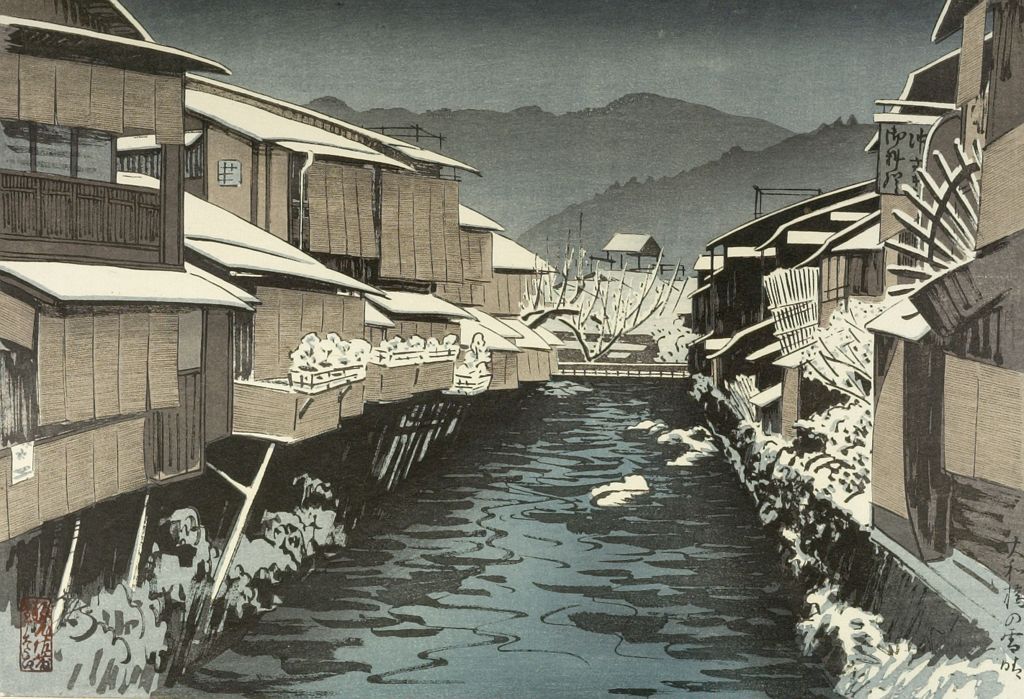
Fair Weather After Snow at Yamato Bridge, Kyoto (Yamato bashi no yukibare), Taishô period, dated 1924
Woodblock print
![Mount Fuji on a Moonlit Night, Kawai Bridge (Tsukiyo no Fuji [Kawaibashi]), from the series "Selection of Views of the Tokaido (Tokaido fukei senshu)" by Kawase Hasui](https://www.artic.edu/iiif/2/d0960668-1e73-339a-b182-fb995a54bff0/full/843,/0/default.jpg)
Mount Fuji on a Moonlit Night, Kawai Bridge (Tsukiyo no Fuji [Kawaibashi]), from the series "Selection of Views of the Tokaido (Tokaido fukei senshu)"
1947
Color woodblock print; oban

Shin Ohashi Bridge (Shin Ohashi), from the series "Twenty View of Tokyo (Tokyu nijukkei)"
1926
Color woodblock print; oban

Sacred Bridge in Nikko (Nikko Shinkyo)
1930
Color woodblock print; oban
Frequently Asked Questions
Eight Indoor Scenes (Zashiki Hakkei):The Bridges of a Zithern-Geese Alighting (Kotoji no rakugan) was created by Suzuki Harunobu (鈴木春信).
Eight Indoor Scenes (Zashiki Hakkei):The Bridges of a Zithern-Geese Alighting (Kotoji no rakugan) depicts bridges.