
Yatsuhashi, Eight-Platform Bridge
- Source:
- ukiyo-e.org
Description
Yatsuhashi, Eight-Platform Bridge by Suzuki Harunobu draws on one of classical Japanese literature's most beloved scenes, the moment in the Tale of Ise when the courtier-poet Ariwara no Narihira pauses at a Mikawa marsh whose eight zigzagging plank bridges crisscross a field of irises. Harunobu transforms the canonical episode into a piece of Edo bijin-ga, replacing the exiled poet with stylish contemporary figures whose modern dress signals the practice of mitate, in which present-day fashion is layered over a classical reference. The bridge planks angle across the sheet in long diagonals, leading the eye through clusters of irises whose blues and purples were finely graded by the nishiki-e team of designer, block carver, and printer. Such layered color became possible only after the technical breakthroughs Suzuki Harunobu helped to establish around 1765, when fully registered polychrome prints replaced the two- and three-block color schemes that had dominated earlier ukiyo-e. The print works simultaneously as a literary allusion and a fashion plate: educated viewers recognized the Yatsuhashi setting and the irises that prompted Narihira's acrostic poem on longing, while less learned customers could simply admire the geometry of the bridge and the cool seasonal mood. By inserting young women into a scene traditionally occupied by a male poet, Harunobu typifies the way Edo bijin-ga repurposed the canon for an urban, commercial audience. The impression is in the Art Institute of Chicago and reproduced via ukiyo-e.org.
More Prints by Suzuki Harunobu

Two Women Washing Their Hair
c. 1767/68
Color woodblock print; chuban

Parody of Kawachi-goe from "Tales of Ise"
1765
Color woodblock print; right sheet of chuban diptych (left sheet: 1925.2025)

Young Man Holding Umbrella Beside a Fence
c. 1767/68
Color woodblock print; chuban

Going to the Theater
c. 1770/71
Color woodblock print; chuban
More Bridges Prints
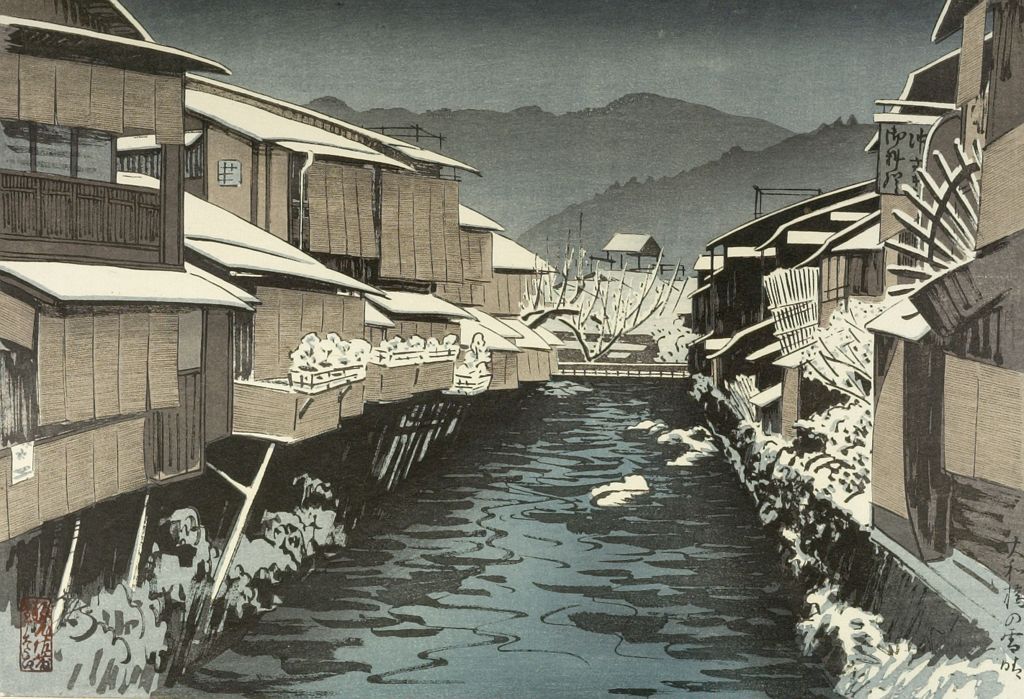
Fair Weather After Snow at Yamato Bridge, Kyoto (Yamato bashi no yukibare), Taishô period, dated 1924
Woodblock print
![Mount Fuji on a Moonlit Night, Kawai Bridge (Tsukiyo no Fuji [Kawaibashi]), from the series "Selection of Views of the Tokaido (Tokaido fukei senshu)" by Kawase Hasui](https://www.artic.edu/iiif/2/d0960668-1e73-339a-b182-fb995a54bff0/full/843,/0/default.jpg)
Mount Fuji on a Moonlit Night, Kawai Bridge (Tsukiyo no Fuji [Kawaibashi]), from the series "Selection of Views of the Tokaido (Tokaido fukei senshu)"
1947
Color woodblock print; oban

Shin Ohashi Bridge (Shin Ohashi), from the series "Twenty View of Tokyo (Tokyu nijukkei)"
1926
Color woodblock print; oban

Sacred Bridge in Nikko (Nikko Shinkyo)
1930
Color woodblock print; oban
Frequently Asked Questions
Yatsuhashi, Eight-Platform Bridge was created by Suzuki Harunobu (鈴木春信).
Yatsuhashi, Eight-Platform Bridge depicts bridges.