
Mt Fuji and two galloping horses
- Medium:
- Mokuhanga (Japanese woodblock)
- Image courtesy of
- Saru Gallery
Description
Nakayama's signature horses appear here against the silhouette of Mt Fuji, combining the meisho-e tradition of the celebrated mountain with the artist's own established equine subject. Where Hokusai and Hiroshige used Fuji as a stable compositional anchor for human activity in the foreground, Nakayama places galloping horses against it — animals in motion played against the mountain's permanence. The two-horse composition lets him exploit the rhythmic possibilities of paired forms: legs and necks set against each other to suggest forward momentum without literal sequencing. His carving for horses was characteristically muscular, with broad gouge strokes defining flanks, manes, and the surge of the hindquarters in a manner closer to expressive woodcut than to the fine line work of older ukiyo-e printers. Fuji's profile would typically be rendered as a flat silhouette, registered as a single color block, in keeping with sosaku-hanga's preference for graphic flatness over atmospheric perspective. The print bridges his horse oeuvre with the wider Japanese landscape vocabulary.
More Prints by Tadashi Nakayama
More Mount Fuji Prints
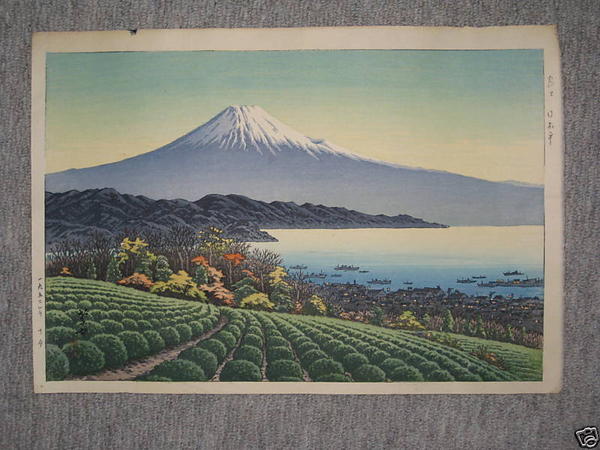
Fuji from tea farm
Woodblock print

Akasaka, Fujikawa, Okazaki, Chiryu, and Narumi, from the series "Famous Places on the Fifty-three Stations of the Tokaido, Five Stations (Tokaido gojusan eki goshuku meisho)"
c. 1830/35
Color woodblock print; oban
![Mount Fuji on a Moonlit Night, Kawai Bridge (Tsukiyo no Fuji [Kawaibashi]), from the series "Selection of Views of the Tokaido (Tokaido fukei senshu)" by Kawase Hasui](https://www.artic.edu/iiif/2/d0960668-1e73-339a-b182-fb995a54bff0/full/843,/0/default.jpg)
Mount Fuji on a Moonlit Night, Kawai Bridge (Tsukiyo no Fuji [Kawaibashi]), from the series "Selection of Views of the Tokaido (Tokaido fukei senshu)"
1947
Color woodblock print; oban

Mt. Fuji in Rain (Ame no Fuji)
n.d.
Color woodblock print
Featured in Collections
Curated cross-cuts that include this print.
Frequently Asked Questions
Mt Fuji and two galloping horses was created by Tadashi Nakayama (中山正).
Mt Fuji and two galloping horses depicts mount fuji.