
Sawatari In Joshu district
- Medium:
- Mokuhanga (Japanese woodblock)
- Image courtesy of
- Saru Gallery
Description
Sawatari is a small hot-spring village in the mountainous Joshu region, the old province corresponding to modern Gunma prefecture, set in a narrow valley along the Agatsuma River. Shotei's print presumably shows the cluster of inn buildings and tiled roofs threaded along the gorge, with steep wooded slopes rising on either side. Compositionally such scenes lean on the contrast between the geometry of village architecture and the irregular silhouettes of mountain ridges, often resolved through baren-pulled flat color blocks for the buildings and more textured, gradated impressions for the surrounding terrain. Steam rising from bathhouse roofs, lanterns, or a few small figures on the road typically animate the foreground. Sawatari belongs to Shotei's wider catalogue of onsen and mountain-village subjects, a distinctly modern travel iconography that emerged with the expansion of rail tourism in the late Meiji and Taisho periods. The print's placement within the urban-scenes grouping reflects its focus on the built fabric of the village rather than open landscape.
More Prints by Takahashi Shotei


More Urban Scenes Prints
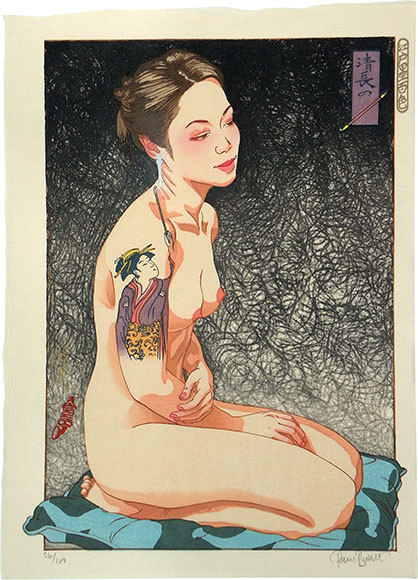
A Hundred Shades of Ink of Edo: Kiyonaga's Pipe (Edo zumi hyaku shoku: Kiyonaga no kiseru)
Woodblock print

View of Kabuki Theater from Matsuya (Ginza Matsuya yori Kabukiza), no. 3 from the series "Pictures of Ginza, First Series (Gashu Ginza dai isshu)"
1928
Color lithograph

Distant View of Mitsukoshi Movie Theater in Shinjuku from the Sixth Floor of Hoteiya (Hoteiya rokkai kara Shinjuku Mitsukoshi Musashi no kan enbo zu), no. 1 from the series "Scenery of Shinjuku (Gashu Shinjuku fukei)"
1930
Color lithograph
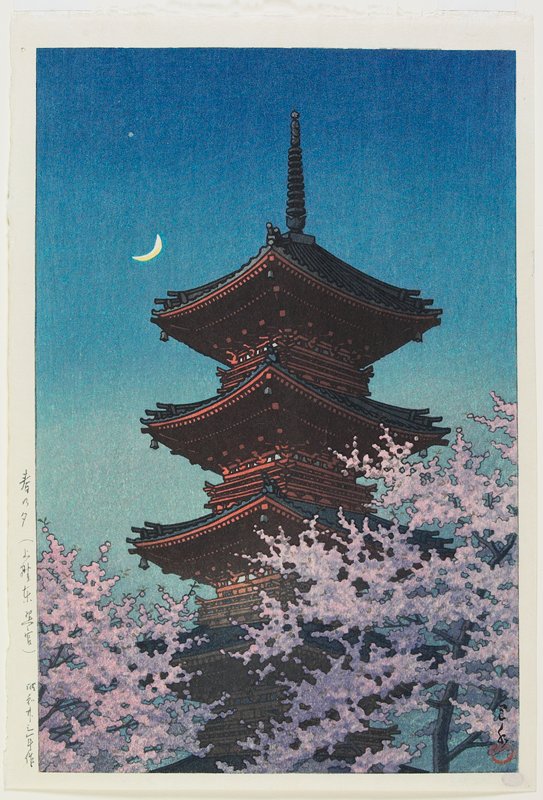
Spring Dusk at the Tōshō Shrine in Ueno
1948
Woodblock print, ink and color on paper
Featured in Collections
Curated cross-cuts that include this print.
Frequently Asked Questions
Sawatari In Joshu district was created by Takahashi Shotei (高橋松亭).
Sawatari In Joshu district depicts urban scenes.