
Susaki
- Source:
- ukiyo-e.org
Description
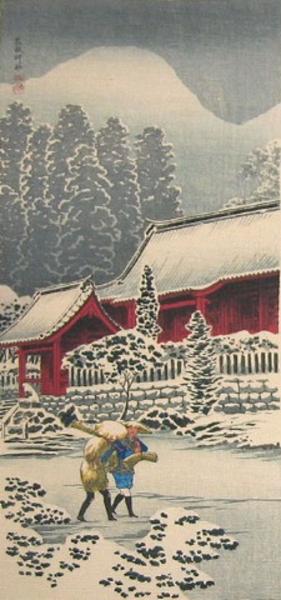
Susaki, held in the Honolulu Museum of Art, is one of the most direct entries in Takahashi Shotei's long-running series of Susaki promontory designs. Susaki at Fukagawa was a long sandy spit on the east side of the Sumida River where a Benten shrine offered an unimpeded view across Edo Bay, and the place had been a staple of late ukiyo-e landscape before Shotei revisited it for the publisher Watanabe Shozaburo in the early twentieth century. Signing as Hiroaki, Shotei treats the spit with the calm, atmospheric handling characteristic of the shin-hanga revival, replacing the bustle of earlier Edo-period meisho compositions with a measured arrangement of foreground reeds or torii, mid-distance water and a high horizon. The chuban landscape format gives the design an intimate scale well suited to the publisher's overseas market, and the carefully graded bokashi skies show the printer's skill in conveying a humid coastal light. Susaki appears repeatedly in Shotei's catalogue because Watanabe Shozaburo found it a reliably popular subject; the Honolulu Museum's impression is therefore best read in dialogue with the many other titled variants (Susaki Benten Shrine, Sea View from Susaki and so on) that the artist produced. Because much of his pre-1923 output disappeared in the Great Kanto earthquake along with Watanabe's stock and blocks, the Honolulu collection has been important for documenting designs like Susaki that otherwise survive only sporadically. The print also stands as a quiet, almost emblematic example of how shin-hanga remade the Edo meisho into a modern collector's object.
More Prints by Takahashi Shotei



Featured in Collections
Curated cross-cuts that include this print.
Frequently Asked Questions
Susaki was created by Takahashi Shotei (高橋松亭).