
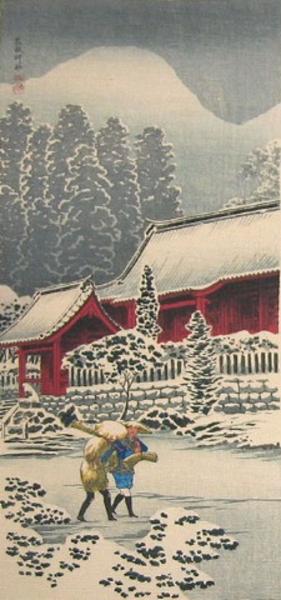
View of Ushijima and the Asakusagawa at Sanyabori
- Source:
- ukiyo-e.org
Description
View of Ushijima and the Asakusagawa at Sanyabori, in the Honolulu Museum of Art, takes a quieter Sumida-side neighborhood as its subject. Sanyabori was a small canal in the Asakusa district that fed into the Sumida River near Ushijima, and from there the Asakusa shoreline opens out into the broader band of riverside life that characterized old Edo. Takahashi Shotei, signing as Hiroaki, captures the corner where the canal meets the river in his characteristic shin-hanga manner: a controlled foreground of boats or timber, a middle band of water, and a softly graded sky above the low rooflines. The artist's collaboration with the publisher Watanabe Shozaburo produced many such Sumida and Asakusa views, all keyed to the chuban landscape format that suited the workshop's export-focused program. The Honolulu Museum's impression rewards close attention to the printer's craft, where bokashi gradients in the sky and water do the heaviest expressive work and the keyblock line is reserved for boats, vegetation and architecture. The shin-hanga revival's love of these unspectacular but place-specific Tokyo scenes is on full view; Sanyabori was never one of the great meisho of Edo, but Shotei's treatment elevates it into a representative slice of the city's water-borne life. Because so many of his pre-1923 blocks were destroyed in the Kanto earthquake, surviving impressions like this one in Honolulu are crucial documents of the publisher's early Tokyo cycle and of Shotei's place within the broader shin-hanga effort to memorialize the old city's quieter corners.
More Prints by Takahashi Shotei



Featured in Collections
Curated cross-cuts that include this print.
Frequently Asked Questions
View of Ushijima and the Asakusagawa at Sanyabori was created by Takahashi Shotei (高橋松亭).