
Rising Moon
- Medium:
- Mokuhanga (Japanese woodblock)
- Image courtesy of
- Saru Gallery
Description
A woman in a dark indigo coat over a grey underlayer stands in half-profile against a solid green ground, a pale hood or wrap framing her face and a red cord or sash knotted at her waist. She holds a woven basket filled with round white forms (eggs or fruit) against her body with both hands, her eyes lowered. Behind her a pale semicircular moon rests low against rolling grey-green hills; vertical columns of Japanese text run along the left and right margins of the print. *Rising Moon*, Takehisa Yumeji, mokuhanga (Japanese woodblock print).
More Prints by Takehisa Yumeji
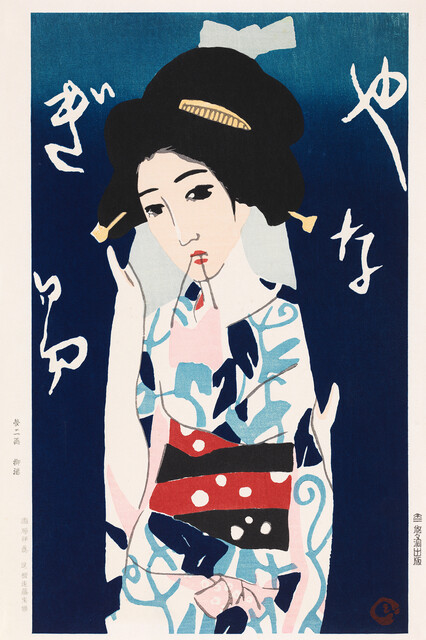
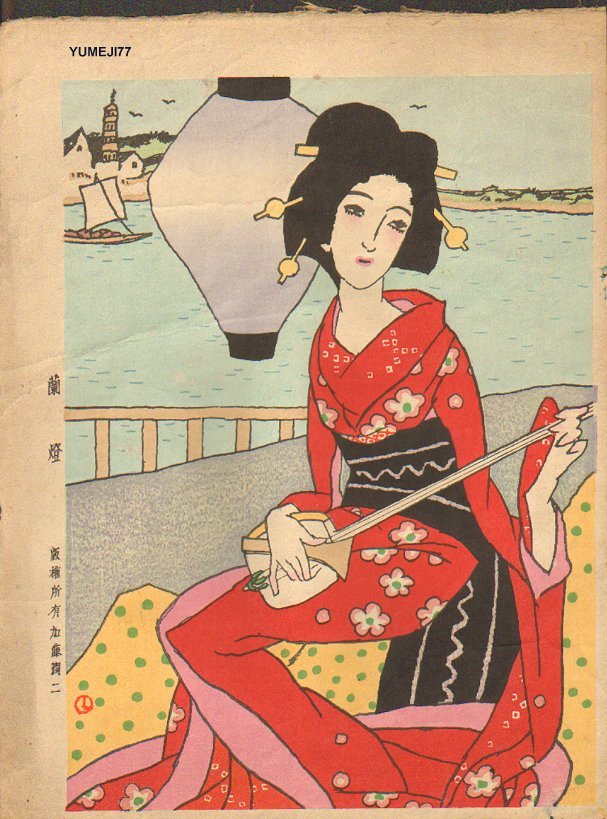

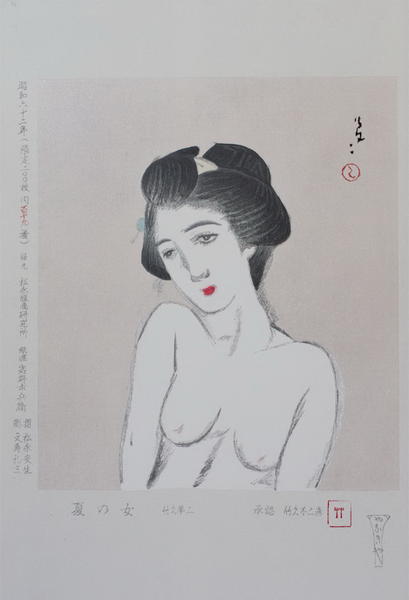
More Moonlight Prints
![Mount Fuji on a Moonlit Night, Kawai Bridge (Tsukiyo no Fuji [Kawaibashi]), from the series "Selection of Views of the Tokaido (Tokaido fukei senshu)" by Kawase Hasui](https://www.artic.edu/iiif/2/d0960668-1e73-339a-b182-fb995a54bff0/full/843,/0/default.jpg)
Mount Fuji on a Moonlit Night, Kawai Bridge (Tsukiyo no Fuji [Kawaibashi]), from the series "Selection of Views of the Tokaido (Tokaido fukei senshu)"
1947
Color woodblock print; oban

Evening Moon at Nakanoshima, Sapporo (Sapporo Nakanoshima no yuzuki), from the series "Collection of Views of Japan, Eastern Japan Edition (Nihon fukei shu higashi Nihon hen)"
March 1933
Color woodblock print; oban

Matsushima in Moonlight (Tsuki no Matsushima)
1919
Color woodblock print

Kiyozumi Garden in Moonlight
January 1938
Woodblock print, ink and color on paper
Frequently Asked Questions
Rising Moon was created by Takehisa Yumeji (竹久夢二).
Rising Moon depicts moonlight.