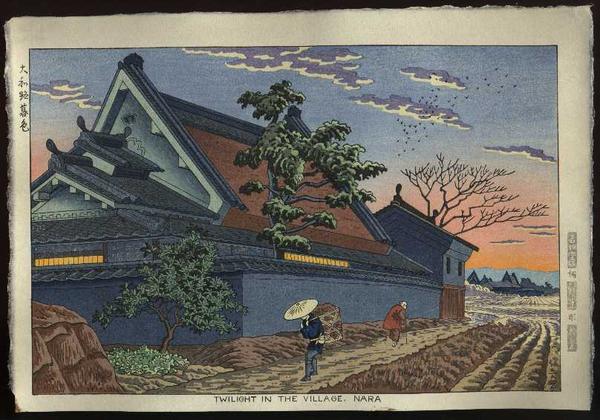
Twilight in the Village, Nara
by Takeji Asano
- Date:
- ca. 1950s
- Medium:
- Woodblock print
- Format:
- Oban
- Publisher:
- Unsodo
- Source:
- Ukiyo-e.org (via Artelino)
Description
Twilight in the Village, Nara, dated to the early 1950s, presents a rural or semi-rural scene in the old capital's environs in the particular atmospheric conditions of fading daylight. The Nara countryside — rice fields, traditional farmhouses, the presence of deer who roamed freely through the ancient city — offered Asano a pastoral subject distinct from the temple and shrine architecture for which his Nara compositions were best known. At twilight, the familiar landscape took on a dreamlike quality, the soft light dissolving precise forms into something more atmospheric and evocative.
More Prints by Takeji Asano


More Night Scenes Prints
Evening in East Africa
Woodblock print

Evening Shower at Teradomari (Teradomari no yau), from the series "Souvenirs of Travel, Second Series (Tabi miyage dai nishu)"
Teradomari no yau
1921
Color woodblock print; oban
![Mount Fuji on a Moonlit Night, Kawai Bridge (Tsukiyo no Fuji [Kawaibashi]), from the series "Selection of Views of the Tokaido (Tokaido fukei senshu)" by Kawase Hasui](https://www.artic.edu/iiif/2/d0960668-1e73-339a-b182-fb995a54bff0/full/843,/0/default.jpg)
Mount Fuji on a Moonlit Night, Kawai Bridge (Tsukiyo no Fuji [Kawaibashi]), from the series "Selection of Views of the Tokaido (Tokaido fukei senshu)"
1947
Color woodblock print; oban

Evening Moon at Nakanoshima, Sapporo (Sapporo Nakanoshima no yuzuki), from the series "Collection of Views of Japan, Eastern Japan Edition (Nihon fukei shu higashi Nihon hen)"
March 1933
Color woodblock print; oban
Featured in Collections
Curated cross-cuts that include this print.
Frequently Asked Questions
Twilight in the Village, Nara was created by Takeji Asano (浅野竹二) in ca. 1950s.
Twilight in the Village, Nara uses Bokashi, Nishiki-e, and Moku-hanga, on woodblock print.
Twilight in the Village, Nara was published by Unsodo (ca. 1950s).
Twilight in the Village, Nara depicts night scenes and village scenes, set at Nara.