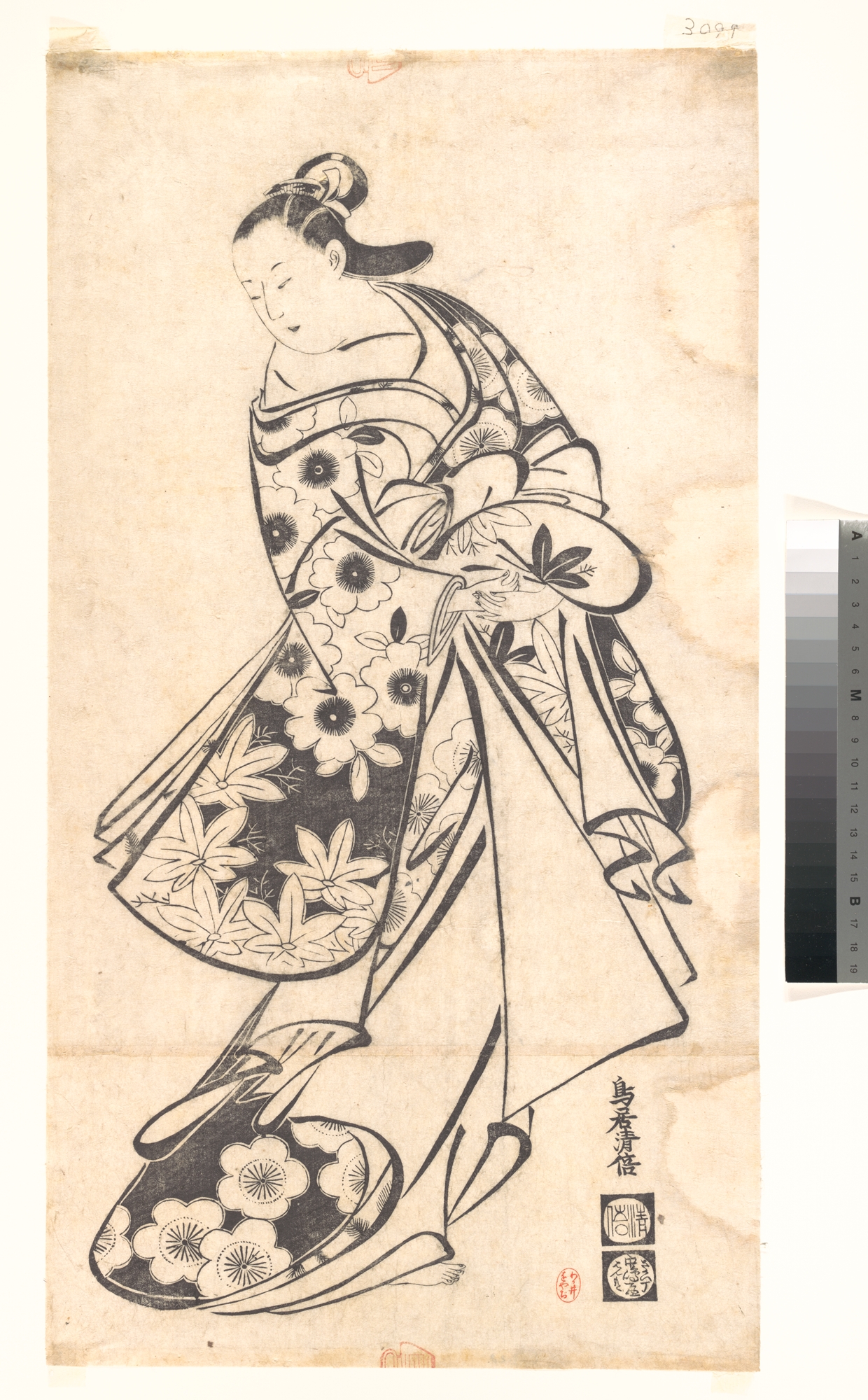
Courtesan
- Date:
- ca. 1712
- Medium:
- Monochrome woodblock (tan-e) print; ink on paper
- Source:
- Metropolitan Museum of Art
Description
A standing courtesan is shown in profile facing left, her head bowed and eyes downcast, with an elaborate coiffure gathered high and pinned with an ornamental comb. She wears a heavy outer robe patterned in bold black-and-white florals — chrysanthemums and maple-like leaves on the upper body and sleeves, plum blossoms on the trailing lower hem — its sash-like folds and long overhanging sleeves rendered in thick black outline against the plain paper ground; her bare feet peek out beneath the swept train. The print is entirely monochrome (black ink on aged, toned paper), with the artist's signature and two seals in the lower right corner.
More Prints by Torii Kiyomasu I

The Actors Arashi Koroku I as Makomo no Mae and Ichikawa Uzaemon VIII as Taira no Koremochi in the play "Shusse Momijigari," performed at the Ichimura Theater in the eleventh month, 1747
1747
Color woodblock print; hosoban, benizuri-e

The Actors Sanogawa Ichimatsu I as Soga no Goro and Ikushima Daikichi II as Kewaizaka no Shosho in the play "Monzukushi Nagoya Soga," performed at the Ichimura Theater in the first month, 1748
1748
Color woodblock print; hosoban, benizuri-e
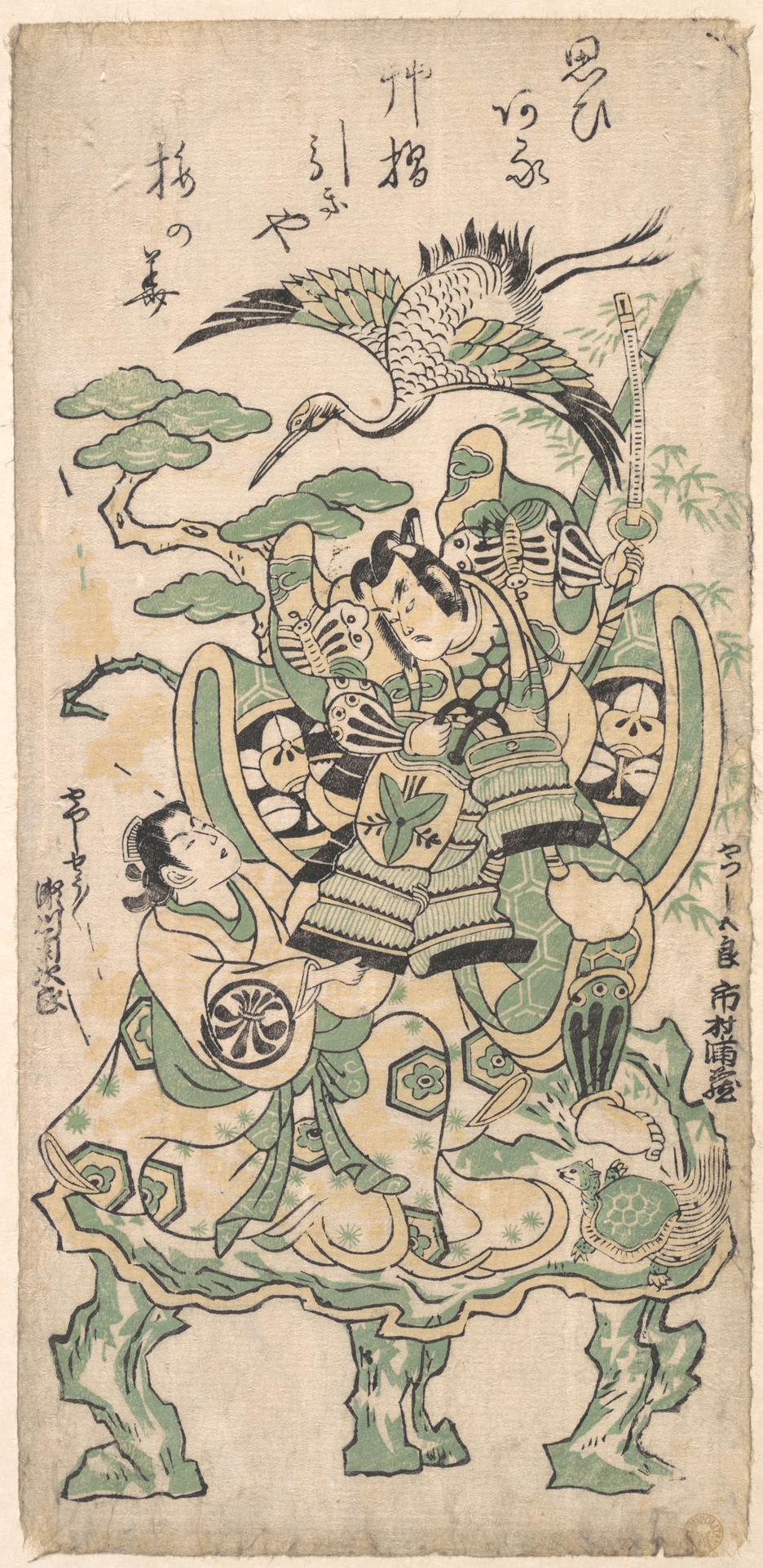
Ichimura Manzo as Yatsushi Goro and Segawa Kikujiro as Yatsushi Shosho
ca. 1745
Woodblock print; ink and color on paper

A Hawk Capturing a Crane in Flight
c. 1715
Hand-colored woodblock print; vertical o-oban, tan-e
Frequently Asked Questions
Courtesan was created by Torii Kiyomasu I (鳥居清倍) in ca. 1712.