
Biography
Torii Kiyomasu I (active c. 1696-1716) stands as one of the foundational figures of the Torii school, an Edo ukiyo-e workshop whose stylistic identity became inseparable from the visual culture of kabuki theater for more than two centuries. Working in the bustling theatrical districts of early eighteenth-century Edo, Kiyomasu I helped codify a robust, muscular style of actor portraiture and theatrical advertising that would define the look of kabuki signage and print collecting for generations. His prints survive today in the world's great collections of Japanese woodblock prints, including the Art Institute of Chicago, the Museum of Fine Arts Boston, and the British Museum, and continue to be studied as touchstones of the early ukiyo-e idiom.
The biographical details of Torii Kiyomasu I remain partially obscured by the limited archival record of late seventeenth-century Edo print workshops. Scholars have long debated his exact relationship to Torii Kiyonobu I (1664-1729), the artist conventionally credited as the founder of the Torii school. Some art historians have proposed that Kiyomasu I was Kiyonobu I's son; others argue he was a younger brother or close collaborator within the Torii family workshop, and a few have even suggested that the two names belonged to a single artist. The two artists' careers overlap so closely in date, signature style, and theatrical clientele that distinguishing their individual hands has been one of the persistent problems in the connoisseurship of early ukiyo-e. Whatever their precise relationship, Kiyomasu I worked within the Torii workshop during the formative years of the school, contributing to a body of work that established the visual conventions of kabuki publicity in the Genroku and Shotoku eras.
The Torii school's principal business was the design of kabuki theater billboards, programs, and illustrated playbills (e-zukushi banzuke and tsuji banzuke) for the major Edo theaters, particularly the Ichimura-za and Nakamura-za. Kiyomasu I and his contemporaries developed a bold, exaggerated graphic vocabulary that could be read at distance from the street: heavy outlines, swelling contours, and the iconic 'gourd-shaped legs' (hyotan-ashi) and 'earthworm lines' (mimizu-gaki) that became the signature of Torii actor prints. These conventions translated the dynamic poses and ostentatious costumes of the kabuki stage into a print idiom that emphasized theatrical power over anatomical accuracy. Kiyomasu I's o-oban-format tan-e and sumizuri-e prints exemplify this approach, presenting actors in full-length poses with broad, decorative drapery and emphatic facial expressions calibrated to the requirements of stage presence.
Kiyomasu I worked across the principal printing technologies of his era. His earliest documented works are sumizuri-e (black-ink woodblock prints) executed in the years bracketing 1700, often as illustrations for theater programs or as standalone single-sheet prints. As tan-e coloring (hand-application of orange-red tan pigment, sometimes with yellow and green) gained popularity in the first decades of the eighteenth century, Kiyomasu I produced many of the genre's most celebrated examples, including large-format actor prints and theatrical scenes hand-colored after printing. Later in his career, he and his successors adopted urushi-e (lacquer prints), in which black ink was thickened with animal glue and dusted with brass filings to produce a glossy, jewel-like surface; works traditionally attributed to Kiyomasu I in the late 1710s and 1720s show this technique applied to hosoban-format actor portraits.
The subject matter of Kiyomasu I's prints reflects the dual interests of the Torii workshop: actor portraiture and the broader visual culture of theatrical Edo. He depicted leading kabuki performers of the early eighteenth century, including Ichikawa Danjuro I and II, Nakamura Takesaburo, Sanjo Kantaro II, and Otani Hiroji, often in specific roles drawn from contemporary productions such as the perennially popular Soga brothers revenge plays. His designs frequently identify the play, theater, and performance month, making them valuable documentary records of Edo kabuki history. Beyond actor prints, Kiyomasu I also produced standalone images of bijin (beautiful women), historical and legendary subjects such as Sakata Kintoki wrestling a tengu, and a notable body of prints of fierce birds of prey — hawks and sparrowhawks rendered with the same bold linear vocabulary he applied to his theatrical work.
Kiyomasu I's role within the Torii lineage is structural as well as artistic. The Torii school operated as a hereditary workshop, with the headship and the right to design official kabuki signage passing through a succession of artists who took the Torii name. Kiyomasu I was a member of this founding generation, working alongside Kiyonobu I to establish the visual brand that subsequent Torii heads, including Kiyonobu II, Kiyomasu II, and Kiyomitsu, would carry forward through the eighteenth century. The conventions Kiyomasu I helped codify, particularly the muscular drawing style and the formats used for actor portraits, became enduring features of Edo period theatrical printmaking, influencing artists well beyond the Torii workshop itself.
The attribution and dating of works signed Kiyomasu present ongoing challenges for scholars. Many prints traditionally given to Kiyomasu I bear dates of publication or theatrical performance that extend into the 1720s, well after his presumed active period. This has led some specialists to posit a second-generation Kiyomasu (Torii Kiyomasu II) who continued working under the same artistic name in the manner of his predecessor. The Art Institute of Chicago and other major museums catalogue many such prints under Kiyomasu I, reflecting traditional attributions while acknowledging the difficulty of distinguishing the work of successive Torii artists who shared techniques, signatures, and workshop conventions. This ambiguity is itself characteristic of the Torii school's collaborative production model.
Torii Kiyomasu I's importance to the history of ukiyo-e is twofold. As an artist, he produced some of the most visually compelling examples of early Edo period printmaking, prints whose graphic boldness and theatrical authority still command attention three centuries later. As a founding member of the Torii school, he helped establish a workshop tradition that became one of the longest-running and most influential institutions in Japanese print culture, providing visual continuity to kabuki theater across more than two hundred years. Today his prints are sought by museums and private collectors of Japanese woodblock prints as essential documents of the period when ukiyo-e first emerged as a distinct, mature artistic tradition in the entertainment quarters of Edo.
Key Facts
- Nationality
- 🇯🇵Japan
- Movement
- Ukiyo-e
- Subjects
- Birds & FlowersMount Fuji
- Works Indexed
- 22
Frequently Asked Questions
Torii Kiyomasu I (active c. 1696-1716) stands as one of the foundational figures of the Torii school, an Edo ukiyo-e workshop whose stylistic identity became inseparable from the visual culture of kabuki theater for more than two centuries. Working in the bustling theatrical districts of early eighteenth-century Edo, Kiyomasu I helped codify a robust, muscular style of actor portraiture and theatrical advertising that would define the look of kabuki signage and print collecting for generations. His prints survive today in the world's great collections of Japanese woodblock prints, including the Art Institute of Chicago, the Museum of Fine Arts Boston, and the British Museum, and continue to be studied as touchstones of the early ukiyo-e idiom.
Torii Kiyomasu I's work was shaped by the Ukiyo-e tradition in Japanese woodblock printmaking. Ukiyo-e: ## What is ukiyo-e? Ukiyo-e ([浮世絵](/glossary/ukiyo-e)) — literally "pictures of the floating world" — is the Edo-period Japanese print and painting tradition that flourished from roughly 1660 to 1868, depicting the pleasures of urban life in Edo (modern Tokyo): courtesans, kabuki actors, sumo wrestlers, famous landscapes, and seasonal beauties.
Torii Kiyomasu I's prints frequently feature birds & flowers, mount fuji.
Original prints by Torii Kiyomasu I can be found in collections including Art Institute of Chicago, Metropolitan Museum of Art.
Woodblock Prints by Torii Kiyomasu I (22)
The love story of O-yuri and Ohara Iori (no title)
1696
Woodblock-printed book, sumizuri-e

The Actor Tsutsui Kichijuro
c. 1704
Hand-colored woodblock print: o-oban, tan-e

The Actor Uemura Kaemon (?)
c. 1706
Hand-colored woodblock print; ōban, tan-e
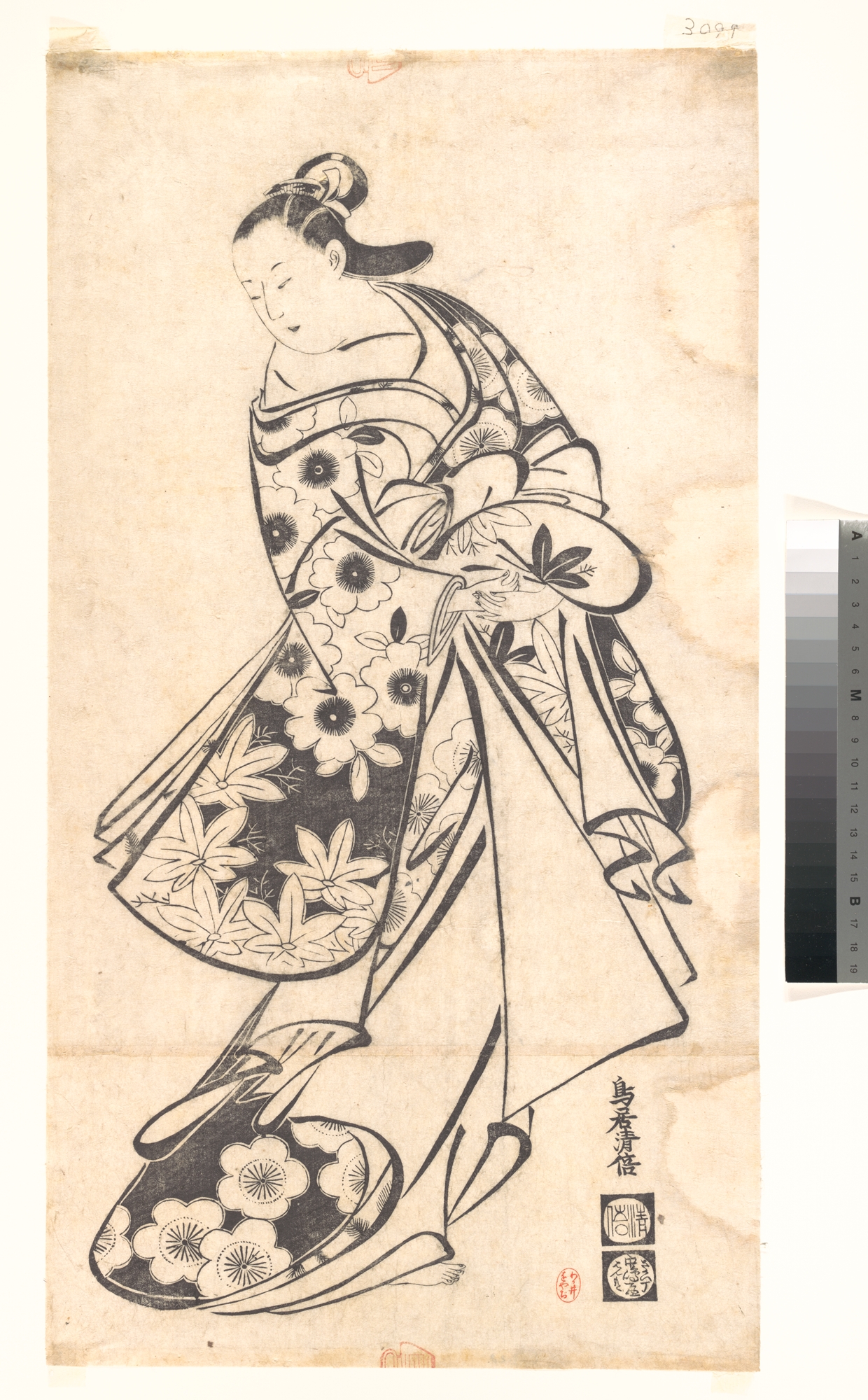
Courtesan
ca. 1712
Monochrome woodblock (tan-e) print; ink on paper

Scene from the Drama "Lyric Dance of Shizuka Gozen (Taihei Shizuka Horaku no mai)"
c. 1711
Hand-colored woodblock print; horizontal o-oban, tan-e

Standing Figure of a Woman
c. 1715
Woodblock print; o-oban, sumizuri-e

A Hawk Capturing a Crane in Flight
c. 1715
Hand-colored woodblock print; vertical o-oban, tan-e

Sakata Kintoki Wrestling with a Tengu
1715-18
Hand-colored woodblock print; o-oban, tan-e

The Actor Fujimura Handayu II as Oiso no Tora
c. 1715
Hand-colored woodblock print; o-oban, tan-e

The Actors Ichikawa Monnosuke I and Tamazawa Rinya
c. 1715
Hand-colored woodblock print; o-oban, tan-e

A Hawk on a Cliff near a Kiri Tree
c. 1716
Hand-colored woodblock print; o-oban, tan-e

Sparrowhawk (Konori taka)
c. 1716
Hand-colored woodblock print; vertical o-oban, tan-e

Sparrowhawk and Macaw (Konori taka, inko)
c. 1718
Hand-colored woodblock print; hosoban, tan-e

The Actors Nakamura Takesaburō as Kewaizaka no Shōshō and IchikawaDanjurō II as Soga Gorō
1715
Woodblock print; ō-ōban yoko-e, sumizuri-e

Two Actors in a Drama
About 1715
Woodblock print; sumizuri-e, ōban

A Playbill for the Ichimura Theater
1715
Hand-colored woodblock print; o-oban, sumizuri-e
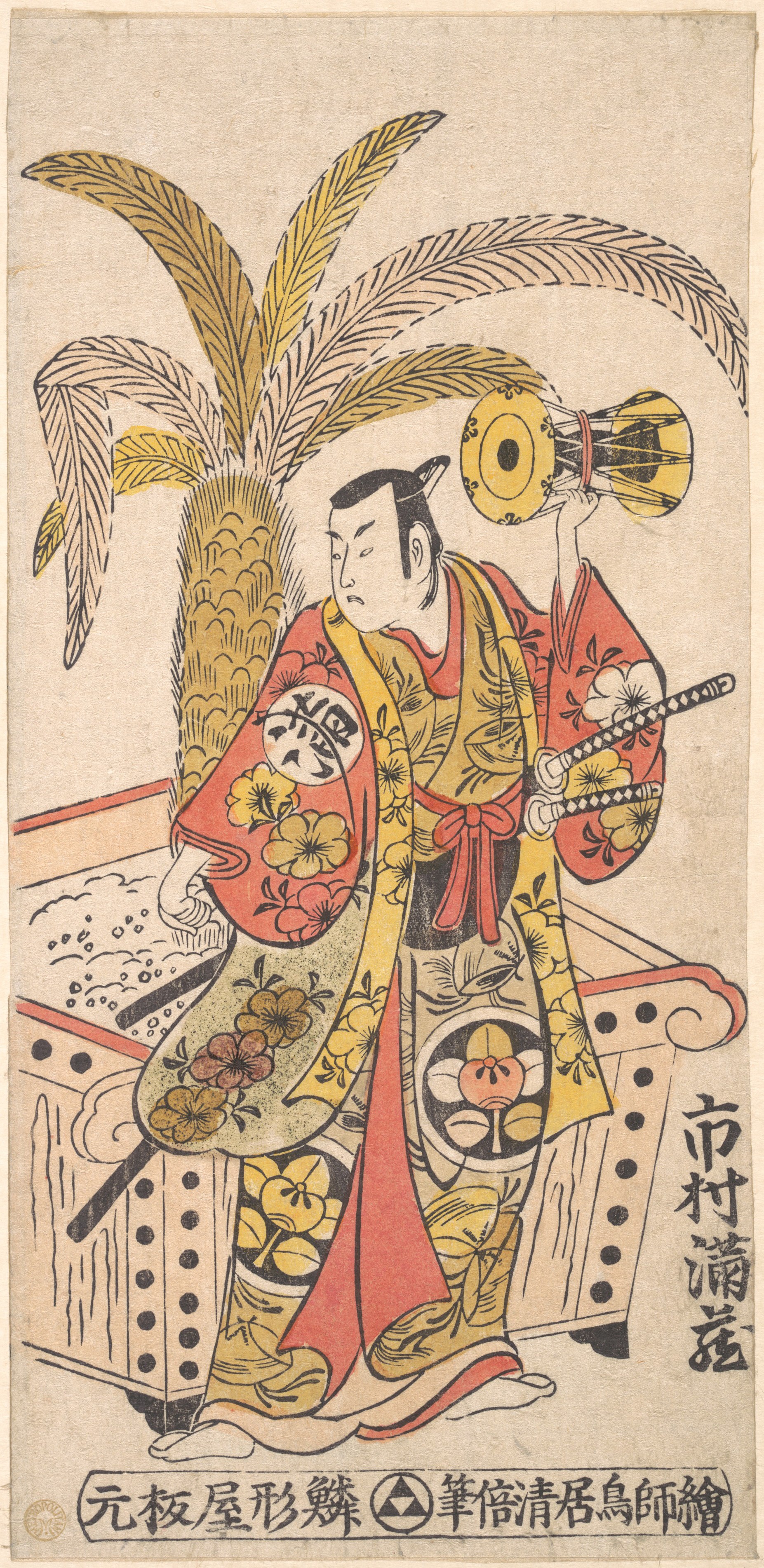
ca. 1730
Woodblock print; ink and color on paper

The Actor Segawa Kikunojo I as Kuzunoha
c. 1737
Hand-colored woodblock print; hosoban, urushi-e
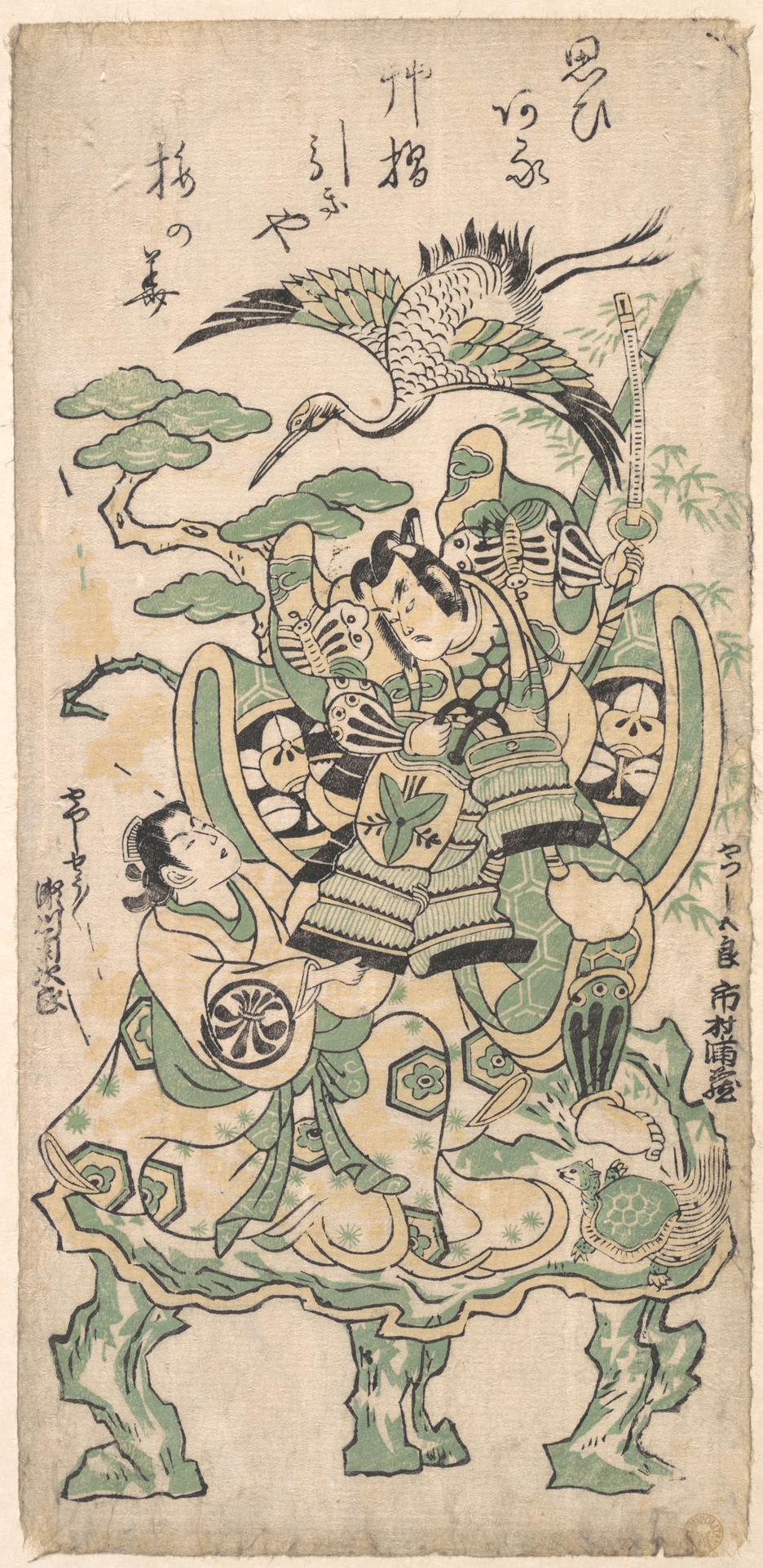
Ichimura Manzo as Yatsushi Goro and Segawa Kikujiro as Yatsushi Shosho
ca. 1745
Woodblock print; ink and color on paper

The Actors Arashi Koroku I as Makomo no Mae and Ichikawa Uzaemon VIII as Taira no Koremochi in the play "Shusse Momijigari," performed at the Ichimura Theater in the eleventh month, 1747
1747
Color woodblock print; hosoban, benizuri-e

The Actors Sanogawa Ichimatsu I as Soga no Goro and Ikushima Daikichi II as Kewaizaka no Shosho in the play "Monzukushi Nagoya Soga," performed at the Ichimura Theater in the first month, 1748
1748
Color woodblock print; hosoban, benizuri-e

The Actors Ichimura Kamezo I as Yosaku and Arashi Tominosuke I as Koman
c. 1754
Color woodblock print; hosoban, benizuri-e