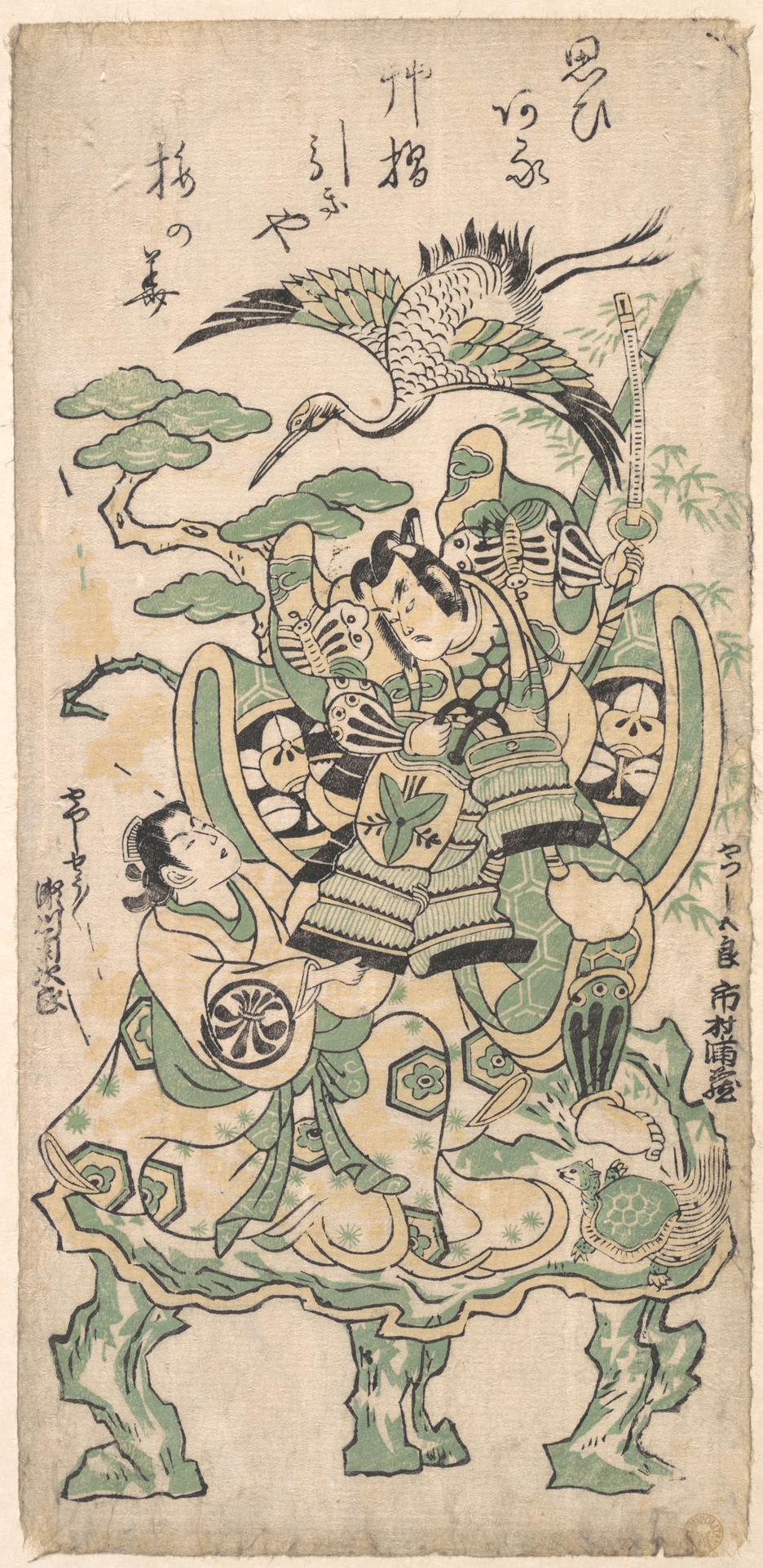
The Actor Ichikawa Danjuro II as Soga no Goro
- Date:
- c. 1725
- Medium:
- Hand-colored woodblock print; hosoban, tan-e
- Source:
- Art Institute of Chicago
Description
The Actor Ichikawa Danjuro II as Soga no Goro, dated 1720, situates Torii Kiyomasu I within the foundational [yakusha-e](/glossary/yakusha-e) tradition that the Torii school built around the Ichikawa Danjuro line of aragoto actors. Soga no Goro Tokimune, the younger of the vendetta brothers whose story underpinned the annual Soga drama cycle in Edo kabuki, was among the signature roles in the Danjuro household repertoire, and prints commemorating the role's performance functioned as both souvenir and advertisement for upcoming runs. Kiyomasu draws the actor in the muscular bold-outlined hyotan-ashi mimizu-gaki manner pioneered by his Torii circle for violent aragoto figures, with thick gourd-shaped legs and writhing earthworm-like contours that translate kabuki bombast into print form. Ichikawa Danjuro II, who had inherited the line from his father in 1704 and developed the Soga roles further during the 1710s and 1720s, here appears as the embodiment of the youthful, righteous warrior whose vendetta gives the cycle its emotional drive. The print belongs to the late phase of Kiyomasu's career, when the early hand-colored tan-e mode of the Torii school was giving way to the larger black-and-white sumizuri-e sheets in which actor portraits could occupy a tall vertical field. Bold black outlines carry nearly the entire expressive weight, with patterned costume motifs and the angular stance of the body providing visual interest against the lightly inked ground. The Art Institute of Chicago preserves this impression (source_url https://www.artic.edu/artworks/19119) as a representative document of how the Torii house image-makers and the Ichikawa actor-house collaborated to define the visual register of Edo aragoto for the next century.