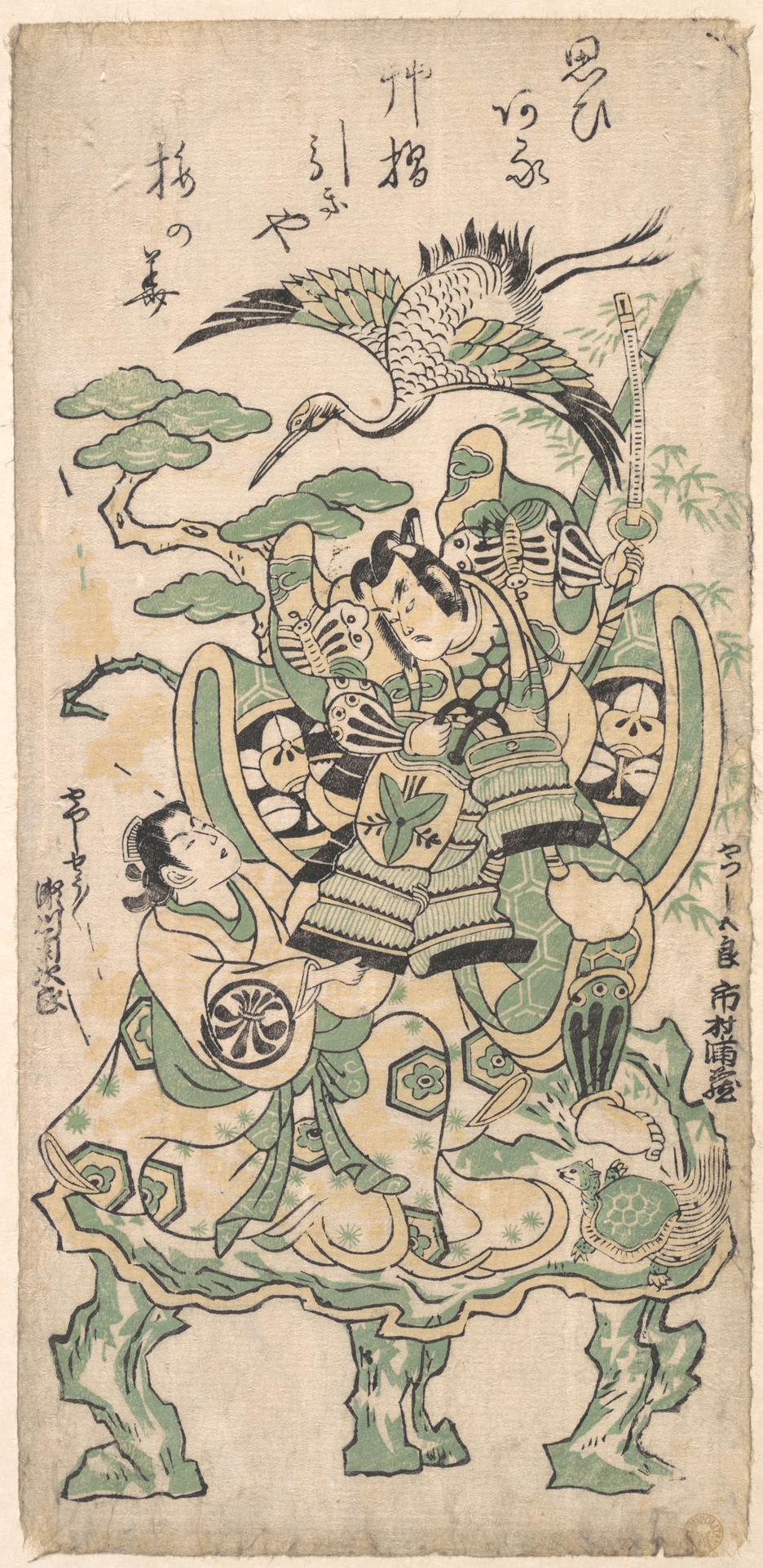
The Actor Sanogawa Mangiku I
- Date:
- c. 1731
- Medium:
- Hand-colored woodblock print; hosoban, urushi-e
- Source:
- Art Institute of Chicago
Description
The Actor Sanogawa Mangiku I, dated to the 1720s, presents one of the female-role specialists who succeeded the first generation of onnagata stars in the Edo kabuki of the Kyoho era. Sanogawa Mangiku I rose to prominence in the years after the deaths of the early eighteenth-century leading onnagata, and his career intersected directly with the late production of Torii Kiyomasu I, whose Torii workshop continued to supply the kabuki houses with single-sheet actor portraits. The print isolates the standing figure in the full-length manner that the Torii school established for sumizuri-e [yakusha-e](/glossary/yakusha-e), the disciplined bold contour describing both costume and posture without elaborate background. The [hosoban](/glossary/hosoban) or wide-bordered tate-e format concentrates the viewer's attention on the long vertical of the figure, with the patterned robe motifs functioning as the principal source of visual interest against the lightly inked ground. The Torii circle's working relationship with the Edo theaters depended on producing such portraits in close consultation with the actor houses, with costume detail and stance fidelity essential for the prints to function as both souvenir and advertisement. By the mid-1720s the Torii school was transitioning fully from the earlier tan-e mode, with its hand-applied orange tan pigment, toward the larger black-and-white sumizuri-e sheets that allowed greater compositional ambition. The Art Institute of Chicago preserves this impression (source_url https://www.artic.edu/artworks/19315) as a representative document of how Kiyomasu I extended the founding Torii yakusha-e tradition into the careers of the second generation of Edo onnagata.