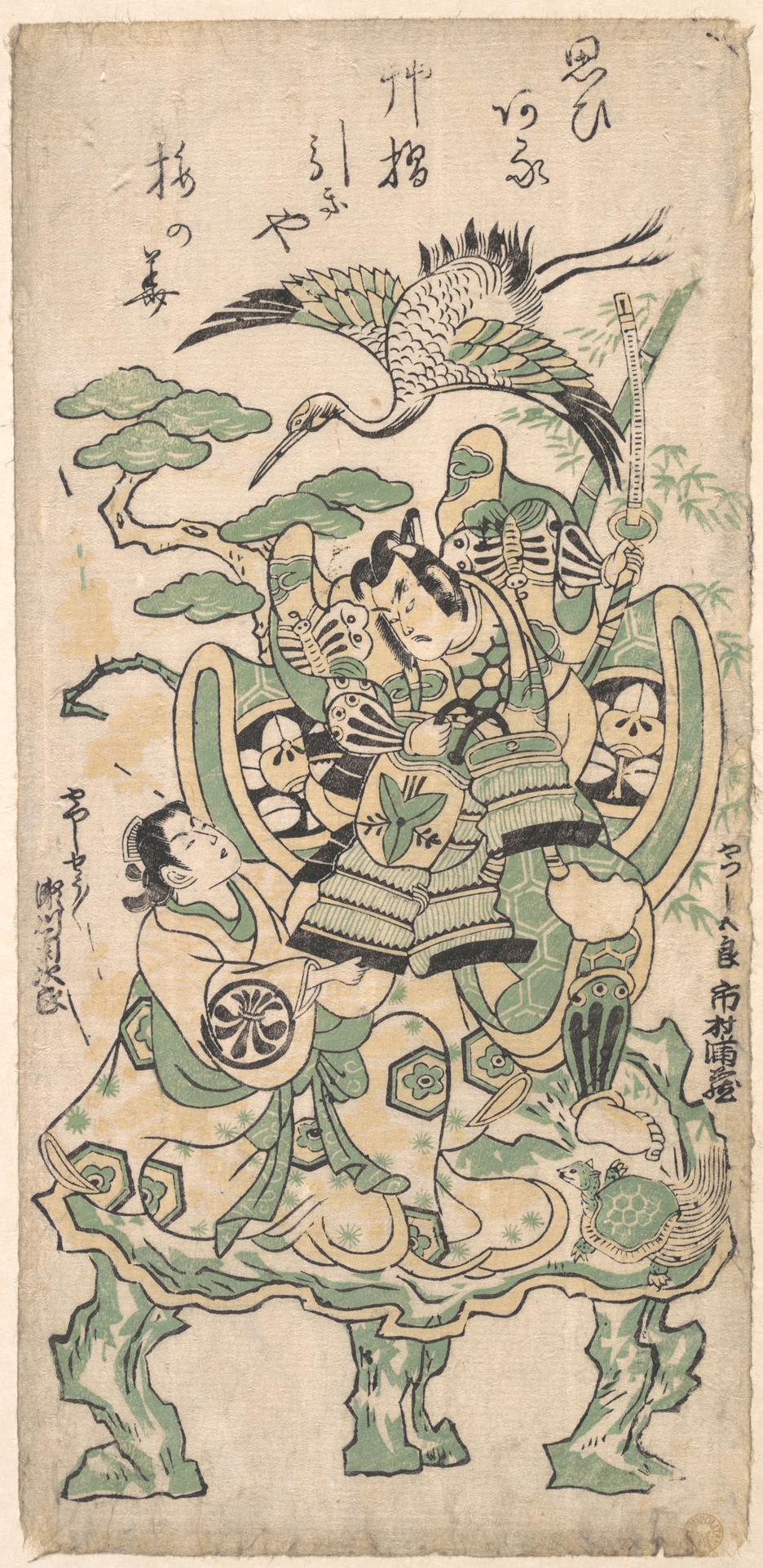
The Actor Yamashita Kinsaku I as a peddler of tooth-blackening dye
- Date:
- c. 1727
- Medium:
- Hand-colored woodblock print; hosoban, urushi-e
- Source:
- Art Institute of Chicago
Description
The Actor Yamashita Kinsaku I as a peddler of tooth-blackening dye, dated 1722, presents one of the earliest stars of the onnagata female-role tradition in a humble disguise that the kabuki repertoire reserved for moments of comic disclosure. Yamashita Kinsaku I, who rose to prominence in Kyoto and Edo in the first decades of the eighteenth century, was among the leading female-role specialists of his generation, and prints of him circulated alongside the Ichikawa aragoto sheets as the Torii school's standard [yakusha-e](/glossary/yakusha-e) output. The role of the kanetsuke uri, the itinerant vendor of o-haguro tooth-blackening dye, allowed an onnagata to enter a play in modest male disguise before revealing the character's true identity, a convention dear to Edo theatergoers. Torii Kiyomasu I, working in the late phase of his career, draws the figure with the disciplined bold contour that the Torii circle had codified for actor portraits, the line less violent than for aragoto roles but still carrying the principal expressive weight against a lightly inked ground. The [hosoban](/glossary/hosoban) or wide-bordered tate-e format, characteristic of the Torii school's monochrome sumizuri-e production of the 1720s, frames the standing figure full-length with peddler's box and implements at hand. As a member of the founding generation of the Torii yakusha-e tradition, Kiyomasu produced such prints in close consultation with the actor houses, ensuring fidelity to costume and stance even when the character was disguised. The Art Institute of Chicago preserves this impression (source_url https://www.artic.edu/artworks/19324) as a record of the female-role peddler subgenre at the moment of its early definition.