
Finely-Dressed Woman Crossing Nihonbashi Bridge
- Date:
- c. 1783
- Medium:
- Color woodblock print; hashira-e
- Source:
- Art Institute of Chicago
Description
Finely-Dressed Woman Crossing Nihonbashi Bridge is a 1778 woodblock print by Torii Kiyonaga, the fourth-generation head of the Torii school and the principal figure of late eighteenth-century Edo bijin-ga. Nihonbashi, the wooden arch at the eastern edge of central Edo, was the symbolic center of the city: it marked the zero point of the great post roads radiating into the provinces and stood as the busiest crossing in the realm. Kiyonaga places a finely dressed young woman on the bridge, isolating her against the suggested arch of the structure and using the architecture less as documentary backdrop than as a setting that confers urban dignity on the figure. The composition emphasizes the elongated proportions that would become the signature of his bijin in the 1780s: long limbs, a tall, slender body, and a small, oval head, the whole framed by the trailing fall of an outer kimono whose patterns Kiyonaga renders with crisp keyblock outlines and a restrained palette of pink, blue, and grey. His Torii school inheritance is visible in the confident, sustained line and in the readiness to allow a single figure to stand for an entire urban scene. The print is preserved at the Art Institute of Chicago, which holds it as part of the museum's broad collection of late-Edo bijin-ga. It demonstrates how Kiyonaga turned the famous places of the city into stages on which contemporary women appeared as the true subject of the print.
More Prints by Torii Kiyonaga

Watching the Water Festival from Azuma Bridge, from the series "Eight Precincts of the Kinryuzan Temple in Asakusa (Asakusa Kinruzan hakkei)"
c. 1782
Color woodblock print; chuban

Courtesans of Yoshiwara and their attendants viewing the peonies on Nakanocho
c. 1787
Color woodblock print; center and right sheets of oban triptych

A visit to a shrine, from the series "Twelve Scenes of Popular Customs (Fuzoku juni tsui)"
c. 1786
Color woodblock print; koban

A Party Viewing the Moon Across the Sumida River
c. 1787
Color woodblock print; oban triptych
More Bridges Prints
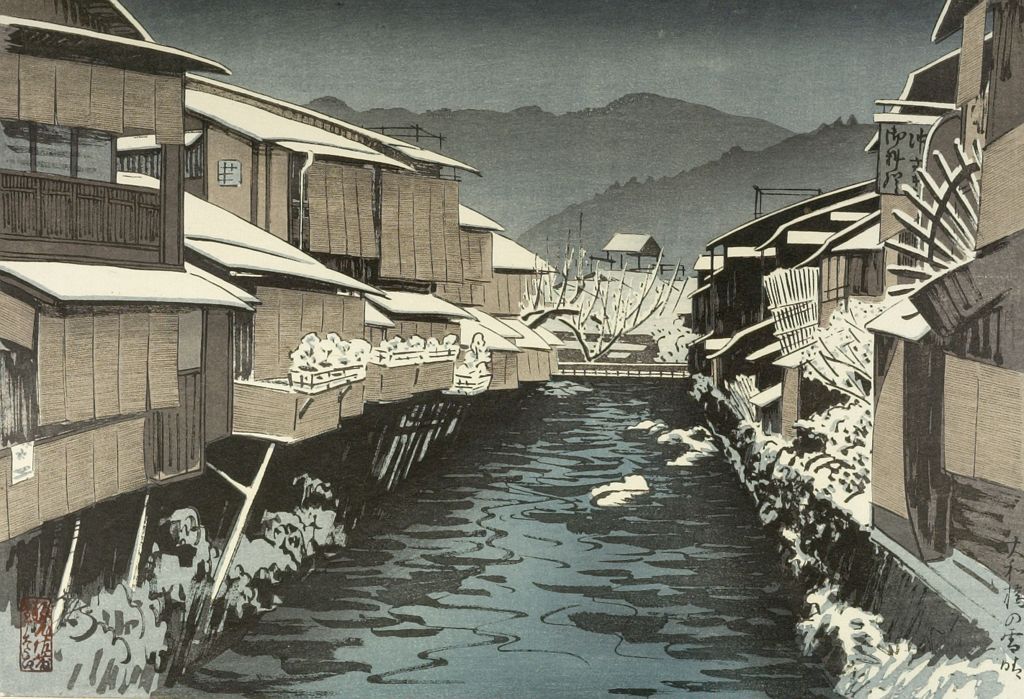
Fair Weather After Snow at Yamato Bridge, Kyoto (Yamato bashi no yukibare), Taishô period, dated 1924
Woodblock print
![Mount Fuji on a Moonlit Night, Kawai Bridge (Tsukiyo no Fuji [Kawaibashi]), from the series "Selection of Views of the Tokaido (Tokaido fukei senshu)" by Kawase Hasui](https://www.artic.edu/iiif/2/d0960668-1e73-339a-b182-fb995a54bff0/full/843,/0/default.jpg)
Mount Fuji on a Moonlit Night, Kawai Bridge (Tsukiyo no Fuji [Kawaibashi]), from the series "Selection of Views of the Tokaido (Tokaido fukei senshu)"
1947
Color woodblock print; oban

Shin Ohashi Bridge (Shin Ohashi), from the series "Twenty View of Tokyo (Tokyu nijukkei)"
1926
Color woodblock print; oban

Sacred Bridge in Nikko (Nikko Shinkyo)
1930
Color woodblock print; oban
Frequently Asked Questions
Finely-Dressed Woman Crossing Nihonbashi Bridge was created by Torii Kiyonaga (鳥居清長) in c. 1783.
Finely-Dressed Woman Crossing Nihonbashi Bridge depicts bridges.