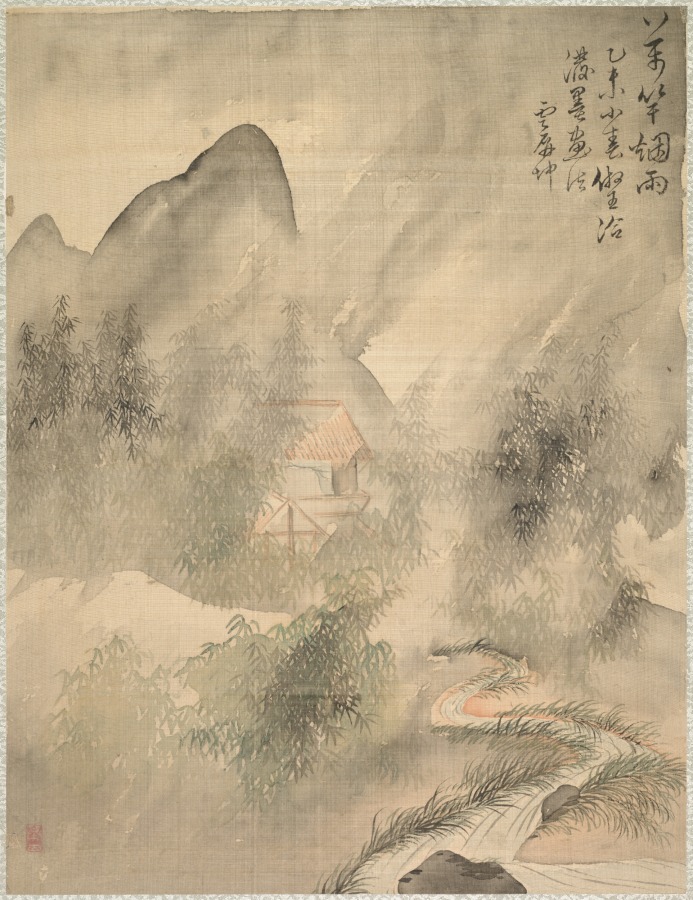
Ten Thousand Bamboos in the Mist and Rain
- Date:
- 1847
- Medium:
- Album leaf; ink and color on silk
- Source:
- Cleveland Museum of Art
Description
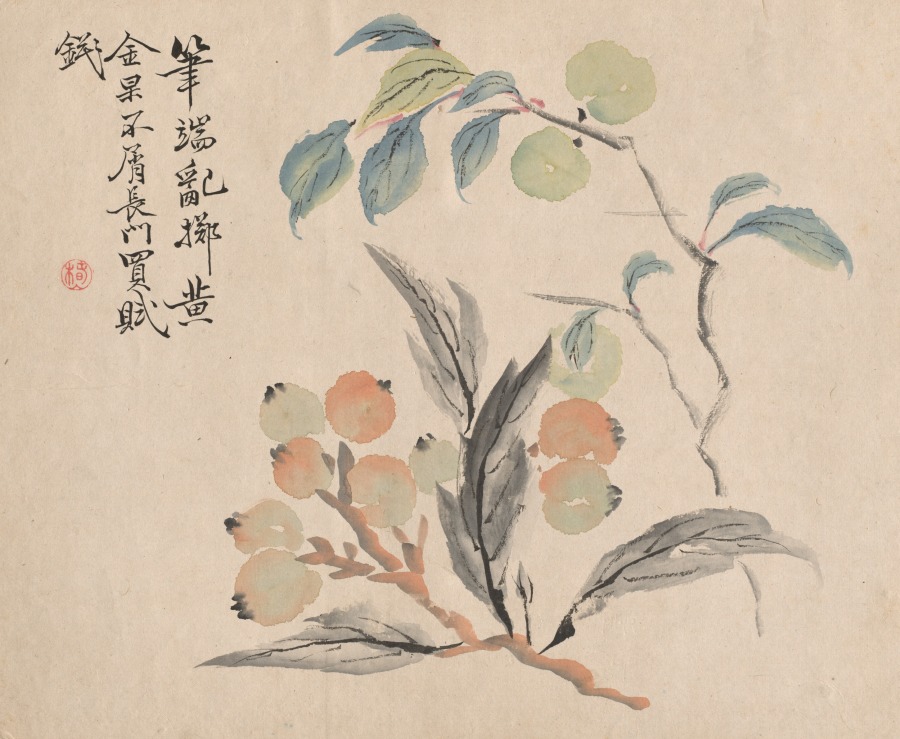
Ten Thousand Bamboos in the Mist and Rain, dated 1847, is an ink-and-color landscape leaf by Tsubaki Chinzan (椿椿山, 1801-1854) in the Cleveland Museum of Art (accession 1985.251.5; https://www.clevelandart.org/art/1985.251.5), part of the related 1847 ensemble (accessions 1985.251.1-10). The title gestures explicitly toward the Chinese literati tradition: bamboo in mist and rain is a canonical subject, painted from the Song period onward by scholar-painters who understood the bamboo grove as a moral and atmospheric figure for the cultivated mind. 'Ten thousand bamboos' — the conventional Chinese phrase wan zhu — signals not literal count but multitude, a screen of stalks dissolving into weather. The motif belongs to a lineage that runs from the Northern Song scholar-painter Wen Tong through the Yuan masters such as Li Kan and Wu Zhen, whose monochrome bamboo had been celebrated as a painted form of calligraphy and as a vehicle of moral expression. By the late Edo period the theme had become a touchstone of nanga literacy, a subject through which a painter could demonstrate his absorption of the entire Chinese scholar-painter inheritance. As Watanabe Kazan's most trusted pupil and a leading figure in the Tani Bunchō circle that defined the late-Edo nanga revival, Chinzan inherited and prized this iconography. A leaf of this kind exhibits the wet-into-wet ink handling and tonal restraint that nanga painters drew from Chinese painting manuals and imported Ming and Qing scrolls: the rain is a wash, the mist a withholding of the brush, the bamboo a series of decisive strokes preserved within the surrounding softness. The 1847 date places the sheet within Chinzan's mature post-Kazan production, and the Cleveland catalogue confirms attribution, date, and grouping.
More Prints by Tsubaki Chinzan
More Rain Prints

Rain Shower at Shо̄no, from the series Fifty-three Stations of the Tо̄kaidо̄ (Tо̄kaidо̄ gojusan tsugi)
1962
Woodblock print, ink and color on paper

Shōno: Driving Rain (Shōno hakuu), from the series Fifty-three Stations of the Tōkaidō (Tōkaidō gojūsan tsugi no uchi), also known as the First Tōkaidō or Great Tōkaidō
c. 1833-36
Woodblock print (nishiki-e); ink and color on paper

Omiya in Rain (Ame no Omiya)
Ame no Omiya
1930
Color woodblock print; oban

Evening Shower at Teradomari (Teradomari no yau), from the series "Souvenirs of Travel, Second Series (Tabi miyage dai nishu)"
Teradomari no yau
1921
Color woodblock print; oban
Frequently Asked Questions
Ten Thousand Bamboos in the Mist and Rain was created by Tsubaki Chinzan (椿椿山) in 1847.
Ten Thousand Bamboos in the Mist and Rain depicts rain.